


Why in the News?
Union Budget 2026–27 proposes a two-track manufacturing strategy i.e. strengthening capabilities in technology-intensive sectors while sustaining scale and employment in labour-intensive industries.
Key Budget announcements
- Strategic and Frontier Manufacturing Initiatives
- Biopharma SHAKTI: ₹10,000 crore to promote biologics and biosimilars.
- India Semiconductor Mission (ISM) 2.0: Focus on fabrication, packaging, and equipment.
- Electronics Components Manufacturing Scheme (ECMS): Outlay increased from ₹22,919 crore to ₹40,000 crore.
- Rare Earth Magnet Initiative: Dedicated rare earth corridors in Odisha, Kerala, Andhra Pradesh and Tamil Nadu to promote local mining, processing and magnet manufacturing.
- Chemical Parks: Three plug-and-play parks to reduce import dependence.
- Construction and Infrastructure Equipment (CIE) Scheme: New scheme to strengthen domestic manufacturing of high-value and technologically-advanced CIE.
- Support for Labour-Intensive and Legacy Industries
- Textiles Sector: Launch of an integrated programme covering fibre self-reliance, modernisation of clusters, Mega Textile Parks developed in challenge mode and the Mahatma Gandhi Gram Swaraj initiative to strengthen khadi and handlooms.
- Sports Goods: A dedicated initiative to enhance manufacturing, innovation and R&D in sports equipment and material sciences.
- Legacy Clusters: A dedicated scheme to revive 200 legacy industrial clusters through technology and infrastructure upgradation.
- Measures for MSME Growth
- Financial Support: Creation of a dedicated ₹10,000 crore SME Growth Fund to support high-potential enterprises, and a ₹2,000 crore top-up for the Self-Reliant India Fund for micro-enterprises.
- Liquidity and Compliance: Mandating the Trade Receivables Discounting System (TReDS) as the settlement platform for all CPSE purchases from MSMEs to ease liquidity stress.
- Tax and Customs Reforms
- Direct Tax Incentives: 5-year exemption for non-residents supplying capital goods.
- Customs Duty Reductions: Exemption from basic customs duty on specified parts used for manufacturing microwave ovens and aircraft components.
- Trade Facilitation: Introduction of a deferred duty payment window for trusted manufacturers and Customs Integrated System (CIS) alongside a single digital window to streamline multi-agency cargo clearances.
Significance of the change in Manufacturing strategy
- Two-Track Manufacturing Strategy: The announcements reflect a dual approach- deepening capabilities in strategic, technology-intensive sectors (like semiconductors and biologics) while simultaneously scaling up employment and export diversification through labour-intensive sectors (like textiles and sports goods).
- Shift to Strategic Indispensability: The budget charts a deliberate path for India to transition from mere "strategic autonomy" to "strategic indispensability," ensuring that India becomes a critical and irreplaceable node in Global Value Chains (GVCs).
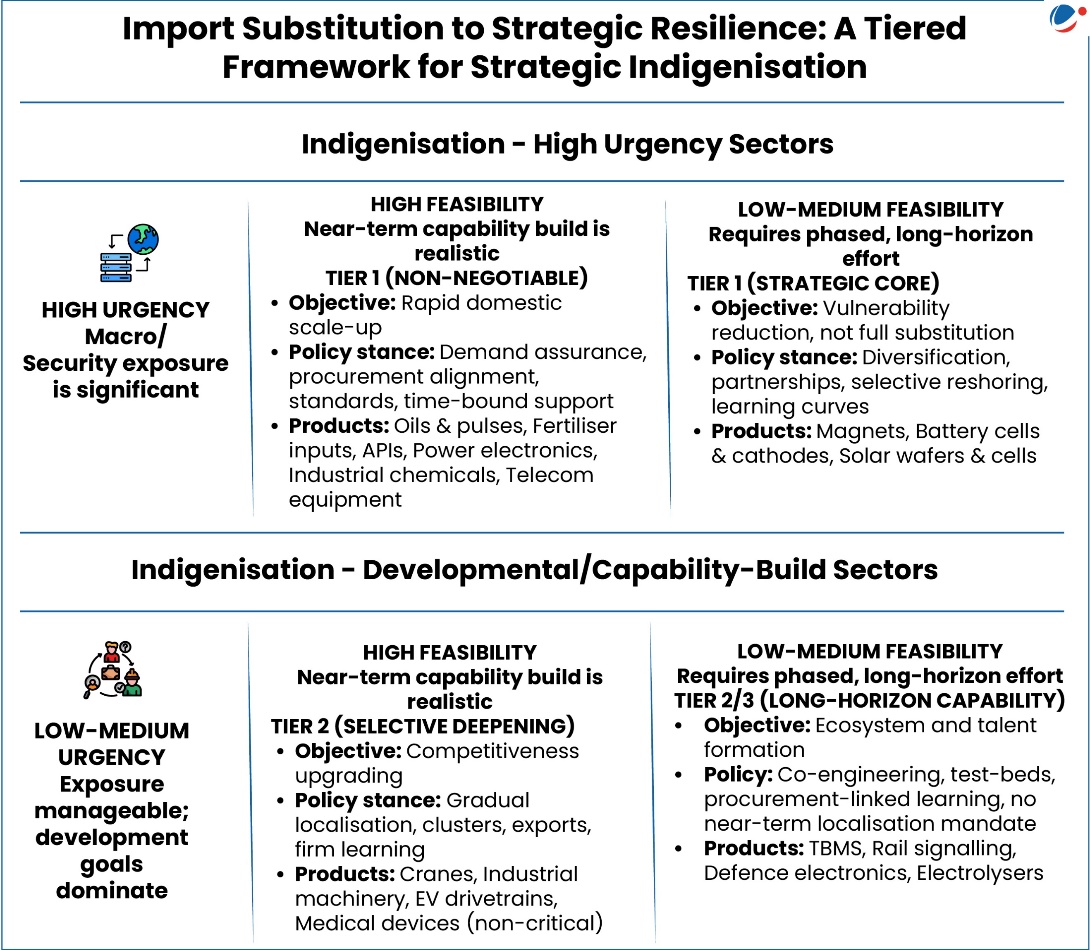
- Disciplined swadeshi for strategic resilience: Swadeshi must be a disciplined strategy, as not all import substitution is either feasible or desirable.
- Protection without productivity-enhancing investment, capability upgrading, and export orientation creates fragility rather than strength.
- Moving Up the "Smiling Curve": Several measures aim to move India up the "smiling curve" by shifting from low-value assembly to higher-value activities like design, R&D, and component manufacturing.
- Smiling Curve is a concept in global value chains showing that higher value is generated in upstream activities (R&D, design) and downstream activities (branding, marketing), while manufacturing and assembly in the middle create relatively lower value.
- Geo-economic Hedging and Supply Security: By localising critical upstream inputs, India aims to reduce import dependence and strategic vulnerabilities.
- For instance, the Rare Earth Permanent Magnets scheme seeks to build domestic capacity for EVs and renewables, while Biopharma SHAKTI helps hedge against potential US tariffs on branded drugs.
- Broad-Based and Inclusive Growth: Reviving 200 legacy industrial clusters aims to broaden growth beyond high-tech hubs by boosting productivity through shared infrastructure and knowledge spillovers
- Nurturing MSME "Champions": The three-pronged support - equity, liquidity via TReDS and compliance assistance recognises MSMEs as a key growth engine and aims to scale them into globally competitive industry champions.
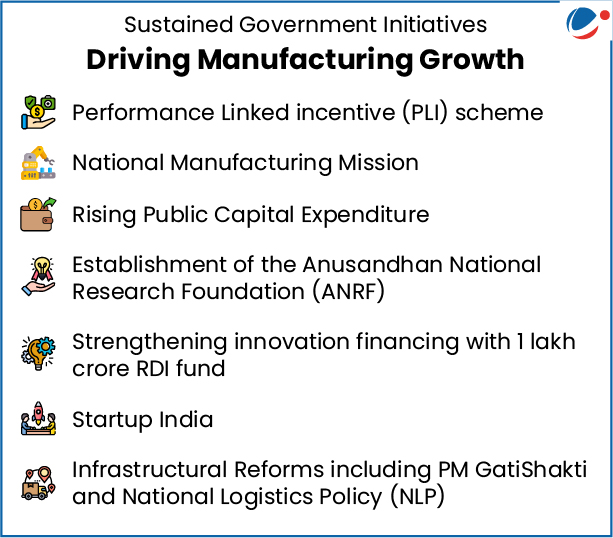
- Infrastructural Reforms Driving Manufacturing Expansion: Government-led infrastructure and logistics reforms are enabling manufacturing expansion through continued investments in connectivity, industrial infrastructure, and skilling support.
Conclusion
Amid a rapidly evolving global order, the stages of Aatmanirbharta are increasingly overlapping rather than sequential. This necessitates a simultaneous pursuit of import substitution (reducing import dependence), resilience (continuity and security of supply chains), and indispensability (global leadership and enabling leverage in negotiations). By treating manufacturing as an institutional stress test and aligning intent with execution, India can evolve from a recipient of stability to a source of global influence.


