


President of India approved conferment of 131 Padma Awards.
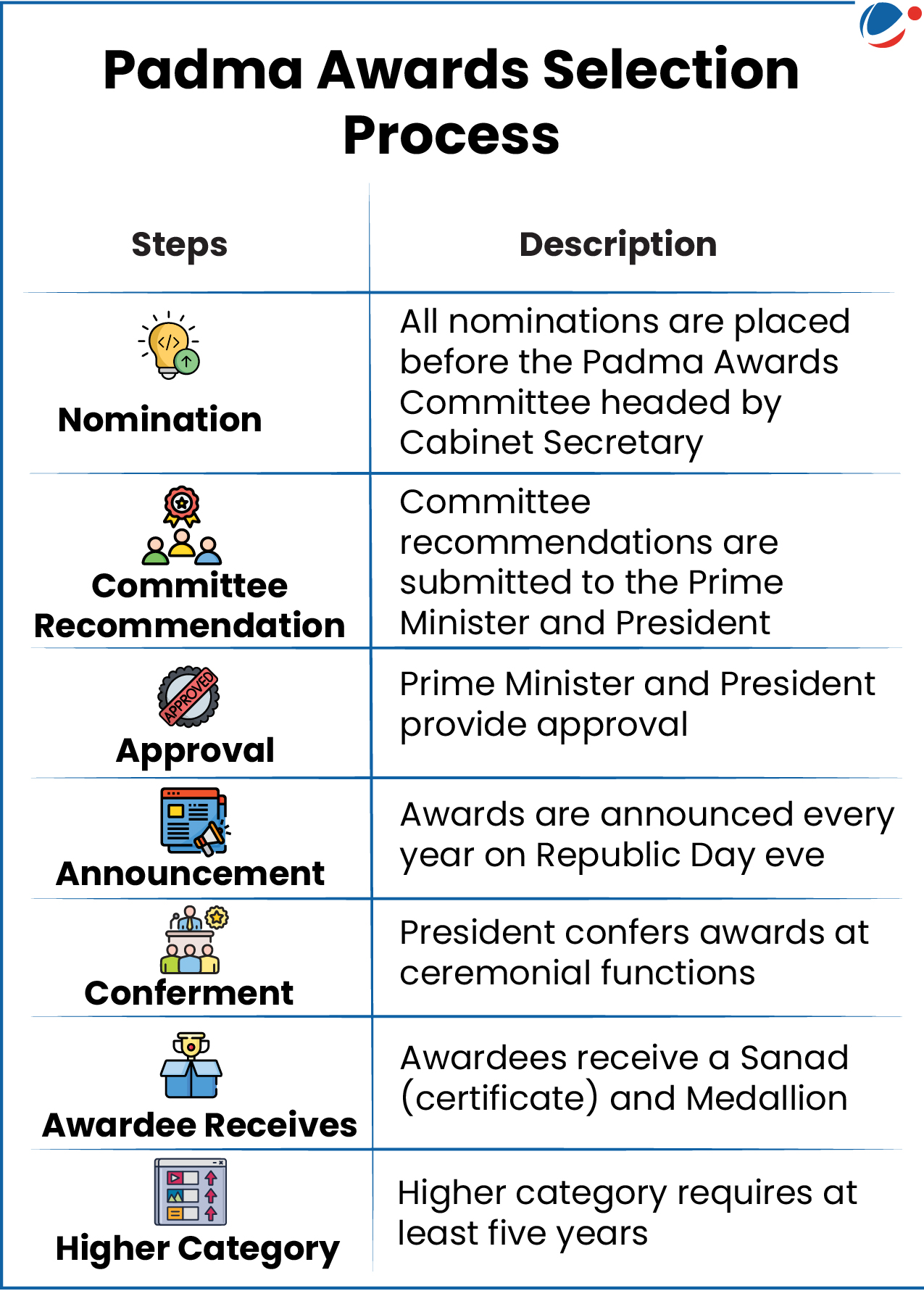
- It comprises 5 Padma Vibhushan, 13 Padma Bhushan, and 113 Padma Shri Awards.
- Awardees include 19 women, 6 persons from Foreigners/NRI/PIO/OCI category, and 16 posthumous awardees. There are 2 Duo cases (in a duo case, the Award is counted as one).
About Padma Awards
- It is one of the highest civilian awards of the country, are conferred in three categories, namely,
- Padma Vibhushan for exceptional and distinguished service;
- Padma Bhushan for distinguished service of a high order; and
- Padma Shri for distinguished service in any field.
- The other civilian award is the Bharat Ratna (highest civilian award).
- History: Instituted as Padma Vibhushan in 1954 with three classes, it was renamed in 1955 as Padma Vibhushan, Padma Bhushan, and Padma Shri.
- Conferred annually except interruptions during the years 1978, 1979, and 1993 to 1997.
- Activities/ Disciplines: All fields such as Art, Social Work, Public Affairs, Science, etc. involving public service.
- Not eligible: Government servants including those working with PSUs, except doctors and scientists.
- Status: The award does not amount to a title under Article 18(1) and cannot be used as a suffix or prefix. (Balaji Raghavan vs. UoI, 1996)
- Article 18(1) prohibits the State from conferring any titles except military and academic distinction.
- Cap: Number of awards is capped at 120 per year (excluding Posthumous and Foreigners/NRI).
- Normally not conferred posthumously. However, in highly deserving cases, it is awarded.
Article Sources
1 sourcePresident of India approved Gallantry awards to 70 Armed Forces personnel, including six posthumous.
About Gallantry Awards
- Established:
- Wartime Awards: Param Vir Chakra, Maha Vir Chakra, and Vir Chakra were instituted on January 26, 1950.
- Peacetime Awards: Ashoka Chakra Class-I, Class-II, and Class-III were instituted on January 4, 1952.
- These peacetime awards were renamed Ashoka Chakra, Kirti Chakra, and Shaurya Chakra, respectively in 1967.
- Conferred by: President, who is the supreme commander of the Armed Forces.
- Objective: Recognitions given for acts of bravery, valour or self-sacrifice both during wartime and peacetime.
- Selection Process: Ministry of Defence invites recommendations twice in a year from the Armed Forces and Union Ministry of Home Affairs for gallantry awards.
- Frequency: announced twice a year, on the occasion of Republic Day and Independence Day.
Two main categories | |
Gallantry in the Face of Enemy:
| Gallantry Other than in the Face of Enemy:
|
Order of precedence: Param Vir Chakra, the Ashoka Chakra, the Mahavir Chakra, the Kirti Chakra, the Vir Chakra and the Shaurya Chakra. | |
Article Sources
1 sourceThe Bhadrakali inscription serves as a vital 12th-century epigraphic record that authenticates the historical and architectural evolution of the Somnath Temple under the patronage of the Solanki dynasty.
About the Bhadrakali Inscription
- Location: Situated at Prabhas Patan, Gujarat, this 1169 CE inscription is embedded in the wall of the ancient Bhadrakali Temple.
- Context: It serves as a prashasti (eulogy) for Acharya Bhavabrihaspati, the spiritual preceptor of the Solanki (Chaulukya) King Kumarapala.
- Chronology: The record provides a legendary history of the Somnath Temple across the four Yugas, mentioning its construction in gold, silver, wood, and finally stone by Bhimdev Solanki.
- Patronage: It highlights the role of the Solanki dynasty in the temple’s revival, specifically Kumarapala’s efforts in the 12th century.
Article Sources
1 sourceThe discovery of stupas (man-made mounds) at Zehanpora underscores Kashmir’s rich Gandhara Buddhist heritage and its historical role as a centre of Buddhist culture and learning.
Zehanpora Site (Baramulla, North Kashmir)
- Stupa structures belong to the Kushan period (1st–3rd century CE).
- Located along the ancient Silk Route to Kandahar.
- Other Findings: Evidence of wooden superstructures, an urban settlement complex (potentially chaityas and viharas), Kushan-era pottery, copper artefacts, etc.
Prime Minister participated in “Bagurumba Dwhou 2026”, celebrating rich heritage of the Bodo community in Assam.
About Bagurumba Dance
- Traditional folk dance of the Bodo community of Assam.
- Inspired by nature, symbolises blooming flowers, reflects harmony between human life and the natural world.
- Traditionally performed by young Bodo women, men accompany as musicians, playing traditional instruments.
- Usually performed in groups, forming circles or lines that enhance its visual elegance.
- Cultural Significance: Dance represents peace, fertility, joy and collective harmony, and is closely associated with festivals such as Bwisagu (the Bodo New Year) and Domasi.
Article Sources
1 sourceTraditional harvest festivals are being celebrated in different parts of India.
- These festivals, celebrated under different names and customs across the country, mark the change of seasons, the Sun’s northward journey (Uttarayana), and the harvest of crops.
Traditional Harvest Festivals
- Makar Sankranti (Maharashtra): It marks the Sun’s transition into Capricorn.
- Uttarayana (Gujarat and Rajasthan): It is known for kite flying, which commemorates the Sun's rise and is a day of joy and celebration.
- Pongal (Tamil Nadu): It marks four-day harvest festival that includes Thai Pongal, Mattu Pongal, Kaanum Pongal, and Bhogi, people make the rice and lentil dish Pongal.
- Lohri (Punjab): Celebrated a day before Makar Sankranti, it marks the harvest of Rabi crops and is celebrated around bonfires with folk songs, Bhangra and Gidda.
- Magh Bihu (Assam): It celebrates the end of the harvest season with community feasts, traditional games and bonfires known as Meji.
- Kanuma (Telangana): It is a festival to express thankfulness and admiration towards the agriculture sector.

