


The launch marked the 64th flight of Polar Satellite Launch Vehicle (PSLV) and 9th dedicated commercial mission undertaken by New Space India Limited (NSIL).
- NSIL, incorporated in 2019, is wholly owned Government Company under administrative control of Department of Space and is the commercial arm of Indian Space Research Organisation (ISRO).
About PSLV-C62 / EOS-N1 Mission
- It includes the launch of EOS-N1 earth observation satellite along with 15 co-passenger satellites from domestic & international customers.
- EOS-N1 is designed to strengthen space-based monitoring capabilities.
- It will also demonstrate KID or Kestrel Initial Technology Demonstrator from a Spanish startup.
- KID is a small-scale prototype of a re-entry vehicle which after launch is slated to re-enter the earth’s atmosphere towards splashdown in South Pacific Ocean.
- EOS-N1 and 14 Co-passenger satellites will be injected into a Sun Synchronous Orbit and KID Capsule into a re-entry trajectory.
About PSLV
- 3rd generation launch vehicle and is first Indian launch vehicle to be equipped with liquid stages.
- Workhorse of ISRO: Consistently delivered satellites to Low Earth Orbits, can take up to 1,750 kg of payload to Sun-Synchronous Polar Orbits of 600 km altitude.
- Stages in PSLV
- First Stage: Uses the S139 solid rocket motor augmented by 6 solid strap-on boosters.
- Second Stage: Uses Earth storable liquid rocket engine known as Vikas engine, developed by Liquid Propulsion Systems Centre.
- Third Stage: Solid rocket motor that provides high thrust to upper stages.
- Fourth Stage: Uppermost stage of PSLV, comprising of two Earth storable liquid engines.
- Notable Missions: Chandrayaan-1, Mars Orbiter Mission, Aditya-L1 and Astrosat Mission, PSLV set a world record by launching 104 satellites in a single mission in 2017.
Article Sources
1 sourcePixxel-led Consortium has signed an agreement with IN‑SPACe to design, build, and operate India’s first national EO constellation
- Pixxel-led Consortium comprises Piersight Space, Satsure Analytics India, and Dhruva Space.
- Indian National Space Promotion and Authorisation Centre (IN-SPACe) is India’s nodal agency that authorises, regulates, and promotes private sector participation in space activities.
Key features of the EO constellation Project
- PPP Model: It will be executed under a Public–Private Partnership (PPP) framework.
- The project will create a complete end-to-end Earth Observation ecosystem, from satellite deployment to value-added geospatial analytics.
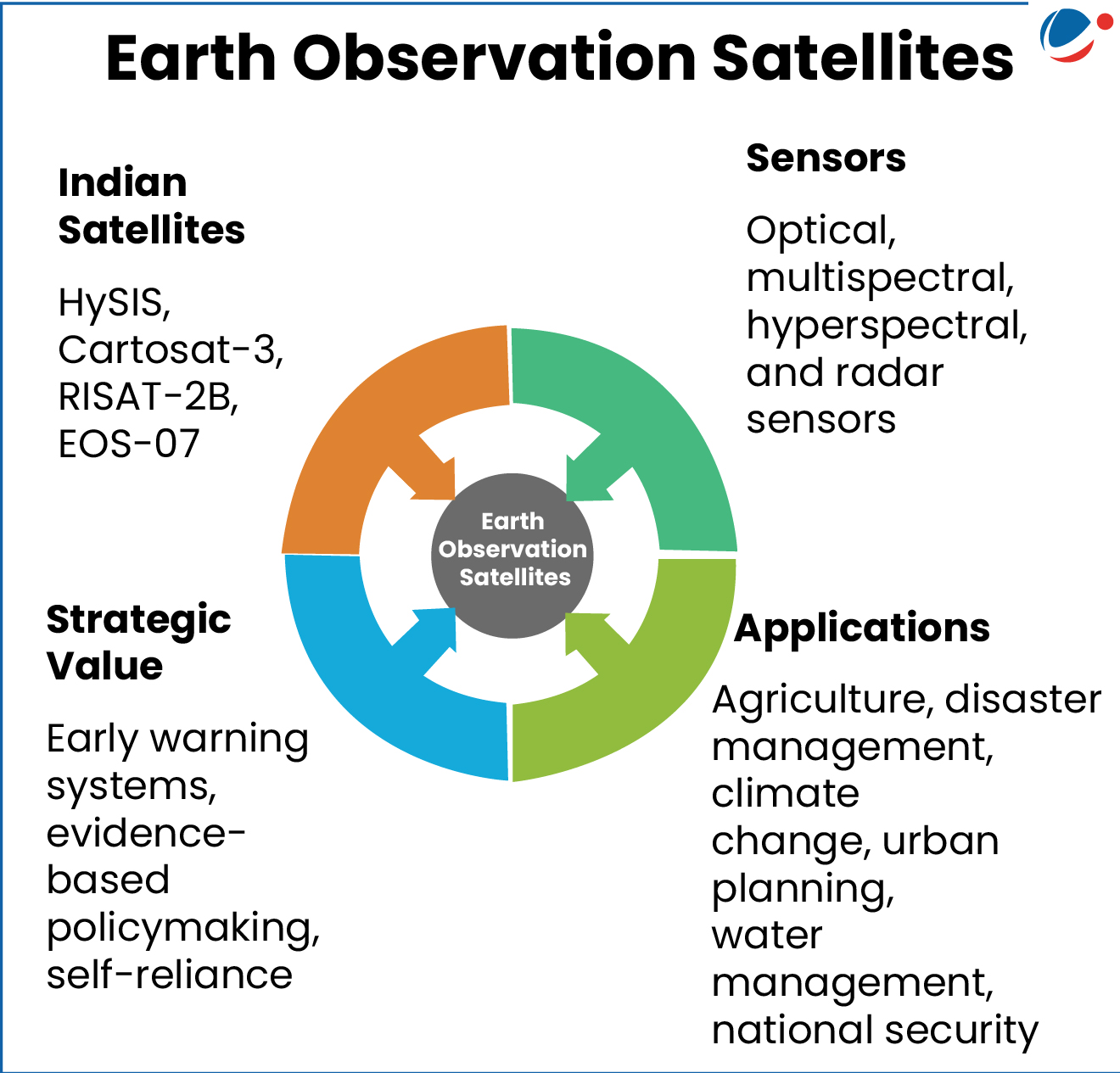
- Constellation: It will consist of 12 satellites covering very high-resolution optical, multispectral, synthetic aperture radar (SAR), and hyperspectral imaging.
- Project scale: ₹1,200 crore investment over a5-year period.
- Strategic shift: Transition from government-built to industry-operated national EO infrastructure.
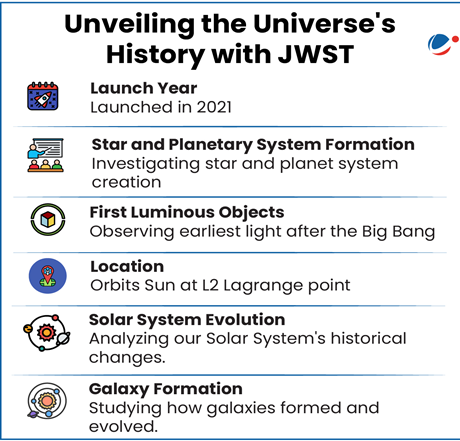
Based on observations from James Webb Space Telescope, astronomers unveil a detailed map of dark matter.
Dark Matter
- It is a hypothesised form of matter that is invisible but is inferred to exist based on its gravitational effects on ordinary matter like stars, planets, moons, etc.
- It does not emit, absorb, or reflect light and barely interacts with normal matter.
- Composition of Universe: normal or visible matter (5%), dark matter (27%), and dark energy (68%).
Article Sources
1 sourceWEF announced five new ‘Fourth Industrial Revolution (IR 4.0) Centres’ globally. One of the Centre will be built in in Andhra Pradesh, India.
- It will be 3rd such centre in India after Mumbai and Telangana.
What is the Fourth Industrial Revolution?
- The term was coined by Klaus Schwab, founder of the World Economic Forum (WEF) in 2016.
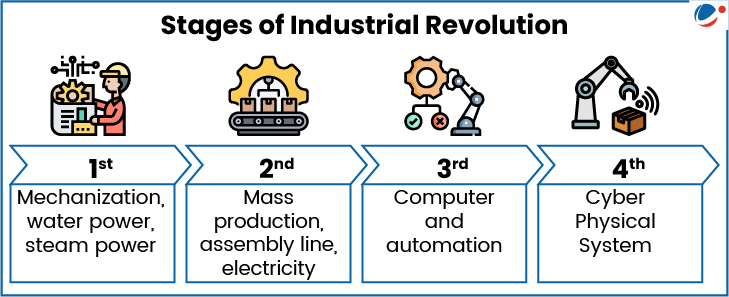
- IR 4.0 describes the current era in which digital, physical and biological technologies converge such as AI, robotics, the Internet of Things (IoT), Quantum Computing, etc.
- Unlike earlier revolutions, IR 4.0 is blurring boundaries between physical, digital and biological systems.
Significance of Fourth Industrial Revolution
- Economic growth: Enhances productivity and improves supply chain resilience through automation, data analytics and smart manufacturing.
- Inclusive development potential: Offers developing countries like India an opportunity to leapfrog legacy technologies and expand digital access.
- Environmental sustainability: Supports low-carbon and resource-efficient growth through smart grids, precision agriculture and circular economy practices.
- For example, "Lighthouse" factories have demonstrated significant reductions in CO2 emissions and water usage through predictive analytics and IoT.
- Human capital centrality: Shifts the focus from physical labour to skills, innovation, and lifelong learning.
Challenges and Risks
|
Government releases draft guidelines for Battery Pack Aadhaar System.
About Battery Pack Aadhaar System
- It is an indigenous digital identification and data storage system developed to ensure end-to-end traceability of batteries throughout their entire lifecycle.
- It includes a unique identification number for each battery pack, capturing and storing vital information from extraction to final disposal.
- Battery categories that are required to maintain a Battery Pack Aadhaar as an electronic record include Electric Vehicle Batteries and Industrial Batteries with capacity greater than 2kWh.
- Significance: Enabling second-life usage, regulatory compliance, and efficient recycling.
Union Road Transport and Highways Minister announced that India will roll out Vehicle-to-Vehicle (V2V) communication technology.
About V2V Communication Technology
- It is an inter vehicle communication paradigm that it does not rely on third party networks like cellular networks to communicate.
- Significance: Increased safety as it works across the front, rear and sides of vehicles, and will factor in terrain and road curves; strengthen Advanced Driver Assistance Systems (ADAS) by allowing vehicles to share warnings even when a hazard is not visible.
Indian scientists developed first supercomputer-powered simulation to capture Mpemba effect.
About Mpemba effect
- It is a long-existing paradox suggesting that hotter substances can freeze faster than colder substances under certain conditions.
- Most famously, observed with water, but the effect is not limited to water and shows up in other materials and physical systems, too.
- Significance: Heat engines and refrigeration systems, Quantum computing, Materials science etc.
Article Sources
1 sourceAs per National Centre for Disease Control (NCDC), only two confirmed cases of Nipah Virus Disease have been reported from West Bengal from December last year till date.
About Nipah Virus
- Nature: Zoonotic virus (spreads from animals to humans).
- Natural reservoir: Fruit bats also known as flying foxes.
- Transmission
- Animal to human: Direct contact with infected bats or pigs or consumption of raw date palm sap or fruit contaminated by bats.
- Human to human: Close contact with body fluids of infected persons.
- First identified: 1999 outbreak in Malaysia and Singapore (from Bats to Pigs to Humans).
- Incubation period: 4–14 days.
- Early symptoms: Fever, Headache, Cough, Sore throat and difficulty in breathing.
Article Sources
1 sourceResearchers found high levels of antibiotic-resistant staphylococci in both the indoor and outdoor environment in parts of Delhi.
About Staphylococcus
- They are gram positive cocci (spherical-shaped bacterium) that occur in groups in clusters.
- It was first observed in humans by Von Recklinghausen.
- They showed tolerance to penicillin and resistances to all clinical useful antibiotics like erythromycin, tetracycline, aminoglycosides.
- Types: Staphylococcus aureus and Staphylococcus epidermidis.


