


Why in the News?
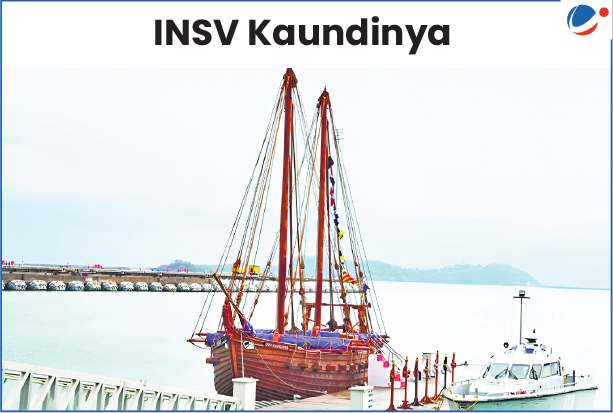
The Indian Navy's traditionally stitched wooden ship INSV Kaundinya reached Oman, after it started its journey from Porabandar, Gujarat.
About INSV Kaundinya
- It is a traditionally-built stitched sail ship using Tankai method inducted into the Indian Navy to revive ancient Indian maritime heritage.
- It is a recreation of a 5th century CE vessel inspired by ship depictions in the Ajanta Caves (cave no 17).
- It was built under a tripartite agreement project (2023) between the Ministry of Culture, Indian Navy and Hodi Innovations (funded by the Ministry of Culture).
- The ship is named after Kaundinya, 1st-century Indian mariner associated with voyages from India to Southeast Asia.
- According to Southeast Asian and Chinese records, he sailed to the Mekong Delta, married Queen Soma and helped establish the Kingdom of Funan (present-day Cambodia).
- Though absent in Indian texts, Kaundinya is regarded as the earliest named Indian sailor with global historical influence.
About Tankai method
- It is a 2000-year-old technique of shipbuilding known as the 'stitched shipbuilding' method.
- It is characterized by no metal use, stitched wooden planks instead of nails, coir rope, coconut fibre, and natural resin as fastening and sealing material.
- Unlike modern naval vessels, it has no engine and no modern propulsion, relying entirely on wind and sails.
- In this method the hull is stitched first, internal ribs are added later, which gives the ship high structural flexibility that absorbs wave pressure instead of cracking.
- Though built traditionally, hull geometry, rigging, and hydrodynamic properties were tested scientifically to ensure open ocean seaworthiness.
Maritime Heritage of India
- Foundations of Indian Seafaring:
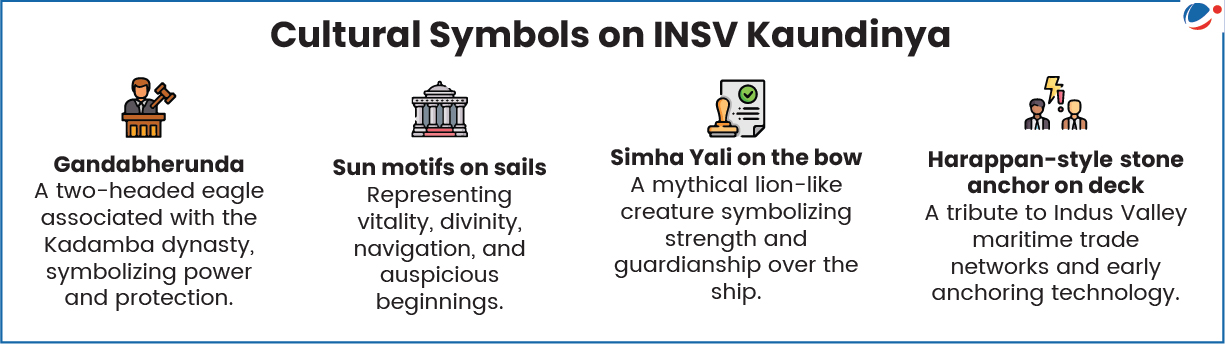
- Indus Valley Civilization had maritime trade links with Mesopotamia, proven by Harappan seals found there.
- Lothal dockyard is one of the world's earliest known dry dock, showing advanced knowledge of tides, shipbuilding, and navigation.
- Vedic literature, especially the Rig Veda, mentions sea voyages, ships, merchants, and Varuna, the god of the sea.
- Trade and Commercial Networks
- Indian merchants sailed across the Arabian Sea, Bay of Bengal, and Indian Ocean for trade.
- The Cholas, Cheras, and Pandyas had thriving maritime trade with the Roman Empire, Arabia, and Southeast Asia.
- The Vijayanagar and Bahmani kingdoms imported horses from Iran and Iraq via the port of Goa, showing India's integration into global trade routes.
- India remained the hub of Indian Ocean commerce until the arrival of Europeans.
- Cultural Expansion & Soft Power
- Ashoka's children, Mahendra and Sanghamitra, sailed from Tamralipti to Sri Lanka to spread Buddhism.
- Indian maritime contacts spread Hinduism, Buddhism, art, architecture, scripts, and language to Southeast Asia.
- Examples: Borobudur (Java), Angkor Wat (Cambodia)
- The Vijayanagar Empire and earlier dynasties reinforced this cultural influence through sustained sea contacts.
- Naval Power & Maritime Technology
- Magadha navy is regarded as the world's first recorded naval force.
- Chanakya's Arthashastra describes department of waterways, Naval warfare, Ports and ship regulation.
- Rajendra Chola I launched major overseas naval expeditions, conquering Sri Lanka and defeating the Sri Vijaya (Sailendra) Empire.
- Cholas and Cheras mastered monsoon wind navigation.
- Chhatrapati Shivaji Maharaj built sea forts like Sindhudurg and Vijaydurg and raised a navy of over 500 ships, later led effectively by Sarkhel Kanhoji Angre, who remained undefeated at sea.
- Maritime Diplomacy
- Meghavarman of Sri Lanka sent a mission to Samudragupta to seek permission to build a Buddhist temple at Gaya.
- The Sailendra dynasty sent embassies to the Pala rulers and built a monastery at Nalanda.
Conclusion
The voyage of INSV Kaundinya symbolises India's revival of its ancient maritime heritage and seafaring traditions through indigenous shipbuilding techniques. It also reinforces India's historical role as a major maritime, cultural, and trading power across the Indian Ocean and Southeast Asia.

