


Introduction: Context and Strategy
- Development Goals: India aims to become a developed nation by 2047, necessitating high, inclusive, and environmentally sustainable growth.
- The central thesis of the chapter is that development is, in itself, a form of adaptation. India must prioritize adaptation to protect its development gains while pursuing a pragmatic, energy-secure mitigation path
- Low Emissions Profile: India's per capita greenhouse gas emissions remain significantly lower than the global average (2.9 tonnes vs 6.7 tonnes).
- Three-Pillar Strategy: India's climate action is built on three pillars: Adaptation (to address vulnerability), Mitigation (transitioning energy systems while maintaining security) and Finance (mobilizing domestic and international capital).
- Global Lessons: The experience of Europe highlights that rapid energy transitions without adequate grid readiness and storage can lead to instability, underscoring the need for a measured strategy that preserves energy security
Chapter Precap
Adaptation & Resilience
| Mitigation & Energy Transition
|
Climate Finance & Markets
| Governance & Future Path
|
Global Context: The "Entropy Effect" in Energy Transitions
- The survey highlights the dangers of rapid decarbonization without institutional readiness, termed the "Entropy Effect" where transition strategies increase systemic volatility if not accompanied by buffers.
- The European Lesson: Countries like the Netherlands and Spain faced grid congestion and blackouts because renewable capacity expanded faster than transmission and storage infrastructure,.
- Implication for India: Transition must be sequenced. Energy security and industrial growth cannot be displaced by climate goals; they must advance alongside them.
- Shift in Global Narrative: There is a move toward "realism," acknowledging that climate policy must prioritize human welfare and that innovation is a more durable path than imposed constraints.
Adaptation: Strengthening climate resilience
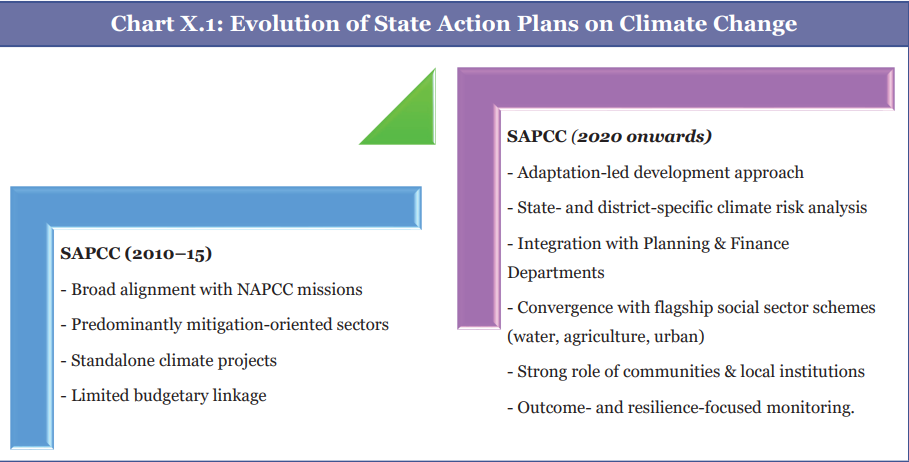
Public Investment–Led Climate Adaptation in India
- Expenditure: Adaptation is driven primarily by domestic public investment. Adaptation-relevant expenditure rose from 3.7 per cent of GDP in FY16 to 5.6 per cent in FY22.
- National Missions: The National Action Plan on Climate Change (NAPCC) operates through nine missions, focusing on solar energy, water, health, sustainable agriculture, and habitats.
- Agriculture & Water: The National Mission on Sustainable Agriculture promotes initiatives like "Per Drop More Crop" and Soil Health Cards. The National Water Mission focuses on conservation through State-Specific Plans.
- State Action Plans (SAPCCs): Governance has shifted from mitigation-centric plans (2010–15) to adaptation-led development frameworks (2020 onwards). These new plans emphasise district-specific risks, convergence with social schemes, and the role of local institutions.
Subnational initiatives on adaptation through an ecosystem-based approach and Institutional Innovations
- Meghalaya (Water Security): The MegARISE project protects catchment areas through forest restoration.
- Odisha (Community Governance): Institutionalised climate adaptation through over 39,000 Pani Panchayats.
- Tamil Nadu (Coastal Resilience): Launched the Coastal Restoration Mission covering 14 coastal districts to enhance biodiversity and to protect against sea-level rise
- Ahmedabad (Heat Insurance): Pioneered a parametric heat insurance scheme for informal women workers.
- Uttarakhand (Early Warning): Utilises community radio (Mandakini ki Aawaz) to broadcast early warnings and disaster advisories to remote villages.
- Jodhpur (Urban Cooling): Deployed net-zero cooling stations using passive designs (wind towers, vetiver curtains) and solar power.
Mitigation: Transition to a low-carbon economy
Energy Transformation at Scale: India's Renewable Imperative
- Global Ranking: India ranks fourth globally in total installed renewable energy capacity, as well as in installed solar and wind capacity.
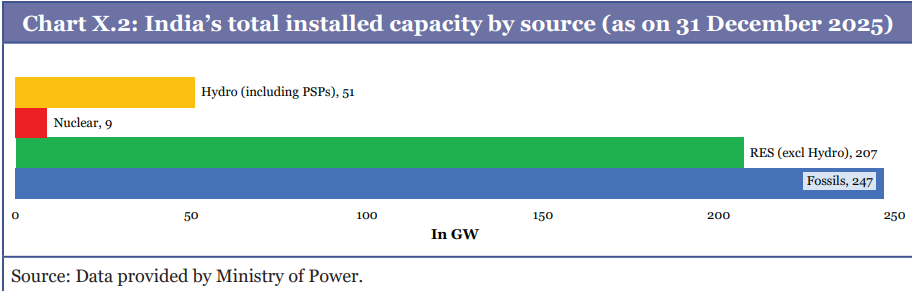
- Target Achievement: India surpassed the target of 50 per cent installed power capacity from non-fossil fuel sources ahead of schedule, reaching 51.93 per cent by December 2025.
Recent measures to boost non-fossil fuel sources of energy
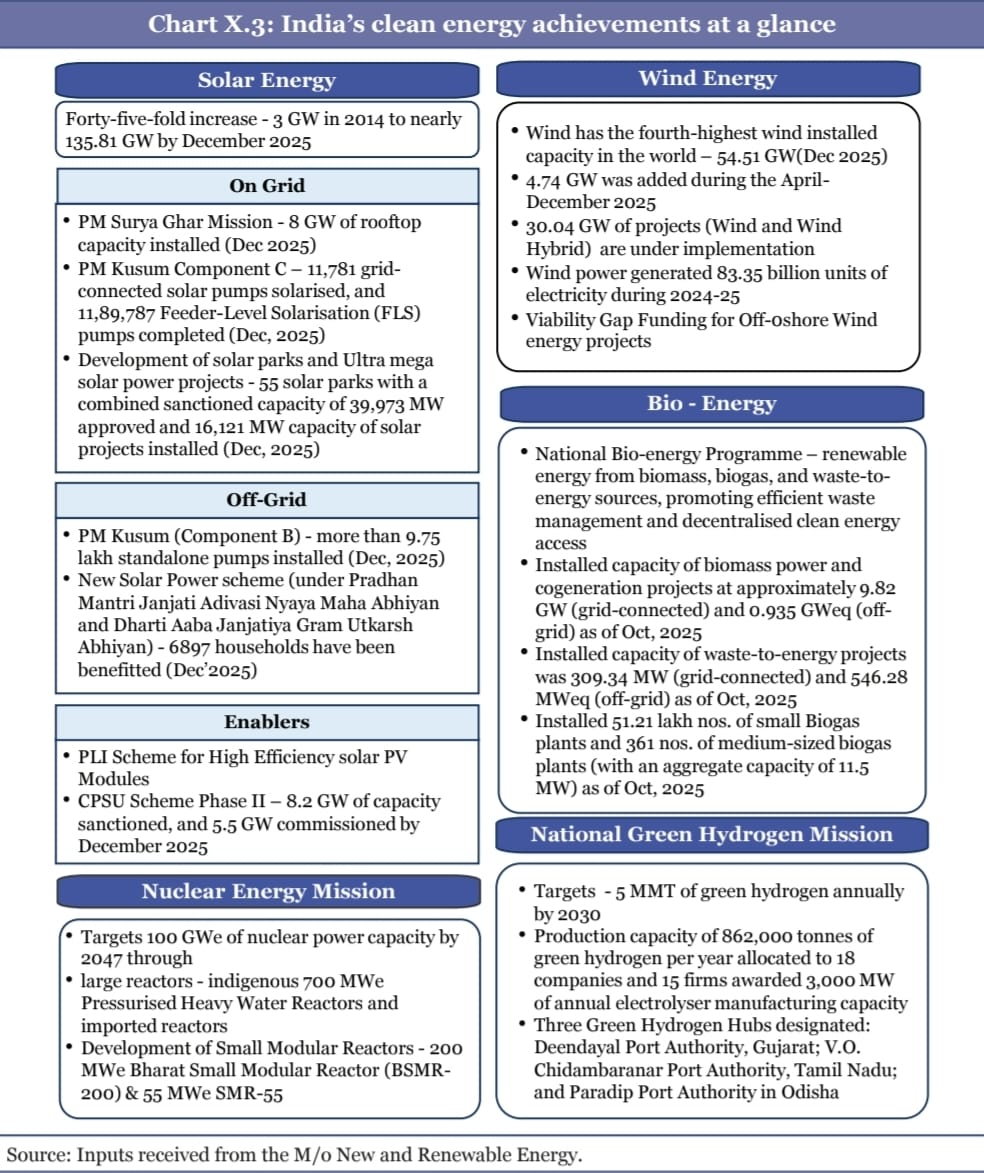
- Solar Initiatives:
- PM KUSUM: Over 9.75 lakh standalone pumps installed (Component B) and 11,781 grid-connected pumps solarised (Component C),.
- PM Surya Ghar: 8 GW of rooftop capacity installed.
- Solar Parks: 55 solar parks with a combined sanctioned capacity of 39,973 MW approved.
- Wind Energy: Total installed capacity reached 54.51 GW (Dec 2025), with another 30.04 GW under implementation.
- Nuclear Energy: The government announced the Sustainable Harnessing and Advancement of Nuclear Energy for Transforming India (SHANTI) Act, 2025, with an allocation of ₹20,000 crore. The goal is to develop Small Modular Reactors (SMRs) and achieve 100 GW of nuclear capacity by 2047 to ensure baseload reliability.
The Case for Battery Storage
- Requirement: To integrate variable renewables, the Central Electricity Authority estimates a need for 336 GWh of storage capacity by 2029–30.
- Incentives: Measures include Viability Gap Funding (VGF) for 4,000 MWh of Battery Energy Storage Systems (BESS) and a PLI scheme for Advanced Chemistry Cells targeting 50 GWh capacity. Inter-state transmission charges for co-located storage are waived.
Critical Minerals and the Political Economy of the Energy Transition-Balancing Resilience, Standards, and Inclusiveness
- Resource Intensity: Renewable technologies are material-intensive. Box X.4 notes that a 1 GW wind turbine requires approximately 2,866 tons of copper, necessitating the movement of over 1,194 truckloads of ore. Copper prices recently hit a record $12,000/ton.
- Supply Chain Security: The National Critical Mineral Mission (NCMM) was approved with an outlay of ₹16,300 crore. KABIL has acquired 15,703 hectares in Argentina for lithium mining to secure supply,.
- Recycling: A ₹1,500 crore incentive scheme was approved to promote the recycling of critical minerals and recovery from end-of-life products.
Carbon Credit Trading Scheme: from framework to implementation
- Structure: Adopted in 2023, the CCTS includes a Compliance Mechanism for obligated entities (e.g., steel, cement) and an Offset Mechanism for voluntary projects in 10 sectors (e.g., agriculture, waste handling),.
- Targets: Greenhouse Gas Emission Intensity (GEI) targets have been notified. Entities achieving lower intensity than the target earn tradeable Carbon Credit Certificates (CCCs), while those exceeding targets must purchase them.
- Surat Model: The Surat Emissions Trading Scheme (ETS) for particulate matter proved that pollution markets work in India, reducing emissions by 20-30% while lowering costs.
Mission LiFE
- Introduced at COP26, this initiative integrates behavioural change into climate action.
- Existing schemes like UJALA (LED bulbs) and PAT (industrial efficiency) align with LiFE by promoting mindful consumption and resource efficiency.
Climate Finance
Bridging the Finance Gap in the Indian Context
- Global Disparity: In 2023, global climate finance reached USD 1.9 trillion, but developing countries (excluding China) received only about 15 per cent. Private capital flows remain heavily skewed toward advanced economies.
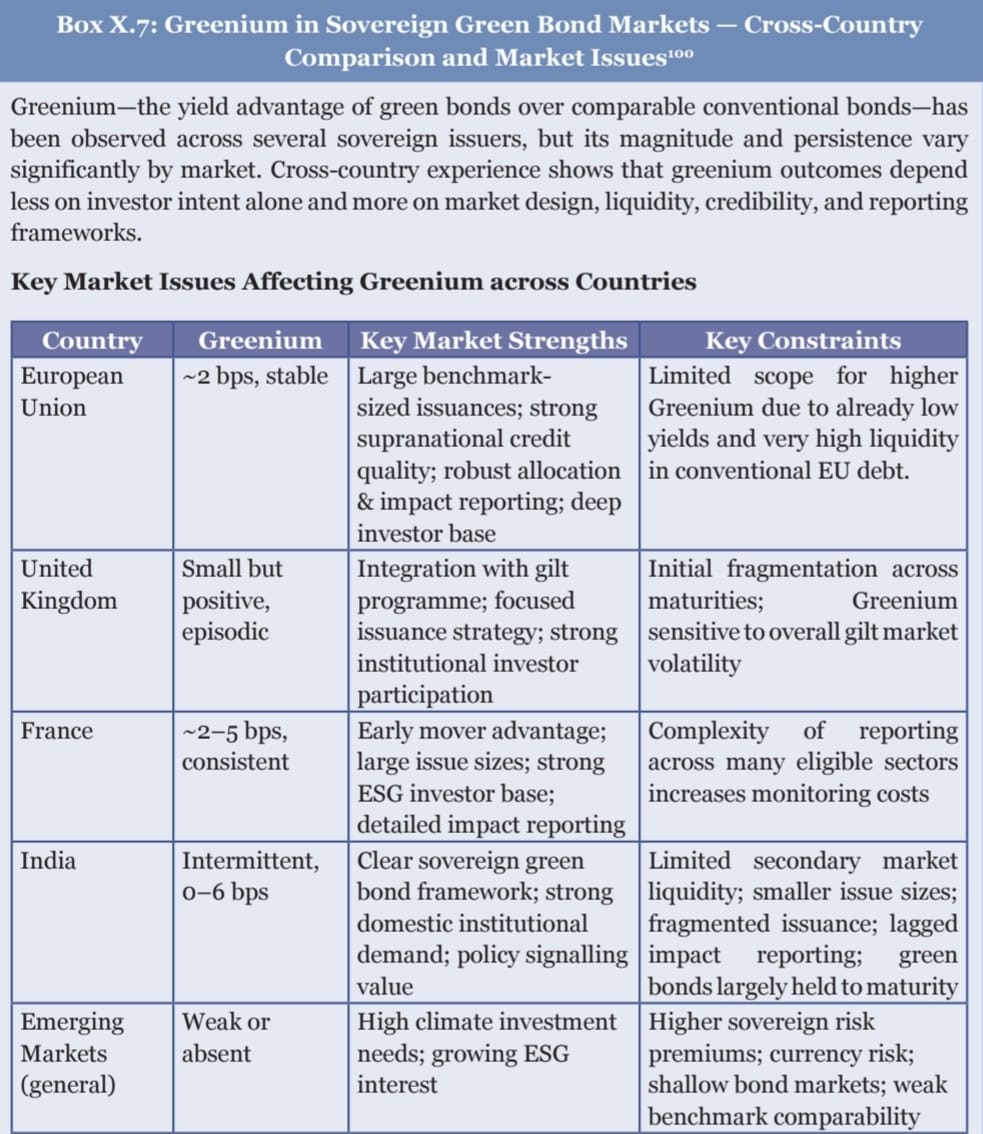
- Domestic Reliance: India funds 83 per cent of its mitigation and 98 per cent of its adaptation expenditure through domestic resources. It is estimated that ₹150 lakh crore is needed between 2024 and 2030 for green energy transition.
- Sovereign Green Bonds: The government issued ₹15,000 crore in FY26, taking cumulative issuance to ₹72,697 crore since FY23.
- Municipal Bonds: Cities like Vadodara (₹100 cr), Ahmedabad (₹200 cr), Indore (₹244 cr for solar), and Ghaziabad (₹150 cr) have successfully issued green bonds.
- Greenium: India has seen a modest "greenium" (yield advantage for green bonds vs conventional bonds) of 0–6 basis points. Deepening secondary market liquidity and consolidating issue sizes are needed to improve this advantage.
- Disaster Finance: The 15th Finance Commission established National and State Disaster Mitigation Funds (NDMF/SDMF). A ₹150 crore Glacial Lake Outburst Flood (GLOF) mitigation project was recently approved under NDMF.
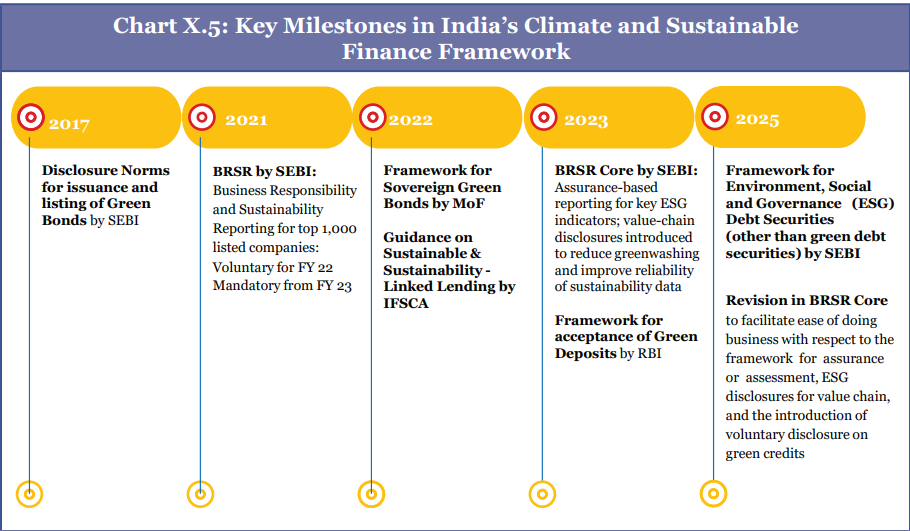
Recent reforms in Environmental Clearance and Related Regulations
- PARIVESH 3.0: A single-window digital platform enabling transparent processing of environmental clearances and compliance monitoring.
- Jan Vishwas Act: Decriminalised minor offences under environmental acts (Air and Water Acts) to reduce harassment and focus on compliance through penalties.
- Circular Economy: Extended Producer Responsibility (EPR) frameworks have led to the recycling of 308 lakh tonnes of waste (plastic, e-waste, batteries) and the generation of 296.53 lakh tonnes of EPR certificates.
- Rationalisation: Industry classifications (Red/Orange/Green/White) have been updated based on pollution potential. Green belt norms were rationalised to optimise land use.
- State Reforms: States like Kerala, Tamil Nadu, and Andhra Pradesh have streamlined clearances through digitisation and single-window systems under the Business Reform Action Plan (BRAP).
Conclusion: Towards a green, resilient and competitive India
- Adaptation Priority: With developed countries off-track on 2030 climate targets, India must prioritise adaptation to safeguard development gains.
- Strategic Pragmatism: India's transition balances renewable expansion with system reliability (nuclear, thermal) to ensure energy security and industrial competitiveness.
- Finance Constraint: Finance remains the binding constraint. While domestic markets are strengthening, international financial architecture reforms are essential to lower capital costs.
- Governance: The evolution of environmental regulation towards a trust-based, technology-enabled framework proves that environmental protection can coexist with economic growth.
What does the Budget Say?
- Carbon Capture Utilization and Storage (CCUS): An outlay of ₹20,000 crore is proposed to achieve higher readiness levels for CCUS technologies in 5 industrial sectors (Power, steel, cement, refineries, and chemicals).
- Nuclear Power: To support energy transition, the existing basic customs duty exemption on goods for Nuclear Power Projects is extended till 2035 and expanded to cover all nuclear plants irrespective of their capacity.
- Critical Minerals: To incentivize prospecting and exploration, basic customs duty exemption is provided for capital goods required for processing critical minerals. Additionally, Rare Earth Corridors will be established in Odisha, Kerala, Andhra Pradesh, and Tamil Nadu to promote mining and processing.
- Battery Energy Storage: The basic customs duty exemption given to capital goods for manufacturing Lithium-Ion Cells is extended to those used for manufacturing Lithium-Ion Cells for battery energy storage systems.
- Solar Energy: To support domestic manufacturing, basic customs duty is exempted on the import of sodium antimonate for use in the manufacture of solar glass.
- Biogas Promotion: To promote cleaner fuels, the budget proposes to exclude the entire value of biogas while calculating the Central Excise duty payable on biogas blended CNG.
- Sustainable Logistics: A Coastal Cargo Promotion Scheme will be launched to incentivize a modal shift from rail/road to waterways, aiming to increase the share of inland waterways and coastal shipping to 12% by 2047.
- Green Mobility: As part of the development of the Purvodaya States and North-East Region, a provision is made for 4,000 e-buses to accelerate sustainable transport.
Glossary
Terms | Meanings |
| Adaptation | Measures taken to reduce vulnerability and enhance resilience to climate change impacts. |
| Mitigation | Actions aimed at reducing greenhouse gas emissions or enhancing carbon sinks. |
| Climate Finance | Financial resources mobilised for climate mitigation and adaptation activities. |
| Non-Fossil Fuel Capacity | Electricity generation capacity derived from renewable and nuclear sources. |
| Battery Energy Storage Systems (BESS) | Systems that store electricity for later use to stabilise renewable energy supply. |
| Critical Minerals | Minerals essential for clean energy technologies such as lithium, cobalt, and copper. |
| Carbon Credit Trading Scheme (CCTS) | A market mechanism that allows trading of emission reduction certificates. |
| Carbon Credit Certificates (CCCs) | Tradable instruments awarded for achieving emission targets under CCTS. |
| Sovereign Green Bonds | Government-issued bonds to finance environmentally sustainable projects. |
| Greenium | The yield advantage enjoyed by green bonds over conventional bonds. |
| Extended Producer Responsibility (EPR) | A policy making producers responsible for post-consumer waste management. |
| Circular Economy | An economic system focused on reuse, recycling, and waste minimisation. |
| Disaster Mitigation Fund (NDMF/SDMF) | Funds created to finance disaster prevention and resilience measures. |
| Small Modular Reactors (SMRs) | Compact nuclear reactors designed for flexible and safer power generation. |
Mains Questions
1. "India's climate strategy reflects a balance between developmental priorities and environmental sustainability." Discuss this statement in the context of India's three-pillar approach of adaptation, mitigation, and climate finance.
2. Examine the role of renewable energy, critical minerals, carbon markets, and behavioural change in India's transition to a low-carbon and climate-resilient economy.



