Introduction
India benefits from a large working-age population (age group 15-59), expected to exceed 98 crore in next 10 years. As per UN projections, India's demographic dividend is expected to peak around 2030, with nearly 65% of the population in 15-59 years. The population is gradually ageing signalling the onset of demographic transition towards older population with the need to harness longevity dividend.
Chapter Precap
Employment
| Skilling
|
Employment Overview
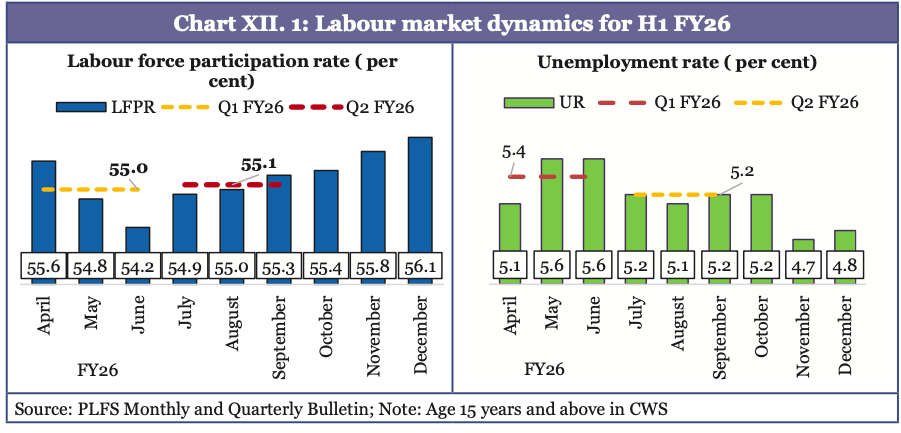
- Periodic Labor Force Survey (PLFS) indicates that period from April to September 2025 (H1 FY26) saw declining Unemployment Rate (UR) in Current Weekly Status (CWS) with a stabilising labour force participation rate (LFPR).
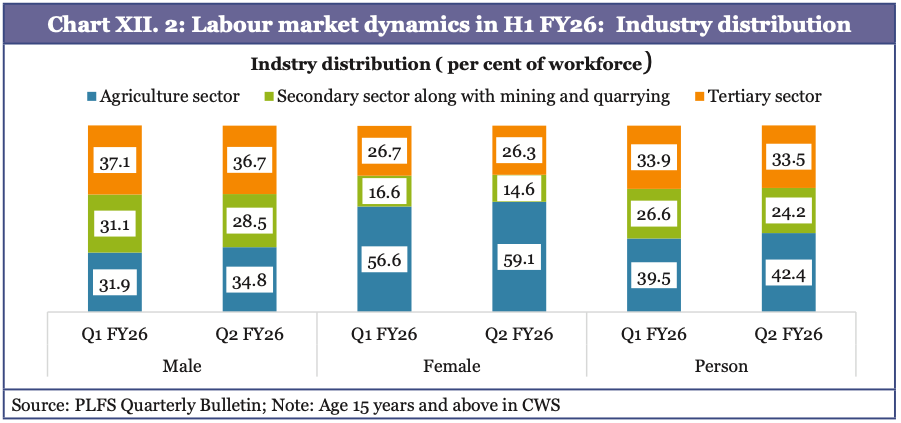
- Total 56.2 crore people (aged 15 years and above) were employed in Q2 (July-September 2025) FY26, reflecting a creation of 8.7 lakh new jobs in Q2 compared to Q1 (April -June 2025) of FY26.
- Rural employment: It is dominated by agricultural workers (57%) and self-employment (62.8%), with women showing relatively higher participation.
- Urban employment: It is primarily concentrated in services sector (62.0%), with regular wage or salaried jobs making up the largest share (49.8%).
- At the aggregate level, in Q2 FY26, agriculture and self-employment accounted for 42.4% and 55.8% of total employment, respectively, while casual labour constituted 18.9%.
- Increasing female participation to around 55% by 2050 is critical for aligning with the vision for Viksit Bharat 2047 and ensuring women led development.
Female Labour Force Participation Rate (FLFPR)
- India's FLFPR: It rose from 23.3% in 2017-18 to 41.7% in 2023-24, alongside a decline in UR from 5.6% to just 3.2%.
- Share of female-headed proprietary: It increased from 24.2% in 2021-2022 to 26.2% in 2023-24. (Women and Men in India, 2024 Report).
- Share of female-headed establishments is highest for manufacturing sector at 58.4% in 2023-24.
- States with higher presence of female-headed establishments like West Bengal, Karnataka, Gujarat, and Andhra Pradesh, also have higher FLFPR.
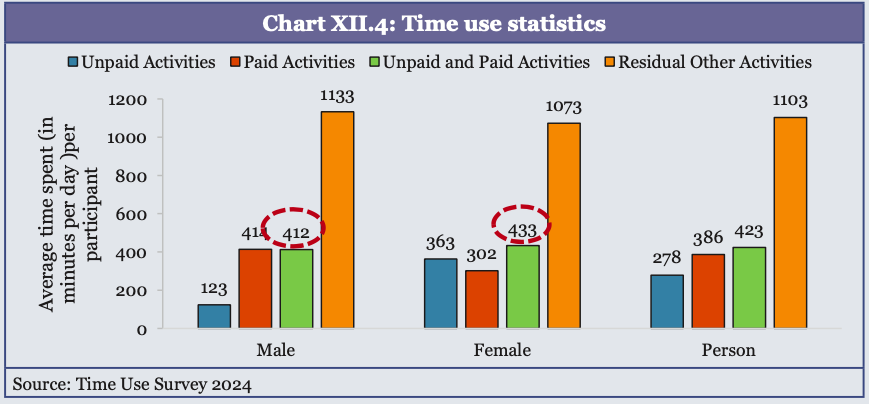
- Estimates suggest that increasing FLFPR to around 55% by the 2050 could be critical for maintaining a high annual GDP growth trajectory. Suggested policy approach-
- Improving access to STEM: PLFS 2023-24 indicates that women aged 25 years and above with advanced degrees constitute only 2.9% of employed female workforce in rural and urban areas with less likelihood of pursuing STEM (Science, Technology, Engineering, and Mathematics) fields.
- Improving urban mobility: Women tend to choose safer but more expensive modes of transport for security reasons, a phenomenon known as the 'Pink Tax.
- Affordable Housing for working women: E.g., Sakhi Niwas scheme of Ministry of Women and Child Development; Tamil Nadu's Working Women's Hostels Corporation ('Thozhi Hostels'), etc.
- Care economy: Professionalising care work can generate formal employment for women.
- Skill development: E.g., 'Back to Work' and 'Returnship programmes' for women with career breaks can bridge re-entry barriers.
- Flexibility in employment: Newly enacted Labour Codes allow women to work from home (Section 59(5), Code on Social Security 2020) after availing maternity benefit (Section 60, Code on Social Security 2020).
- Public-private partnership: E.g., Telangana's WE-Hub connects women with start-up ecosystems; Kerala's Kudumbashree; Maharashtra's Mahila Arthik Vikas Mahamandal, etc.
Ministry of Statistics and Programme Implementation's Time Use Survey, 2024
|
Unorganised Workforce
- e-Shram portal registered over 31 crore unorganised workers, marking an advancement towards formalisation with 54% registrants being women. (January, 2026)
- e-Shram portal serves as National Database of Unorganised Workers, with data on construction workers, migrant workers, gig and platform workers, street vendors, domestic workers, and agriculture workers.
- National Career Service (NCS), launched in 2015, has over 5.9 crore registered job seekers and 53 lakh job providers across diverse sectors and mobilising approximately 8 crore vacancies, recording over a 200% increase in job vacancies in FY24 compared to FY23.
Employment in the Organised Manufacturing Sector
- Annual Survey of Industries FY24 shows a 6% YoY increase in employment over previous year in manufacturing translating to additional 10 lakh jobs in FY24 compared to FY23.
- Sector added more than 57 lakh jobs over the past decade, between FY15 and FY24, with a compound annual growth rate (CAGR) of 4%.
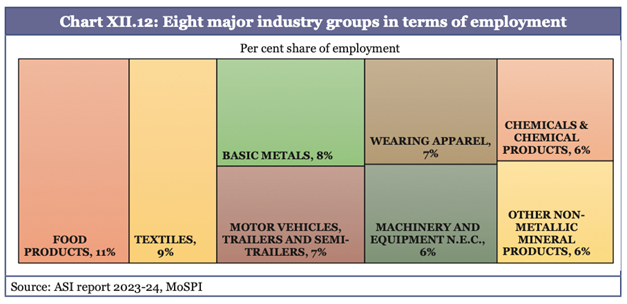
- Seven states contributed to around 60% of total employment in manufacturing sector with Tamil Nadu (15%) followed by Gujarat (13%), Maharashtra (13%), etc.
Jobs in the unincorporated sector
- Unincorporated non-agricultural sector comprises a total of 7.9 crore establishments, employing 12.9 crore individuals.
- Share of working owners among total employed workers increased from 58.9% in 2023-24 to 60% in Q2 FY26, indicating a shift towards self-employment and entrepreneurial activities.
- Rural workforce stood at 6 crore in Q2 FY26, indicating contribution of unincorporated enterprises to rural economic activities.
- Additionally, women represent 28.7% of the workforce in the sector.
Boosting Manufacturing Workforce Participation
- Labour, crucial to the sector's expansion saw 11.4% of total employment in manufacturing sector in 2023-24.
- About 1.9 crore persons are employed in organised manufacturing sector, while about 3.3 crore persons are employed in unorganised manufacturing sector.
- Ways to Boost Workforce Participation:
- Mental well-being: Through Buddies trained in basic cognitive-behavioural techniques.
- Financial well-being with earned wage access (EWA): For immediate short-term liquidity needs.
- Physical well-being through sexual and reproductive health (SRH) awareness.
Catalysing Job Growth
- Four Labour Codes: Code on Wages 2019, Industrial Relations Code 2020, Code on Social Security and Occupational Safety, Health and Working Conditions Code 2020 consolidated 29 central laws.
- Benefits:
- Introduced formal recognition for gig workers (CSS) (Sections 2(35) & 2(60)).
- Mandatory appointment letters for all (Occupational Safety, Health and Working Condition Code,2020).
- Portable social security for migrant workers (CSS).
- Equal benefits (including gratuity and leave after one year) for fixed-term and contract workers.
- Minimum wage, and timely payments, and national floor wage (Code on wages, 2019).
Economics of the Labour Codes
Impact of Consolidation of Labour Codes:
- On FLFPR: Fewer restrictions correlate with a Lower Female Unemployment Rate.
- On formalisation: Implementation of labour could increase formalisation to 75.5% from 60.4% (SBI).
- On employment: Offers medium term employment gains of 1.0–2.2% in organised sector;
- Social Security expansion: CSS mandates aggregators' contribution to 1-2% of annual turnover to fund life/health insurance, and pensions for gig workers, covering 2.35 crore workers by 2030;
- On incomes and growth: Overcome income volatility and benefit gaps contributing 1.25% to GDP by 2029-30.
Gig Economy and Informal Workforce dynamics
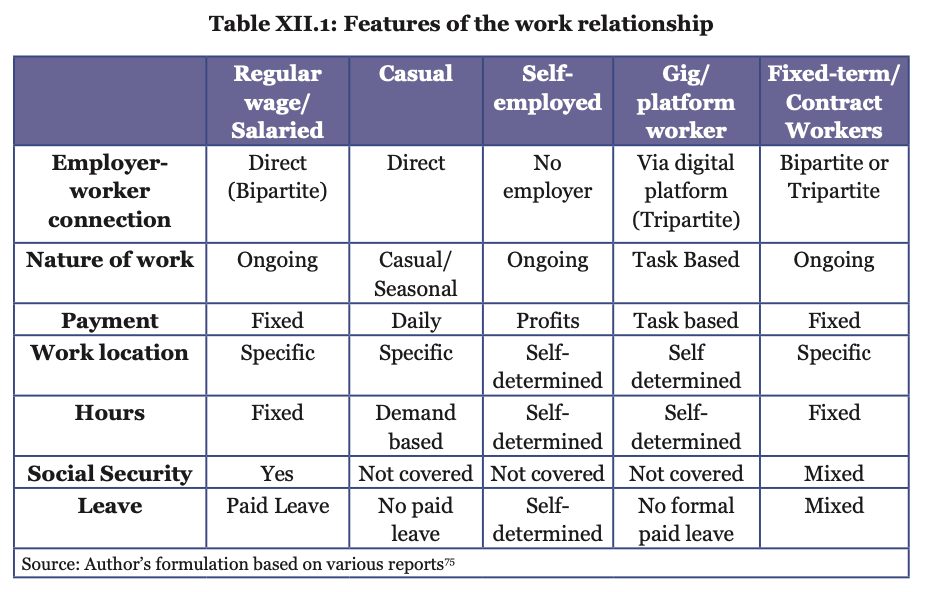
- India saw structural growth transitioning informal jobs into ecosystem -integrated roles.
- From 77 lakh workers in FY21, sector witnessed a 55% increase to 120 lakh workers in FY25, driven by smartphone penetration among over 80 crore users and 15 billion UPI transactions per month.
- Now representing over 2% of total workforce in India, projected to constitute 6.7% by 2029-30, contributing ₹2.35 lakh crore to GDP.
- Key Challenges:
- Low Financial inclusion due to thin-file credit access;
- Control by Platform algorithms;
- Limited skilling and fear of job loss due to Artificial Learning and Machine Learning;
- Code on Social Security (CSS) provides legal acknowledgement however it treats them as a homogenous group who in practice are segmented by skill.
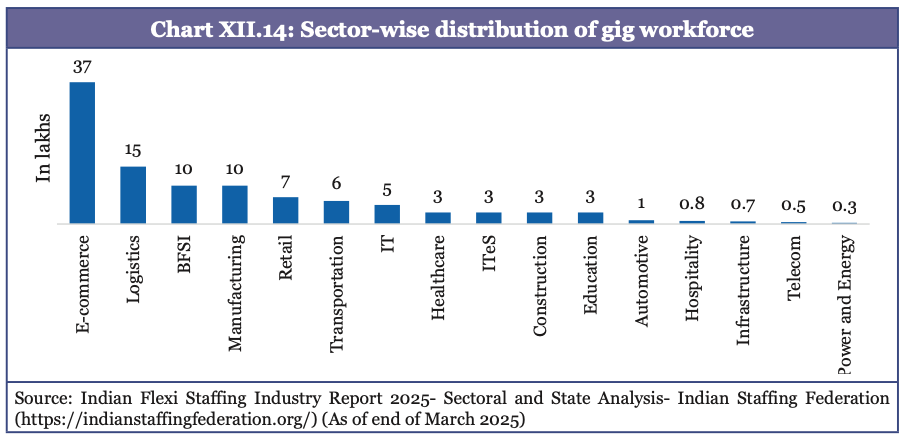
- Share of high-skilled gig workers is expected to be 27.5% by 2030, while for low-skilled workers, it is projected to be 33.8% by 2030. (NITI Ayog).
- Global Regulations Concerning Gig Economy: Spain's 'ley rider' recognising food courier workers as employees; European Union Platform Workers' Directive (2024); In 2025, ILO initiated formal discussions on establishing international standards for decent work in platform economy.
Skill Ecosystem Overview
- As per PLFS 2023-24, share of individuals (15–59 age group) having acquired some form of vocational or technical training has increased from 8.1% in 2017-18 to 34.7% in 2023-24.
- Only 4.9% of youth (15-29 age group) received formal vocational or technical training, while 21.2% received training through informal sources.
- 12% increase in skilled workforce through investment in formal skilling could cause more than 13% increase in employment in labour-intensive sectors by 2030.
- Skill India Digital Hub of Ministry of Skill Development and Entrepreneurship provides a centralised information hub for all government initiatives on a single portal.
Skilling Strategies for Youth
- India experiences a skill mismatch due to weak foundational skills, mismatch between industry needs and training provided, and inability to adapt to emerging technologies.
- PARAKH Rashtriya Sarvekshan 2024 findings show that only 47% of schools offer skill- based courses at grade IX and above with low participation (29%).
- Key Reforms:
- National Credit Framework (NCrF) enabling transfer of credits across academic, vocational, and work-based learning routes.
- Operationalisation of multiple entry-exit provisions: Allowing learners to re-enter higher education with prior credits.
- SWAYAM Plus: Facilitated delivery of industry- aligned digital courses in emerging areas such as artificial intelligence, data analytics, and robotics.
- National Apprenticeship Training Scheme (NATS) 2.0: Scaled apprenticeship support through over 12 lakh DBT stipend transfers.
Early Vocational Education for transforming India's skilling landscape
- Early Vocational Orientation: E.g. China's post-lower- secondary bifurcation into general and vocational tracks, etc.
- Dual/Hybrid models: Integrating school- based instruction with workplace training. E.g., In Switzerland where adolescents alternate between three to four days of apprenticeship and one to two days of classroom learning.
- Extensive industry participation with employers contributing to curriculum design.
- Flexible Education Routes like Korea's 'Job First, University Later' model, etc.
- Indian State level initiatives: Strengthening Teaching-Learning and Results for States (STARS) programme of World Bank, Madhya Pradesh's Skill GPS app, Rajasthan's Comprehensive Career Education Programme, and Maharashtra's Career Portal; Kerala's ESTEEM initiative, etc.
- Central Government: Vocationalisation of School Education scheme under Samagra Shiksha scheme aligned with National Education Policy (NEP) 2020; NCERT Kaushal Bodh textbooks, etc.
Future-ready workforce through apprenticeships
|
Supply-driven to Industry-driven Skilling
- PMKVY 4.0, training is imparted in NSQF-aligned job roles developed by industry-led Sector Skill Councils (SSC), with several courses being delivered directly within industrial premises.
- Mechanisms like Flexi-MoU scheme: Allows firms to customise training and introduce courses aligned with their evolving skill needs.
- Complementing firm-led training models: Strengthening Industry and market linkages for traditional occupations through PM Vishwakarma Kaushal Samman Yojana.
- As of 1 December 2025, 30 lakh beneficiaries have been registered, out of which 23.09 lakh beneficiaries have been trained.
- Upgradation of ITIs: National Scheme for Upgradation of ITIs proposes to upgrade 1,000 government ITIs, including 200 hub ITIs and 800 spoke ITIs, through smart classrooms, modern labs, digital content, and industry-aligned long- and short-term courses.
- Odisha started its skill transformation with Odisha Skill Development Authority (OSDA) in 2016.
- OSDA followed a simple strategy 'Fix, Accelerate, Scale' involving-
- 'fixing' the ITIs by focusing on the perception of vocational education and ITIs;
- 'scaling' the short-term training programmes such as Deen Dayal
- Upadhyaya Grameen Kaushalya Yojana (DDU-GKY); and
- 'accelerating' the setting up of advanced training institutes.
Innovative Financing Mechanisms for skill development
- Direct Benefit Transfer: Under NAPS 2.0, government transfers 25% of the prescribed stipend directly to apprentices through DBT enhancing transparency.
- As of 31 October 2025, amount of ₹1,110.64 crore has been released as stipend support directly to apprentices.
- Modified Credit Guarantee Fund Scheme for Skill Development (CGFSSD): Operationalised as Model Skill Loan Scheme in 2024, to strengthen the credit-based route for skill acquisition by increasing maximum loan limit and expanding pool of eligible lending institutions.
- Outcomes-based Financing: Complementary approach to mobilising private capital while retaining public accountability.
- E.g., India's Skill Impact Bond (SIB), implemented by MSDE.
- Co-Investing in training: Through mandatory or voluntary contributions by employers. Already used in a number of countries
- Role of Employers: E.g. Ireland's Skillnet training networks bring together private firms to undertake collaborative training activities. In India, employers support workforce training.
Alternative Finance Instrument: Skill Vouchers
|
From challenges to accountability via skilling scorecard
- Key Challenges: Weak foundational skills like literacy, numeracy, and soft skills; inadequately aligned local skills with industry needs; infrastructure gaps; scheme implementation challenges like PMKVY; etc.
- Enforcing Accountability: Comprehensive evaluation of skilling system; third party assessment of flagship schemes like PMKVY; Integration of SIDH, NCS, and e-Shram portal; Outcome-linked financing, comprehensive data driven scorecard system, etc.
Outlook
- Measures like deregulation, GST 2.0, and labour reforms implemented by states have contributed to rising labour force participation and employment growth.
- It further requires advancing institutional convergence and whole-of-government approach.
- Development of information system that brings together data from e-Shram on unorganised workers, NCS on job vacancies, and SIDH on training opportunities, etc.
What does the Budget say?
- Government aims to train 1.5 lakh caregivers in coming year with training programs aligned to National Skills Qualifications Framework (NSQF).
- Budget targets Animation, Visual Effects, Gaming, and Comics (AVGC) industry with the intent to establish AVGC Content Creator Labs in 15,000 secondary schools and 500 colleges.
- New National Institute of Design to be established in eastern region of India to address the shortage of Indian designers.
- Corporate Mitras or accredited para-professionals will help MSMEs meet compliance requirements at affordable costs.
- Government proposes the establishment of a High-Powered 'Education to Employment and Enterprise' Standing Committee to identify sub-sectors with high potential.
Glossary
| Unemployment Rate (UR) | Percentage of persons unemployed among those in the labour force. |
| Current Weekly Status (CWS) | Activity status determined based on reference period of last 7 days preceding the survey date. |
| Labour Force Participation Rate (LFPR) | Percentage persons in labour force (i.e. working/seeking/available for work) in the population.
|
| Pink Tax |
|
| Unorganised Workers | Code on Social Security, 2020 (CSS) defines them as home-based, self-employed or wage workers in unorganised sector and includes a worker in organised sector not covered by Industrial Disputes Act, 1947. |
| Gig Workers | Short-term, task-based or project-based work carried on a freelance or independent basis, often mediated through digital platforms. |