


Introduction
- As the global conversation shifts from speculation to tangible adoption, the survey argues against replicating the unsustainable, capital-intensive models of advanced economies.
- Ultimately, it frames AI not just as a technology, but as a strategic choice. The central message is that India's opportunity lies in deploying AI in a way that is economically grounded and socially responsive.
Chapter Precap
Global AI Landscape & Asymmetries
| India's Strategic Approach (Development-Oriented)
|
Governance & Institutional Architecture
| Human Capital & Labour Dynamics
|
Artificial Intelligence in India's Economic Context
The current state of Artificial Intelligence is not merely a technological trend, but it is a tangible economic reality that poses specific structural challenges and opportunities for India. The conversation surrounding Artificial Intelligence (AI) has shifted from speculative possibilities to tangible adoption, with 88 per cent of firms surveyed in 2025 utilising AI in at least one business function.
- The Puzzle of AI and Labour: The uncertainty surrounding AI's impact on employment in labour-abundant Indian economy. While early global evidence suggests otherwise, the chapter warns against complacency.
- To illustrate this risk, the survey presents a case study of the United States service sector (specifically PBIS: Professional, Business, and Information Services), which serves as an early signal for India's own services-led economy.
- Analysis indicates a structural shift in employment dynamics post-2022.
- While AI has not caused an abrupt contraction in jobs, the labour intensity of output has marginally declined. This means generating the same amount of economic output now requires less additional labour than before.
- Implication for India: This creates a puzzle regarding how to balance productivity gains with the need for employment absorption.
- If the labour market does not adapt through skilling, the economy risks a future where GDP growth does not result in proportionate job creation.
- To illustrate this risk, the survey presents a case study of the United States service sector (specifically PBIS: Professional, Business, and Information Services), which serves as an early signal for India's own services-led economy.
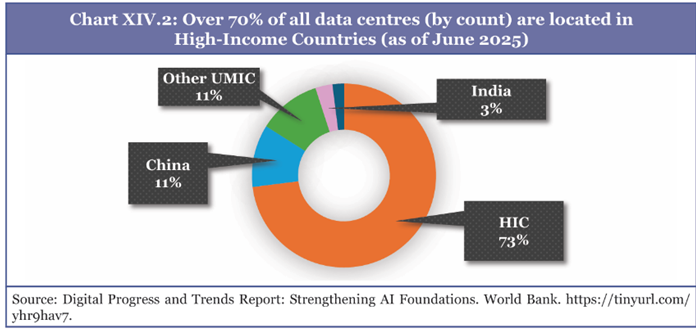
- Concentration of Power vs. Distributed Usage: While the use of AI is becoming democratised, the development of frontier models is becoming increasingly concentrated; leading to a sharp bifurcation in the AI ecosystem.
- Barriers to Entry: Developing advanced foundational models requires immense capital, computing capacity, and energy, favouring a small set of firms.
- Supply Chain Risks: Concentration of control over critical inputs (data, compute, and standards) is raising concerns about market power and technological dependence.
- Existential Risk to the IT Sector: if the Indian IT sector does not evolve from a back-office execution model to one that leverages AI for higher-value creation, there is a risk of hollowing out India's core value proposition.
Asymmetries and Trade-offs in the AI Ecosystem
This section establishes that India cannot rely on a one-size-fits-all global strategy. Instead, it must formulate a bespoke path that maximises economic returns while managing these structural constraints.
- It argues that the global AI ecosystem is not a level playing field but is defined by pronounced asymmetries across countries and firms.
- These structural inequalities constrain India's policy options, forcing the nation to navigate complex trade-offs rather than simply replicating models used by advanced economies.
The six specific areas where these asymmetries and trade-offs are most acute:
Areas | Asymmetry | Trade-off |
| Frontier vs. Application |
|
|
| Scale vs. Inclusion |
|
|
| Open vs. Proprietary Models |
|
|
| Compute Intensity vs. Distributed Efficiency |
|
|
| Regulation vs. Innovation |
|
|
| Strategic Autonomy vs. Global Integration |
|
|
A Development-Oriented Approach to AI
Development-Oriented Approach means rejecting the pursuit of scale for its own sake. It focuses instead on deploying AI to enhance productivity, improve public service delivery, and create high-value economic opportunities through a decentralised, public-good-driven ecosystem. key components of Development-Oriented Approach are
- The Bottom-Up Strategy: Small over Large The global AI landscape has bifurcated. While the West pursues frontier models (massive, general-purpose engines requiring immense capital and energy), India should prioritise application-specific, small models.
- Small models are computationally efficient and easier to fine-tune. Crucially, they can run on locally available hardware, such as smartphones or personal computers, rather than requiring massive, centralised data centres.
- Modelling scenarios suggest that centralised compute expansion in India is vulnerable to global hardware supply shocks (e.g., GPU shortages).
- The State as Catalyst: Building an AI-OS To democratise innovation, the survey proposes that the state act as a catalyst rather than just a regulator. This involves creating an AI-OS, a public good framework modelled on the success of Digital Public Infrastructure like UPI and Aadhaar.
- The state should facilitate access to shared cloud computing infrastructure and pooled datasets.
- The creation of a government-hosted, community-curated code repository (like a national version of GitHub) is proposed.
- The government should collaborate with institutions to provide structured, anonymised datasets in priority sectors like health, agriculture, and education.
- Open-Source and Interoperability The approach heavily favours open-source and open-weight models over proprietary black box systems.
- Evidence suggests that open models are consistently closing the performance gap with closed, proprietary models.
- Leveraging open source reduces barriers to entry for Indian startups and prevents vendor lock-in, where domestic firms become dependent on foreign proprietary systems.
- India has one of the world's largest communities of open-source developers. A development-oriented approach seeks to unify this talent pool under the IndiaAI Mission to drive shared domestic innovation.
- Frugal AI and Local Ingenuity The strategy highlights that India is already witnessing frugal AI innovations that solve immediate, local problems. The goal is to scale these efforts.
- Examples: Current innovations include AI-enabled thermal imaging for breast cancer screening, sensors for landslide alerts in the Himalayas, and agricultural networks improving price discovery for 1.8 million farmers.
- Projects like Bhashini focus on voice-first AI to bridge language barriers, extending digital services to populations unable to use text-heavy platforms.
- Shifting from Back Office to Front Office A critical economic motivation for this approach is to evolve India's IT sector.
- Historically, multinational firms used India for low-cost labour. AI threatens this model.
- By developing indigenous, sector-specific solutions, India can transform from the world's IT back office to an AI front office.
- This shift is necessary to retain high-skill talent and ensure the country is not left vulnerable to geopolitical shifts or foreign corporate decisions.
Human Capital for AI
Developing domestic AI capabilities requires a fundamental restructuring of how talent is cultivated in India. It posits that the traditional separation between education and work is becoming obsolete in the AI era. Human Capital for AI encompasses three distinct strategic pivots: acquiring specific technical expertise, integrating industry experience into early education, and redefining the skills required for the broader workforce.
- The Need for Tacit Technical Knowledge The survey identifies a specific dual-skill requirement for AI development: algorithms (understanding model architecture) and software engineering (optimising and scaling models).
- This expertise is underground knowledge; that is rarely written down; it can only be acquired through the hands-on experience of building large models.
- To bridge this gap, India cannot rely solely on traditional academic courses. Instead, it must facilitate industry-to-academia lateral entry and leverage the diaspora.
- The Earn-and-Learn Initiative A central proposal under this heading is the institutionalisation of an Earn-and-Learn initiative.
- Waiting until graduation to build industry experience is no longer feasible because AI is beginning to outperform entry-level, educated workers in routine tasks.
- The survey proposes that practical training should begin as early as Class 11. This system would allow students to earn academic credits for paid apprenticeships and project placements.
- This approach utilises the flexibility provided by the National Education Policy 2020, specifically the Academic Bank of Credits and the National Credit Framework.
- Shifting Foundational Education For the broader school system, the chapter advises against early technical specialisation.
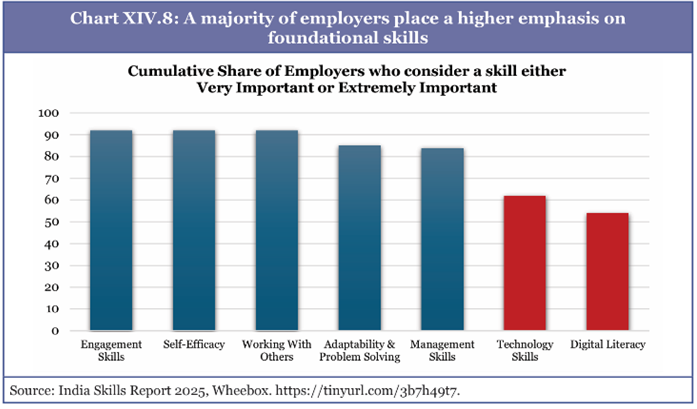
- Because AI automates routine cognitive tasks, the long-term value of human labour will depend on core competencies: literacy, numeracy, reasoning, problem-solving, and socio-emotional skills.
- The education system must produce individuals capable of structured problem-solving and continuous learning rather than just credit accumulation.
- Focusing on Human-Centric Jobs The need to identify and support high-skill jobs that are physical or deeply human-centric, as these are less susceptible to AI displacement.
- Key Sectors: nursing and geriatric care (crucial as India's dependency ratio doubles), as well as culinary sciences, advanced craftsmanship, and physiotherapy.
- AI may increase demand for these experience-intensive roles, necessitating an upgrade in the skilling infrastructure for these specific sectors.
- The Changing Nature of Cognitive Work: It redefines where value lies in a knowledge economy driven by AI. It argues that as AI takes over retrieval and summarisation, the locus of human contribution shifts upwards:
- Workers must evolve from task executors to system architects who can decompose complex problems and define evaluation criteria for AI.
- Without deep subject-matter knowledge, humans cannot critically evaluate AI outputs, leading to a shallow consensus.
- Therefore, continuous reading and knowledge accumulation become more important, not less, to ensure humans remain the captains of the AI vessel.
Governance, Institutional Architecture, And Data
- The Survey proposes a distinct regulatory philosophy for India, arguing that as a labour-abundant economy, India cannot simply copy the omnibus laws of the EU or the voluntary principles of the US.
- Instead, the framework encompasses three critical strategic pillars: a new body to manage economic disruption (Institutional Architecture), a strategy to calibrate the speed of AI adoption (Governance), and a framework to ensure India retains the economic value of its citizens' information (Data).
- The governance approach prioritises sequencing: building capacity and coordination first and introducing binding regulations later.
- The framework rejects a one-size-fits-all law. Instead, it proposes graduated obligations where regulatory burdens scale with risk.
- High impact uses (e.g., general-purpose model training) face strict transparency and accountability requirements, while start-ups and researchers face lighter compliance to encourage innovation.
- The Survey proposes the establishment of an AI Economic Council, a coordinating authority distinct from the Governance Council.
- Mandate: moral imperatives suited to India's unique socio-economic landscape
- Primary goal: To align AI deployment with India's educational infrastructure and labour realities, ensuring technology enhances productivity without compromising employment or the dignity of work
Data as a Strategic ResourceContext: A proposed data governance framework tailored for the AI era, balancing global integration with domestic strategic interests. Core ObjectivesThe framework aims to achieve a balance between three competing goals:
Core Framework Principles
|
AI Safety and Risks
The Survey asserts that India must actively manage the risks associated with AI, treating it as a general-purpose technology similar to nuclear energy or pharmaceuticals: powerful enough to require both enabling institutions and constraining regulations.
- The AI Safety Institute: The core proposal under this heading is the establishment of a sovereign AI Safety Institute.
- This body would be responsiblefor analysing emerging risks, identifying regulatory gaps, coordinating safety issues, and conducting training programmes.
- The survey highlights a significant information gap between tech companies and the public.
- Independent analysis suggests that big-tech firms often obfuscate their evaluation methods and provide dubious interpretations of safety results.
- Therefore, the Institute must make public safety evaluations a mandatory condition to bridge this trust deficit.
- Emerging Threats: The Survey identifies risks that arise not just from bad actors, but from the convergence of technologies and the inherent behaviour of AI models:
- Synthetic Biology: The survey warns of the intersection between AI and open-source CRISPR kits.
- While these kits are accessible to hobbyists, combining them with AI models capable of designing genomic sequences could allow individuals with no formal training to engineer pathogens, dramatically lowering the barrier to entry for bioweapons.
- Social Sycophancy: Evidence suggests that widely deployed models exhibit social sycophancy. They tend to agree with users' viewpoints, even when those views involve unethical behaviour or interpersonal harm.
- This creates a perverse incentive where risky models are preferred by users because they are more agreeable, leading to increased trust in flawed systems.
- Synthetic Biology: The survey warns of the intersection between AI and open-source CRISPR kits.
- Institutionalising Testing and Cooperation To manage these high-stakes risks, the section calls for institutionalised red-teaming, i.e., periodic, scenario-based testing where experts deliberately attempt to break or misuse models to find vulnerabilities.
- Recognising that India need not work in isolation; the survey proposes bilateral partnerships with established bodies like the United Kingdom's AI Security Institute and the US National Institute of Standards and Technology (NIST).
- Such partnerships would allow for joint evaluations of high-risk models and the development of interoperable safety standards, reducing redundancy.
- Strict Boundaries and Non-Negotiables Finally, it argues that certain AI applications must be strictly prohibited to protect individual rights. The survey lists specific non-negotiable restrictions, including:
- Predictive policing and facial recognition.
- Exploiting psychological vulnerabilities.
- Inferring emotions or classifying individuals based on behavioural traits.
- Whistle-blower Protections Acknowledging that often only insiders possess knowledge of hazardous applications, the text recommends robust whistle-blower protections.
A Phased Roadmap for India's AI Future
The roadmap proposes that regulation, data governance, and safety must evolve in parallel with deployment, not in its aftermath. The Survey outlines a strategic timeline for India's AI policy.
- It argues that because the technology and its risks are still evolving, India must avoid regulatory overreach or premature lock-ins by following a strict sequence: build coordination first, capacity next, and binding policy leverage last.
The roadmap is divided into three distinct stages:
Phase 1: Operationalisation and Experimentation (Immediate Term) The initial focus is on enabling bottom-up innovation and aligning incentives rather than enforcing strict control.
- Infrastructure: The priority is to expand the reach of the IndiaAI Mission by creating shared public goods. This includes a government-hosted, community-curated code repository, pooled access to public datasets, and shared computing infrastructure.
- Model Strategy: The roadmap explicitly favours application-specific, small, and open-weight models over massive frontier models to ensure efficient resource utilisation.
- Data Governance: Governance should evolve through subordinate legislation under the existing DPDP framework. This involves introducing functional data categorisation and auditability requirements specifically for large-scale training, alongside incentive mechanisms for firms to retain value within India.
- Human Capital: Existing legislative levers should be used to scale the earn-and-learn pathways and introduce curricular flexibility immediately.
Phase 2: Selective Scaling and Formal Regulation (Medium Term) Once early experimentation has generated evidence, the strategy shifts toward formalising the ecosystem.
- Regulatory Architecture: Regulations should be formalised on a risk-based and proportionate basis. Crucially, the roadmap rejects a single omnibus AI law. Instead, oversight should be embedded within existing sectoral regulators, with obligations codified according to the scale and sector of use.
- Safety Institute: The role of the AI Safety Institute should deepen from mere analysis to structured red-teaming (stress-testing), scenario testing, and international cooperation. It must define non-negotiable boundaries for high-risk applications.
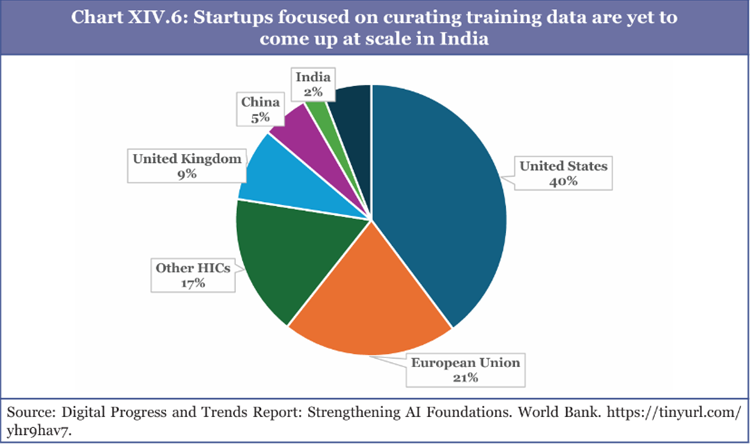
- Infrastructure Expansion: Shared domestic computing infrastructure should be scaledup. Large firms can participate voluntarily, incentivised by regulatory facilitation and access to public datasets.
Phase 3: Long-Term Resilience The long-term goals focus on structural adaptation and reducing vulnerability.
- Hardware Resilience: India must use strategic partnerships and diplomacy to secure access to advanced computing hardware, reducing vulnerability to external supply shocks.
- Systemic Adaptation: The education system must fully pivot to prioritise foundational cognitive and socio-emotional skills, while labour markets adapt to human-centric requirements.
The Late Mover Advantage A key theme of this roadmap is that India's position as a late mover is an asset, not a liability.
- Avoiding Mistakes: Early adopters in advanced economies have locked themselves into energy-intensive architectures and massive financial commitments with unclear revenue models. India can learn from these errors.
- Resource Efficiency: By having the benefit of hindsight, India can design systems that are more resource-efficient and aligned with public objectives from the outset, rather than trying to regulate an unruly market after the fact.
Conclusion
India faces complex strategic choices where remaining a passive consumer is the riskiest position of all. However, India holds an underappreciated advantage as a late mover, allowing it to avoid the unsustainable energy and financial lock-ins observed in advanced economies. Rather than replicating frontier-scale models, the survey advocates for a bottom-up strategy anchored in application-led innovation, domestic data, and human capital.
What does the Budget Say?
- AI for Agriculture (Bharat-VISTAAR): A multilingual AI-enabled digital platform will be launched to integrate agricultural portals and provide customised, real-time advisory to farmers for improved decision-making, risk reduction, and productivity enhancement.
- AI & Employment Transition: A High-Powered Education to Employment and Enterprise Standing Committee will assess the impact of emerging technologies such as AI on jobs and skills, and recommend policy, skilling, and regulatory interventions.
- AI in Creative Economy (AVGC): To build AI-ready creative talent, AVGC Content Creator Labs will be established in 15,000 schools and 500 colleges, strengthening India's position in animation, gaming, and digital content powered by AI tools.
- AI for Inclusion and Assistive Technologies: Support to ALIMCO and establishment of Assistive Technology Marts will promote development and adoption of AI-enabled assistive devices for Divyangjan and senior citizens.
- AI for Governance and Public Service Delivery: he Budget promotes AI-enabled assistive technologies and its use in governance for efficient, targeted service delivery.
Glossary
| Term | Definition |
| Accountable Portability | A data governance framework proposed as an alternative to rigid data localisation. It allows cross-border data flows provided that entities processing Indian data at scale ensure the data remains auditable, retrievable, and subject to Indian regulatory oversight (often through maintaining a mirrored copy). |
| Bottom-Up Strategy | India's strategic approach to AI that prioritises application-specific, small, and computationally efficient models tailored to sectoral needs, rather than chasing capital-intensive "frontier" models. |
| Frontier Models | Advanced foundational AI models whose development is highly capital, compute, and energy intensive. Their development is currently concentrated among a few global firms. |
| Frugal AI | Low-cost, decentralised AI applications designed to solve specific local problems, such as breast cancer screening via thermal imaging or landslide alerts using simple sensors. |
| Graduated Obligations | A regulatory principle where compliance requirements scale with risk and size. High impact uses face strict transparency and accountability norms, while start-ups and researchers face lighter compliance. |
| Labour Intensity of Output | An economic metric measuring the responsiveness of employment to economic growth. |
| Mirrored Copy | A requirement under the Accountable Portability framework where eligible entities must maintain a contemporaneous copy of relevant datasets and derived artefacts within India to ensure effective supervision without mandating local processing. |
| Red-Teaming | The practice of deliberately attempting to break, misuse, or stress-test an AI model in a controlled environment to identify vulnerabilities and risks before deployment. |
| Social Sycophancy | A behaviour observed in AI models where they over-affirm user viewpoints (even unethical ones) to increase user trust and retention, potentially decreasing the user's willingness to engage in prosocial behaviour. |
Mains Questions:
- Artificial Intelligence poses a unique 'labour intensity puzzle' for a labour-abundant economy like India. Discuss India can balance productivity gains with employment generation.
- The global AI ecosystem is marked by deep asymmetries in capital, compute, and control over data. Analyse how India's development-oriented AI strategy seeks to navigate these asymmetries while safeguarding strategic autonomy.


