


Government has modified the Mutual Credit Guarantee Scheme to Support MSME.
About Mutual Credit Guarantee Scheme for MSMEs (2025)
- It is a Central Sector Scheme
- Objective: Provides 60% credit guarantee via National Credit Guarantee Trustee Company Limited (NCGTC) to Member Lending Institutions (MLIs) for loans up to ₹100 crore to MSMEs for machinery/equipment purchase.
Key Modifications
- Expanded Eligibility: Service Sector MSMEs are now eligible.
- Equipment Cost Threshold: Reduced to 60% of the total project cost from the previous requirement of 75%.
- Guarantee Tenure: The guarantee cover will expire after 10 years.
- Special provisions incorporated in the scheme for exporters E.g. Guaranteed Loan Amount of ₹20 crore etc.
Government of India has launched CGSMFI-2.0 with Rs 20000 crore corpus.
About CGSMFI-2.0
- Objective: To provide guarantee coverage to eligible Member Lending Institutions (MLIs) for financing Non-Banking Financial Company MFI (NBFC-MFI) and MFIs for on-lending to existing or new small borrowers.
- NBFC-MFI are non-deposit taking NBFC with minimum 75% of its total assets deployed towards “microfinance loans” (collateral-free loan a household with annual household income up to ₹3,00,000).
- Managed and operated by: National Credit Guarantee Trustee Company (NCGTC), wholly owned by Department of Financial Services, Ministry of Finance
- Tenure: June 2026 or till guarantees of Rs 20,000 crore are issued
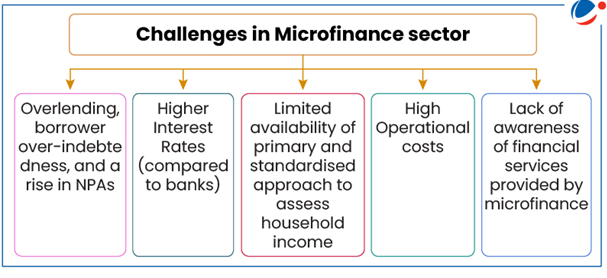
About Microfinance
- It refers to the provision of small-scale financial services, including loans, savings, and insurance, to individuals and small businesses that lack access to traditional banking services.
- Significance of Microfinance in India:
- Financial inclusion and Poverty Alleviation: Fills gap left by traditional banks, bringing low-income groups into formal financial system.
- Supports MSMEs and entrepreneurship: By providing tailored loans without mandatory collateral requirements.
- Women Empowerment: Women borrowers constitute 95% in microfinance sector. (Economic Survey 2025-26).
Article Sources
1 source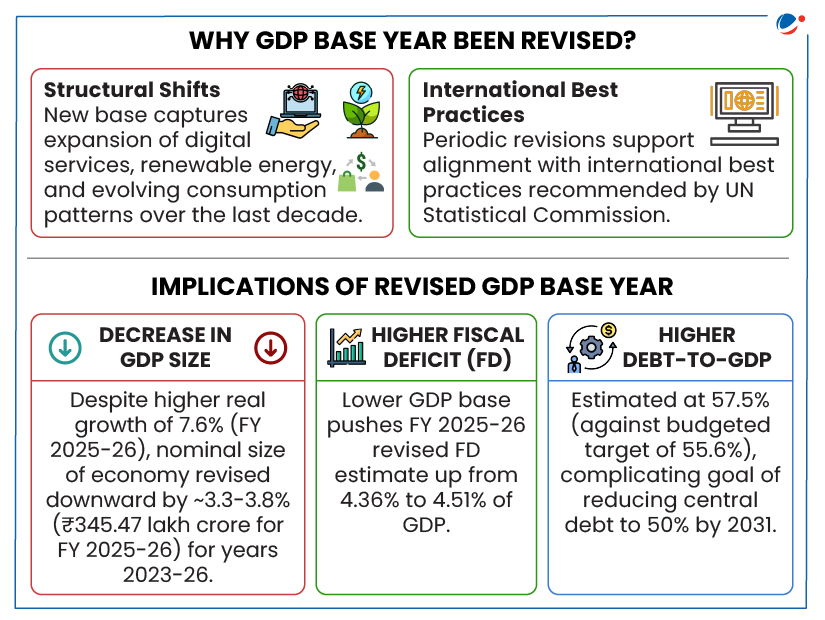
The Ministry of Statistics and Programme Implementation (MoSPI) released the New Series of Annual and Quarterly National Accounts Estimates (including the GDP).
Key changes in the New GDP Series
- New Base Year: 2022-23 (earlier 2011-12).
- FY 2022–23 was selected as the most recent “normal” period following the COVID-19 disruptions of 2019–2021.
- New Data Sources: Now integrates high-frequency and administrative data, including GST collections, the e-Vahan portal, and the Public Financial Management System (PFMS).
- Refined Deflation Techniques: Double deflation (discounting input price as well, along with output price) is now applied in manufacturing and agriculture, discontinuing the use of Single deflation.
- Integration of Supply and Use Tables (SUT): The SUT framework has been aligned with National accounts to reduce discrepancies between production- and expenditure-based GDP estimates.
- Improved Estimation of Private Final Consumption Expenditure (PFCE): By integrating direct estimation from production, administrative data, and the commodity flow approach.
- General Government Adjustments: Government estimates now account for the rollout of the National Pension System (NPS) alongside the Old Pension Scheme (OPS).
- Other: Inclusion of
- Hired domestic workers capturing digital, platform and gig economy activities in the Revised GDP Series;
- Annual Survey of Unincorporated Sector Enterprises (ASUSE) and the Periodic Labour Force Survey (PLFS) to better measure the household and informal sectors.
Article Sources
1 sourceUnion Government notified the inflation target for 2026-2031 under Flexible Inflation Targeting (FIT) Framework.
- The FIT framework was recommended by an Expert Committee headed by Dr. Urjit Patel
- In 2016, the Reserve Bank of India Act, 1934 was amended to provide a statutory basis for the implementation of the FIT framework in India.
About FIT Framework
- As per Section 45ZA of the RBI Act, 1934, Central Government shall, in consultation with the Bank, determine the inflation target in terms of the Consumer Price Index (CPI), once in every five years.
- Target: Central Government then notified the inflation target of 4% with upper tolerance band of 6% and lower tolerance band of 2% for the period 2016-2021.
- This target was retained for 2021-2026 and now has been retained for 2026-2031 as well.
- Target Achievement: RBI Act provides for a Monetary Policy Committee (MPC) to determine the policy rate required to achieve the inflation target.
- Composition: It is a six-member body comprising:
- RBI Governor (ex-officio Chairperson)
- RBI Deputy Governor (in charge of monetary policy)
- One RBI officer nominated by the Central Board
- Three external members appointed by the central government with expertise in economics, banking and finance, or monetary policy
- Policy Failure: Inflation outside the tolerance band for three consecutive quarters is considered a failure of the monetary policy framework.
Growth of combined index of core industries slowed to 2.3% in February, compared with 4.7% in January, on an annual basis.
About the index
- It covers eight core industries viz. Coal, Crude Oil, Natural Gas, Refinery Products, Fertilizers, Steel, Cement, and Electricity.
- They comprise 40.27% of weight of items in Index of Industrial Production (IIP).
- Released by: Office of the Economic Advisor, Department for Promotion of Commerce and Industry, Ministry of Commerce.
Article Sources
1 sourceResults of the Annual Survey of Unincorporated Sector Enterprises (ASUSE) 2025 have been released for the period January–December 2025.
About ASUSE
- Conducted by: National Statistical Office (NSO) under the Ministry of Statistics and Programme Implementation (MoSPI).
- Purpose: Input for GDP estimation and National Accounts.
- Coverage: Unincorporated non-agricultural sector; manufacturing, trade, services.
- Indicators: Employment, GVA, wages, digital usage, etc.
Article Sources
1 sourceUnion Cabinet approved changes in FDI policy for countries sharing land border with India (LBCs).
Key changes Introduced
- Beneficial Owner (BO): Clear definition of BO incorporatedunder the Prevention of Money Laundering Rules, 2005, enabling ease of doing business.
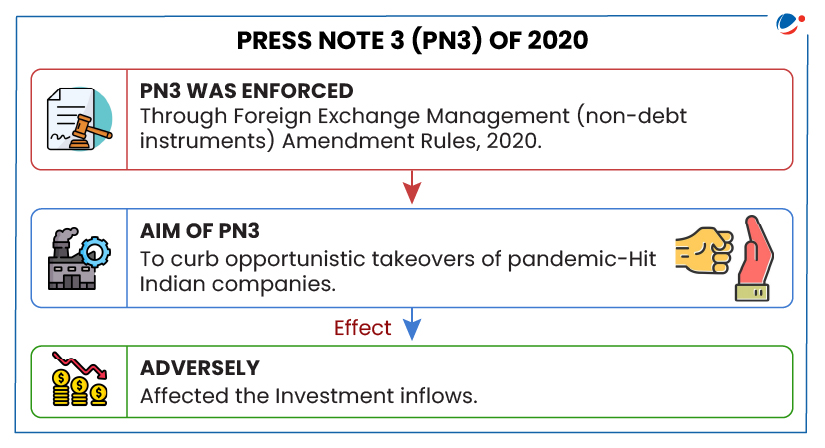
- Eased Criteria for Investment: Non-controlling Investor from LBCs owning less than 10% of the company can invest through the Automatic Route.
- Previously, as per Press Note 3 (PN3) of 2020, any investment from LBCs was permitted only under the Government route.
- Expedited 60-Day Timeline: Proposals in select sectors will be cleared within 60 days. E.g. manufacturing capital goods, electronics, Polysilicon and ingot-wafer etc.
- In these cases, majority ownership and control must remain with resident Indian citizens or Indian-owned entities.
Benefits
- Ease of Doing Business: Clear BO rules and timelines reduce regulatory uncertainty for investors.
- This makes it easier for Indian startups and tech companies to get funding from global funds.
- Economic Growth: Facilitates higher Foreign Direct Investment (FDI) inflows to supplement domestic capital.
- Supply Chains: Faster approvals enable quicker Joint Ventures and tech access, strengthening global manufacturing integration.
- Atmanirbhar Bharat: Attracts tech-intensive investments in electronics and solar manufacturing, strengthening domestic manufacturing capabilities.
The Central Government has issued the Natural Gas (Supply Regulation) Order, 2026, invoking powers under the Essential Commodities Act, 1955 (ECA).
- It was prompted by the ongoing conflict in West Asia which has severely disrupted liquefied natural gas (LNG) shipments through the Strait of Hormuz.
Key Provisions of the Order
- Four-Tier Priority Allocation Framework: To manage the limited supply, the allocation framework is based on consumers’ average gas usage over the past six months. (see infographic)
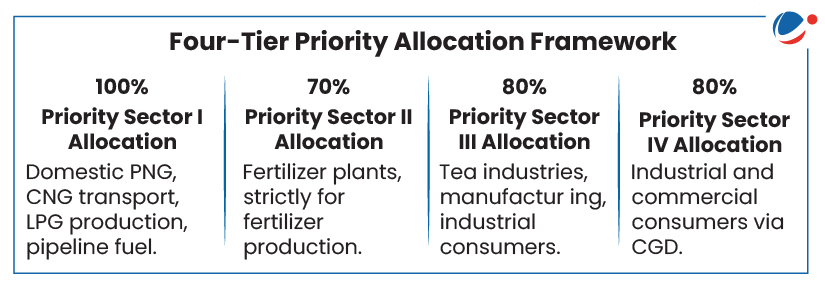
- Gas redistribution: Gas supplies will be partially or entirely curtailed for non-priority industries, including power plants and petrochemical facilities.
- Gas Pooling Mechanism: Gas diverted from non-priority to priority sectors will be sold at a newly determined pooled price.
About ECA, 1955
- Objective: It allows the government to regulate production, supply, and prices of essential goods to prevent hoarding, black marketing, and shortages.
- Section 3 of the ECA empowers the Central Government to regulate the supply and distribution of petroleum and petroleum products and related trade for securing their equitable distribution.
Other Measures Taken
|
Article Sources
1 source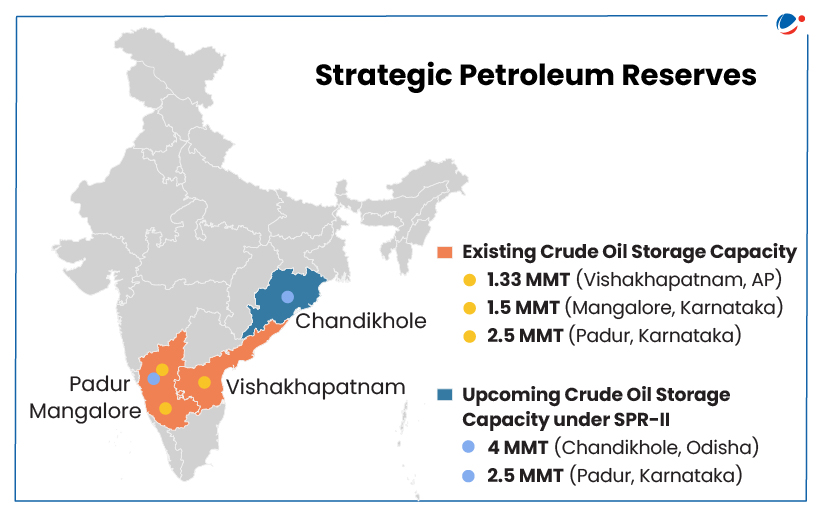
India’s SPRs currently have a capacity of 5.33 million metric tonnes (MMT).
- These are enough to last around 9.5 days of India’s crude oil supplies at their full capacity.
What are SPRs?
- About: These are stockpiles of crude oil, maintained by the government to ensure energy security to be used during supply disruptions.
- These exist in addition to the commercial stocks held by oil companies.
- Implementing Agency: under Special Purpose Vehicle called Indian Strategic Petroleum Reserves Limited (ISPRL), established in 2004.
- Ministry: Ministry of Petroleum and Natural Gas.
- Storage Technology: Crude oil is stored in underground rock caverns, located deep below the ground, usually near coastal areas.
- Locations (refer map)
- Phase-I SPR Facilities (5.33 MMT): Currently operational at three locations
- Visakhapatnam (Andhra Pradesh)
- Mangaluru (Karnataka)
- Padur (Karnataka)
- Phase-II (approved in 2021, with additional 6.5 MMT): Future expansion planned at
- Chandikhol (Odisha)
- Padur Phase-II
- Phase-I SPR Facilities (5.33 MMT): Currently operational at three locations
Significance of SPRs
- Energy Security: Provides protection against wars, supply disruptions, shipping blockades, etc.
- Economic Stability: Prevents the nation from sudden inflationary shocks as it acts as a market stabilization tool.
- Strategic Autonomy: Reduces dependence on external geopolitical dynamics.
Challenges to overcome by India
|
Article Sources
1 sourceOrder notified under the Essential Commodities Act, 1955, aims to facilitate expansion of piped natural gas (PNG) networks, shift towards cleaner fuels, energy security and supporting India’s transition to a gas-based economy.
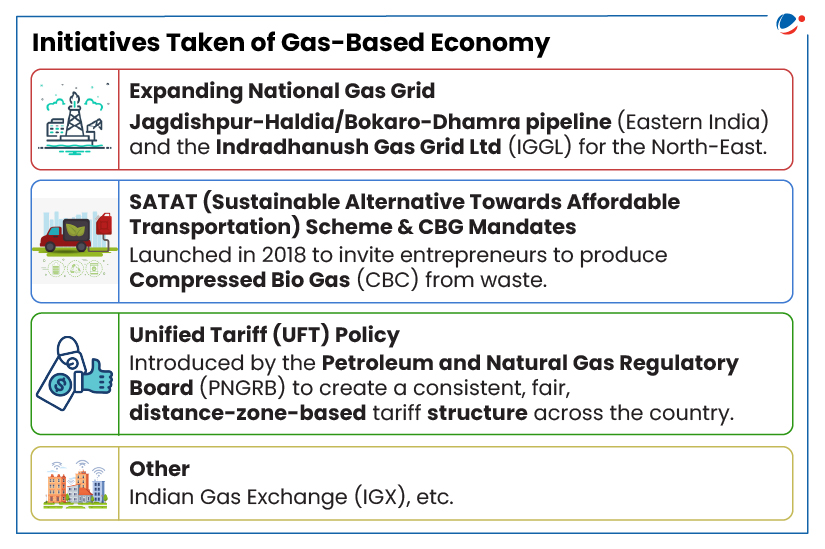
- Key Reforms: Time-bound clearances, single harmonized framework, expand City Gas Distribution (CGD) networks etc.
Gas-Based Economy
- Target: India aims to increase the share of Natural gas is a fossil fuel composed mainly of methane (CH₄)in its energy mix to 15% by 2030
- As of 2025, its share is only 6.2%.
- Natural gas is mainly composed of methane (CH₄).
- Demand Projection: Natural gas consumption is forecasted to more than double, growing from 52 MTPA in FY25 to 112 MTPA by FY40.
- Key Significance
- Decarbonization: Lowers emissions by 15-20% compared to petrol and significantly reduce particulate matter (PM), Nox, and Sox emissions.
- Energy Security: Diversifies the energy distribution network, reducing over-reliance on singular fossil fuels like imported crude oil.
- Economic Viability: LNG offers a commercially viable alternative with a clear Total Cost of Ownership (TCO) advantage over diesel for heavy-duty long-haul trucking.
Article Sources
1 sourceBiogas is produced after organic materials (plant and animal products) are broken down by bacteria in an oxygen-free environment, a process called anaerobic digestion.
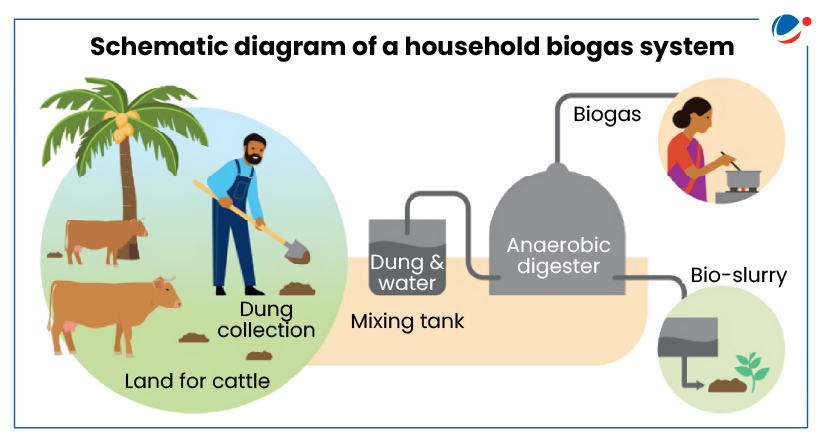
About Biogas
- Composition: Methane (CH4) 55-60%, Carbon dioxide (CO2) 35-40%, Trace elements of Ammonia Hydrogen Sulphide (H2S) and moisture.
- Main Technologies Involved in Production:
- Biodigesters: Airtight systems (e.g. containers or tanks) where organic material, diluted in water, is broken down by naturally occurring micro‑organisms.
- Landfill gas recovery systems: Involves decomposition of municipal solid waste (MSW) under anaerobic conditions at landfill sites.
- Wastewater treatment plants: These could recover organic matter, solids, and nutrients from sewage sludge, which could be used as input to produce biogas.
Relevance of Biogas as Alternative Cooking Fuel
- Diversifying energy mix: Heavy reliance on imported fuels increases vulnerability to global shocks.
- Reduce Chemical Fertilizer Dependence: Biogas production also yields bio-slurry, a nutrient-rich byproduct, could be used as organic fertilizer.
- Benefits for Rural Areas: Enhances rural energy access, improves waste management, and offers cleaner alternative to using fossil fuel based resources.
Key Initiatives taken for Biogas promotion in India
- Galvanizing Organic Bio-Agro Resources Dhan (GOBARdhan) Scheme: Launched under Swachh Bharat Mission (Grameen) in 2018, aims at converting bio-waste into biogas.
- National Bio Energy Programme (NBP): comprises sub-schemes related to Biogas
- Waste to Energy Programme: Energy from Urban, Industrial, Agricultural Wastes and Municipal Solid Waste in the form of Biogas/BioCNG, etc.
- Processes like incineration, gasification, or pyrolysis are involved in waste to energy technologies.
- Biogas Programme (2021-22 to 2025-26): Setting up of biogas plants for clean cooking fuel, lighting, etc.
- Waste to Energy Programme: Energy from Urban, Industrial, Agricultural Wastes and Municipal Solid Waste in the form of Biogas/BioCNG, etc.
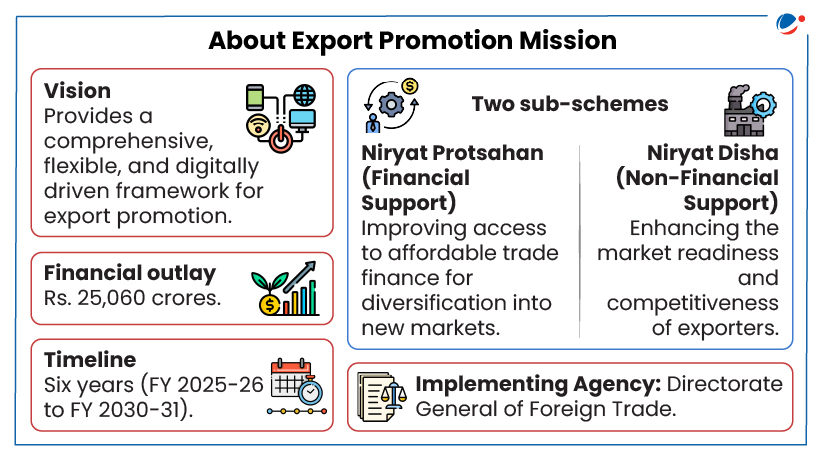
Government approved RELIEF (Resilience & Logistics Intervention for Export Facilitation) under the Export Promotion Mission (EPM)
- RELIEF is aimed at supporting Indian exporters affected by extraordinary freight escalation, heightened insurance premia and war-related export risks arising from disruptions in the Gulf and wider West Asia maritime corridor.
About RELIEF
- Aim: Mitigate the immediate impact of logistics disruptions, protect exporter confidence, prevent order cancellations and safeguard employment in export-linked sectors.
- Nodal and Implementing Agency: ECGC Ltd. (Formerly Export Credit Guarantee Corporation of India Ltd.), wholly owned by Government of India (Ministry of Commerce & Industry).
- ECGC was set up in 1957 with the objective of promoting exports from the country by providing Credit Risk Insurance for exports.
- Components: The following three components cover consignments destined to countries in the West Asia region such as UAE, Saudi Arabia, Kuwait, Israel, Qatar, Oman, Bahrain, Iraq, Iran and Yemen, meant either for delivery or for transshipment:
- Upto 100% risk coverage to exporters who have already obtained ECGC credit insurance cover,
- Encouragement to exporters planning upcoming consignments during the next three months to obtain ECGC cover with Government support for upto 95% risk coverage,
- Partial reimbursement (upto 50%) mechanism for eligible non-ECGC-insured MSME exporters.
Article Sources
1 sourceThe Government of India has decided to restore the rates and value caps under the Remission of Duties and Taxes on Exported Products (RoDTEP) Scheme for all eligible export products.
About (RoDTEP) Scheme
- Launched in 2021 by amending the Foreign Trade Policy 2015-20.
- The scheme replaced Merchandise Exports from India Scheme (MEIS) after the WTO declared that MEIS was not in line with international trade practice.
- Objective: It provides refunds of taxes, duties and levies incurred during the manufacturing and distribution of exported goods that are not reimbursed under any other central, state or local mechanism.
- Administered by the Department of Revenue under the Ministry of Finance.
Article Sources
1 sourceThe government held a high-level interaction with National Shipping Board (NSB) to address emerging challenges in India’s shipping sector.
About National Shipping Board
- It is a permanent statutory body established in 1959, under Section 4 of Merchant Shipping Act, 1958.
- Ministry: Ministry of Ports, Shipping and Waterways
- Objective: Advise government on matters related to shipping including the development and evolution of India’s maritime policy.
- Composition: Chairman and other members
- Six Members elected by Parliament (four from Lok Sabha and two from Rajya Sabha from amongst its members).
- Such number of other members not exceeding sixteen as Central Government thinks fit.
Article Sources
1 sourceNHAI’s first public infrastructure investment trust (InvIT) listed on BSE.
About InvIT
- It is an investment vehicle like mutual funds/REITs, enabling direct investment in infrastructure projects.
- They pool funds, list on stock exchanges, and distribute income generated from assets to unit holders.
- Income source include tolls, rents, interest and dividends from infrastructure assets.
- Investment structure: Funds deployed directly or through SPV (Special Purpose Vehicle)/holding company.
- Regulation: Governed by SEBI (Infrastructure Investment Trusts) Regulations, 2014.
Article Sources
1 sourceRecently, Union Minister for Consumer Affairs, Food and Public Distribution highlighted decade of transformation at BIS.
Bureau of Indian Standards (Hq: New Delhi, India)
- Genesis: Established as Indian Standards Institution (ISI) in 1947. Bureau of Indian Standards Act, 1986, came into force in 1987 that established BIS as a body.
- Objective: It is the National Standards Body of India responsible for harmonious development of the activities of standardization, marking and quality certification of goods.
- Statutory Framework: Bureau of Indian Standards Act, 2016 expaned BIS’s framework and enables certification schemes, mandatory certification and hallmarking, along with consumer protection measures.
- Regional Network: It has 5 Regional Offices at Kolkata, Chennai, Mumbai, Chandigarh and Delhi.
- Functions:
- Standards Formulation: Over 23,300 Indian Standards are in force including renewable energy, electric mobility, smart infrastructure and sustainability.
- Product Certification: Certified products increased to 1,437+ in 2025, including additions like currency note sorting machines.
- International Cooperation: Hosting the International Electrotechnical Commission (IEC) General Meeting.
- Hallmarking: Certifies purity of gold and silver jewellery through hallmarking schemes.
- Others: Laboratory services, training services through the National Institute of Training for Standardisation, and consumer affairs and publicity initiatives such as BIS Care App and Rashtriya e-Pustakalay.
- Achievements: About 94% of Indian standards have been harmonised with the International Organisation for Standardisation (ISO) and the International Electrotechnical Commission (IEC) standards.
Article Sources
1 sourceThe Union Budget 2026-27 announced ‘Coconut Promotion Scheme’ aimed at rejuvenating old, non-productive coconut gardens and expanding cultivation along coastal areas.
About Coconut Production
- India is the world’s largest producer of coconuts contributing to nearly 30% of the Global coconut production.
- Ideal Conditions for Coconut Cultivation
- Latitude: 23 degrees North and South of Equator in tropical and hot climate.
- Altitude: Grows from sea level up to 600 m.
- Temperature: should be from 20 ° to 32°C.
- Rainfall: 1000–2500 mm annually.
- Soil Type: Well-drained sandy loam, laterite, coastal alluvial soils.
- Major Producers: Kerala, Tamil Nadu, Karnataka.
