
Happiness | Current Affairs | Vision IAS

Upgrade to Premium Today

Start Now
MENU
Home
Quick Links

High-quality MCQs and Mains Answer Writing to sharpen skills and reinforce learning every day.

Watch explainer and thematic concept-building videos under initiatives like Deep Dive, Master Classes, etc., on important UPSC topics.

A short, intensive, and exam-focused programme, insights from the Economic Survey, Union Budget, and UPSC current affairs.

ESC

Happiness

30 Apr 2026
6 min

In Summary

  • Finland ranked world's happiest country for ninth year; India rose to 116th, trailing neighbors like Nepal and Pakistan.
  • Report links heavy social media use to declining youth well-being and mental health.
  • Ethical governance, inclusive development, and mental health focus are key for India's citizen happiness.

In Summary

Introduction

 The Wellbeing Research Centre at the University of Oxford, in partnership with Gallup and the UN Sustainable Development Solutions Network, published the annual World Happiness Report (WHR), 2026

Key Highlights of the Report

  • Finland retained its title as the world's happiest country for the ninth consecutive year. 
  • India has shown little progress in 2026, rising from the 116th from the 118th position in 2025.
    • In South Asia, India still trails behind several of its neighbours, e.g. Nepal ranks 99th and Pakistan 104th.
  • The report ranks countries based on key factors: income, social support, healthy life expectancy, freedom to make choices, generosity, and perception of corruption.
  • The report warns that heavy social media use is linked to a significant decline in well-being among young people, causing drops in population-level mental health.
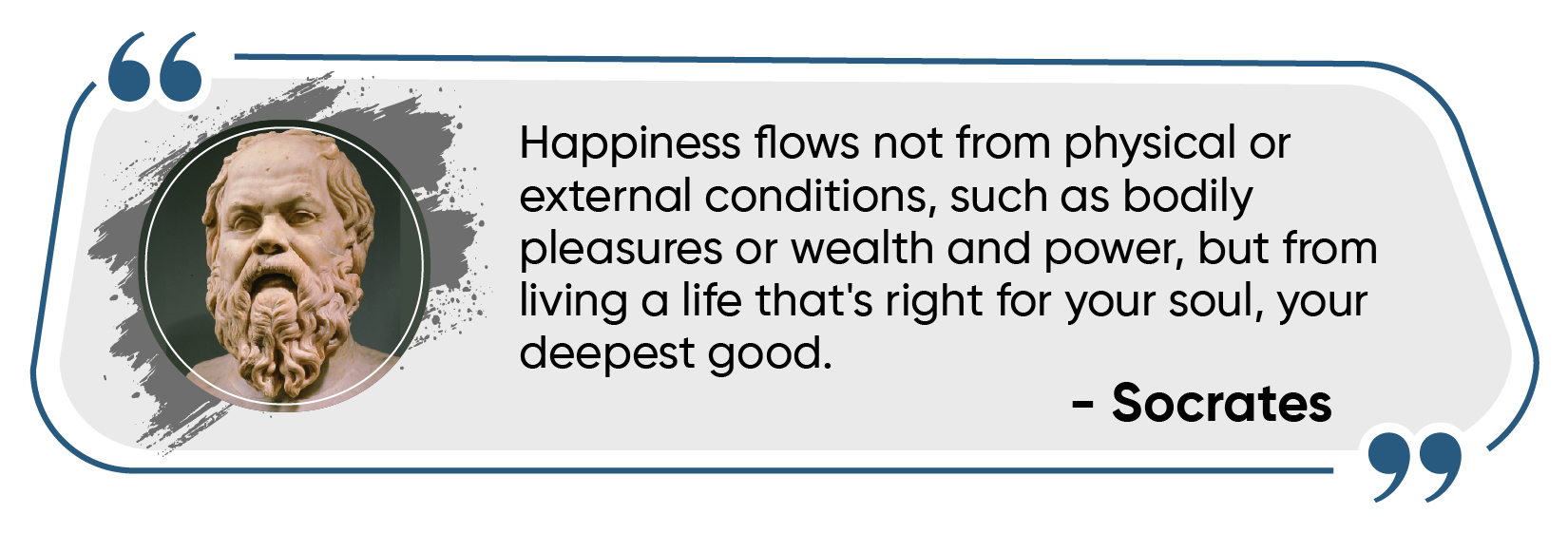
The below inforgraphic shows quote of Socrates.

What is happiness?

Happiness is a multifaceted concept that holds different meanings across various cultures and individuals. The World Happiness Report measures it practically by asking individuals to evaluate their current lives on a scale of 0 to 10 (the Cantril Ladder), treating happiness as an overarching judgment of life quality.

Theoretical Framework to understand Happiness

  • In Upanishadic tradition, Ananda (Bliss) is one of the three essential attributes of Brahman, the ultimate reality, along with Sat (existence) and Chith (consciousness). 
    • These three aspects form the core of Brahman's nature and are often expressed as "Sat-Chit-Ananda." ( Taittiriya Upanishad).
  • Classical Western philosophy, particularly Aristotle's concept of Eudaimonia, defines happiness not as mere sensory pleasure or material wealth, but as a flourishing life achieved through the cultivation of moral virtues, rational activity, and responsible social participation.
  • Buddhist thought defines ultimate happiness as Nirvana (or enlightenment), a state of inner peace and contentment achieved by overcoming worldly attachments and the cessation of suffering.
  • For Bhutan, which coined "Gross National Happiness" (GNH), happiness is a multi-dimensional measure of well-being that purposefully rejects the purely materialistic metrics of the West.
  • In Utilitarianism (by Jeremy Bentham) happiness is the greatest good, and actions should maximize overall happiness for the greatest number.
  • In Nihilism (Friedrich Nietzsche) happiness is an illusion, and individuals must create their own subjective meaning to find happiness.
  • In the Madhyastha Darshan philosophy (propounded by A. Nagraj), happiness is defined as "a state of no-conflict, synergy, or a state of being in acceptance". It is a condition where an individual is in harmony within themselves and with the outside world, requiring both intellectual resolution (understanding) and physical prosperity.

Key ethical concerns about India's poor rankings in the WHR

India's position highlights a paradox: high economic growth but moderate happiness levels. This indicates-

  • Inequality and Justice: Economic gains are unevenly distributed.
    • Violates the principle of distributive justice (Rawls). 
  • Trust Deficit: Perceived corruption and weak institutional trust.
    • Undermines the ethical legitimacy of governance 
  • Social Fragmentation: Rising individualism, social tensions.
    • Weakening of community bonds and empathy 
  • Mental Well-being Crisis: Stress, unemployment, and high social media usage.
    • Neglect of emotional and psychological dignity.

How can India ensure the happiness of her citizens?

  • Promote Ethical Governance: Ensure transparency, accountability, and reduce corruption.
    • Example: Digital India initiatives (e-governance, DBT) reduce leakages and enhance trust. 
  • Strengthen Social Capital: Build trust, community participation, and social harmony.
    • Example: Self-Help Groups (SHGs) and community-led programs enhance solidarity and mutual support. 
  • Focus on Inclusive Development: Reduce inequality and ensure last-mile delivery.
    • Example: Aspirational Districts Programme targets backward regions for holistic development. 
  • Prioritize Mental Health and Well-being: Recognize happiness beyond physical needs.
    • Example: National Mental Health Programme and workplace wellness initiatives addressing stress and depression. 
  • Value-Based Education: Promote empathy, ethics, and civic responsibility.
    • Example: Introduction of life skills and value education under the National Education Policy 2020

Teaching happiness in school

  • Key Examples
    • India: The Delhi Happiness Curriculum, launched in 2018, reaches nearly 8 lakh students daily. It focuses on mindfulness, storytelling, and reflective activities
    • UNESCO "Happy Schools": A global framework that encourages countries to prioritize "joyful learning" over rote memorization to improve both mental health and academic resilience.
    • Latin America: Countries like Chile and Mexico have implemented large-scale well-being curricula. 
  • Impact on Students
    • Improved Focus: Mindfulness exercises help reduce anxiety and increase classroom attentiveness.
    • Emotional Regulation: Students report a better ability to manage anger and support peers or family members during stressful times.
    • Reduced Behavioral Issues: Schools have noted a decline in bullying, aggressive behavior, and truancy.
    • Academic Gains: Happy students often show higher levels of self-efficacy and better memory retention, creating a "virtuous cycle" between well-being and achievement.
      • For e.g. research in Chile (2024) found that students who report being "happy at school" consistently perform better in math and language, even when accounting for socioeconomic factors. 

Conclusion                                                          

The World Happiness Report 2026 reinforces that happiness is the ultimate test of ethical governance. India's ranking is a reminder that development must be inclusive, compassionate, and just. A truly ethical state is one where citizens not only live longer but live happier, dignified, and meaningful lives.

Ethics Case Study

India has recently shown marginal improvement in the World Happiness Report rankings, moving from 118th position in 2025 to 116th in 2026. However, despite being one of the fastest-growing economies in the world, the country continues to lag behind several of its neighbors in terms of overall well-being.

A district magistrate (DM) in a rapidly urbanizing district observes a worrying trend:

  • Rising income levels but increasing stress, anxiety, and social isolation among youth
  • High usage of social media leading to declining mental health
  • Growing inequality between urban elites and rural migrants
  • Declining trust in local governance institutions due to perceived corruption

The DM is under pressure from higher authorities to focus primarily on economic indicators such as infrastructure development and investment inflows. However, civil society groups are demanding initiatives aimed at improving mental well-being, social cohesion, and ethical governance.

At the same time, the DM is considering introducing a "District Happiness Initiative" inspired by programs like the Delhi Happiness Curriculum and Bhutan's Gross National Happiness model. However, there are concerns about feasibility, measurement of outcomes, and administrative burden on already overstretched staff.

Questions

  1. Identify the key ethical issues involved in the above case.
  2. Discuss the conflict between economic growth and holistic well-being. Is prioritizing GDP growth ethically justified in this situation?
  3. Suggest a balanced course of action for the District Magistrate.

Explore Related Content

Discover more articles, videos, and terms related to this topic

RELATED TERMS

3

National Education Policy 2020

A comprehensive policy framework for education in India, aiming to reform and revitalize the entire education system from early childhood to higher education. It emphasizes holistic development, interdisciplinary learning, and integration of technology.

National Mental Health Programme

A government initiative in India aimed at providing mental healthcare services, promoting mental health awareness, and preventing mental illnesses across the country.

Aspirational Districts Programme

Launched in 2018, this programme aims to rapidly and effectively transform 112 under-developed districts across India by focusing on five key themes: Health & Nutrition, Education, Agriculture & Water Resources, Financial Inclusion & Skill Development, and Infrastructure.

Title is required. Maximum 500 characters.

Search Notes

Filter Notes

Loading your notes...
Searching your notes...
Loading more notes...
You've reached the end of your notes

No notes yet

Create your first note to get started.

No notes found

Try adjusting your search criteria or clear the search.

Saving...
Saved

Please select a subject.

Referenced Articles

linked

No references added yet
