


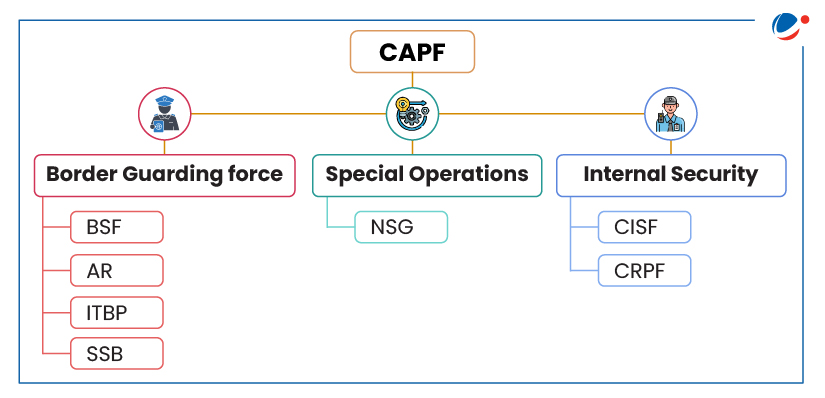
Central Armed Police Forces (CAPF) (general administration) bill, 2026 was passed by both houses of the Parliament.
- The Bill acts as an overarching law to regulate the recruitment, deputation, promotion, and conditions of service for officers in the Central Armed Police Forces (CAPFs), which are presently regulated by respective service acts.
- Bill specifically provides for deputation of IPS (Indian Police Service) Officers to posts in CAPFs.
- Earlier, Supreme Court, in 2025, directed progressive reduction in deputation of IPS Officers in CAPFs to the posts of DIG (Deputy Inspector General of Police) and IG (Inspector General) within a period of two years.
Key Provisions of the Bill:
- Powers to make Rules: It empowers the central government to make Rules on matters related to officers of specified CAPFs.
- Applicability: It applies to the five major CAPFs listed in the First Schedule to the Bill including Central Reserve Police Force (CRPF), Border Security Force (BSF), Central Industrial Security Force (CISF), Indo-Tibetan Border Police (ITBP), and Sashastra Seema Bal (SSB).
- Assam Rifles and National Security Guard (NSG) are not included at present.
- Central Government may amend the Schedule to make bill applicable for other CAPFs.
- Positions to be filled by deputation: The following positions in CAPFs must be filled by deputation of IPS officers:
- 50% of the posts in the rank of Inspector General
- a minimum of 67% of the posts in the rank of Additional Director General,
- all posts in the ranks of Director General and Special Director General.
Tags:
Article Sources
1 sourceReleased by the India Justice Report, it aims to assess the capacity and performance of consumer dispute redressal commissions in India.
Key Findings:
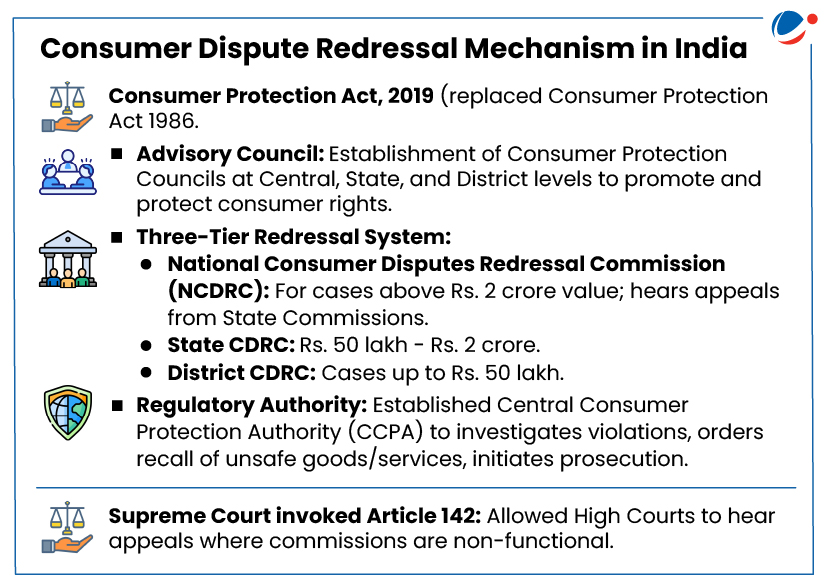
- Rising Pendency: Despite improved disposal numbers (88.5% of the 7.64 lakh cases) post-pandemic, total case pendency increased by 21% between 2020 and 2024.
- This far exceeds the timelines prescribed under the Consumer Protection Act, 2019, which mandates disposal within three to five months.
- Underutilization of Alternative Redressal: Across 23 states providing data, only 134 cases were referred to mediation nationwide.
- Declining Representation of Women: The share of women among presidents and members in 14 responding State Consumer Disputes Redressal Commissions (SCDRCs) declined from an average of 35% in 2021 to 29% in 2025
- High Vacancies: As of 2025, nearly 50% of SCDRCs lacked a sitting president.
Article Sources
1 sourceThe Election Commission has extended the facility of postal ballot voting to electors above 85 years of age and Persons with Disabilities.
About Postal Ballot
- Allows voters to cast their votes on an electronically received postal ballot, avoiding the need to visit polling stations physically.
- The voter must print it, mark their choice manually, and return it by physical post.
- Legal Framework: Governed by Conduct of Election Rules, 1961 and Representation of People Act, 1951.
- Eligibility: Service voters, special voters, absentee voters (seniors above 85, persons with disabilities, etc.) those under preventive detention, and election duty personnel.
- Service Voters include Members of the Armed Forces, central armed police forces, government servants posted abroad etc.
- Special voters include the President, Vice President, Governors, Cabinet Ministers, etc. and their spouses.
ECI has issued orders require to apply to the MCMC for pre-certification of all political advertisements on electronic and social media.
About MCMC
- Created by: ECI
- Purpose: Ensuring compliance with EC guidelines and preventing paid news or misleading content.
- Strict vigil on suspected cases of paid news in the media and take suitable action.
Tags:
Article Sources
1 sourceUnion Minister of Jal Shakti Launched Sujal Gaon ID.
About Sujal Gaon ID
- Launched by: Ministry of Jal Shakti under Jal Jeevan Mission.
- Nature: Unique digital ID for mapping rural piped water supply schemes.
- Purpose: Enables source-to-tap digital mapping of rural drinking water infrastructure.
- Platform: Linked with Sujalam Bharat national digital architecture.
- Significance: Improves monitoring, transparency, accountability and supports universal Har Ghar Jal coverage by 2028.
Tags:



