


Why in the News?
Strong performance of Production Linked Incentive Scheme for Food Processing Industry (PLISFPI), with cumulative investment surpassing ₹9,000 crore, exceeding the initially committed ₹7,000 crore brought focus on PLI Schemes.
About PLI Scheme
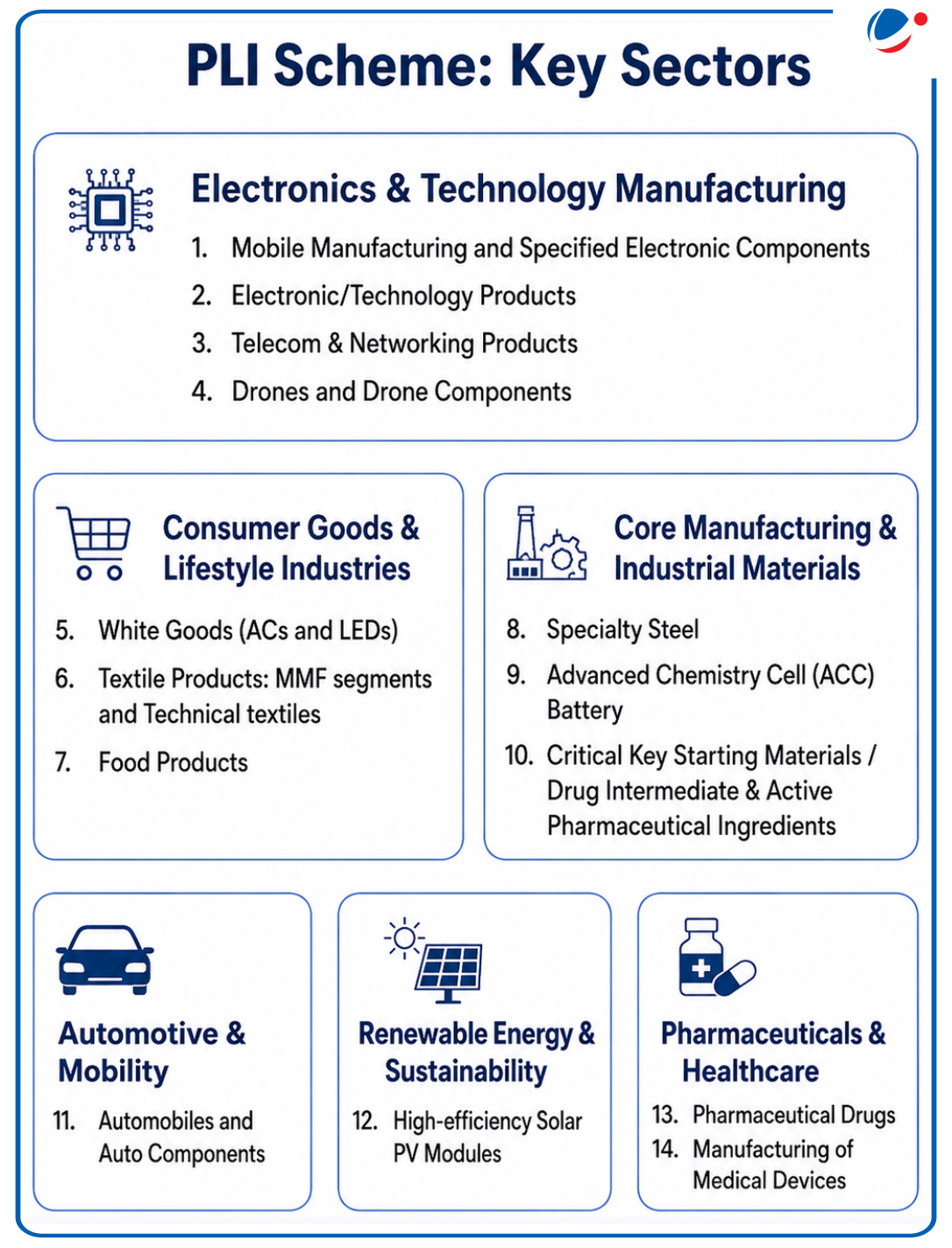
- Launched year: 2020
- Aim: To boost domestic manufacturing capabilities by offering financial incentives to eligible companies based on their incremental sales.
- Objective: To introduce cutting-edge technology, achieve economies of scale, ensure cost efficiency, and enhance India's macroeconomic manufacturing competitiveness globally.
- Aligned with the vision of Atmanirbhar Bharat and Make in India initiative.
- Scale & Outlay: Covers 14 strategic sectors (see infographic) with a total financial outlay of ₹1.97 lakh crore.
Significance of PLI Scheme
India's manufacturing sector has historically been constrained by limited technological infrastructure, a fragmented supply chain, and heavy import dependence for key components, pushing up production costs and reducing global competitiveness. The PLI Scheme addresses these structural weaknesses by:
- Attracting Investment: Incentivises companies to invest in Indian manufacturing at scale, reducing cost disadvantages in comparison to competitors like China and Southeast Asia.
- PLI framework acts as an "entrepreneurial catalyst" designed to absorb early capital risks, build public goods, and systematically crowd-in high-value private sector investment.
- E.g., India attracted over USD 4 billion in FDI in electronics manufacturing since 2020-21.
- Global Value Chain (GVC) Integration: From a net importer of intermediate goods, India is progressively becoming an active participant in GVCs.
- E.g., 57 high-end products of medical devices are now being manufactured domestically.
- Achieving Economies of Scale: Enabling Indian firms to compete on cost and quality at scale.
- E.g. Mobile phone manufacturing like Apple scaled to make India a global hub.
- Import Substitution: Targeted reduction of import dependence in strategic sectors.
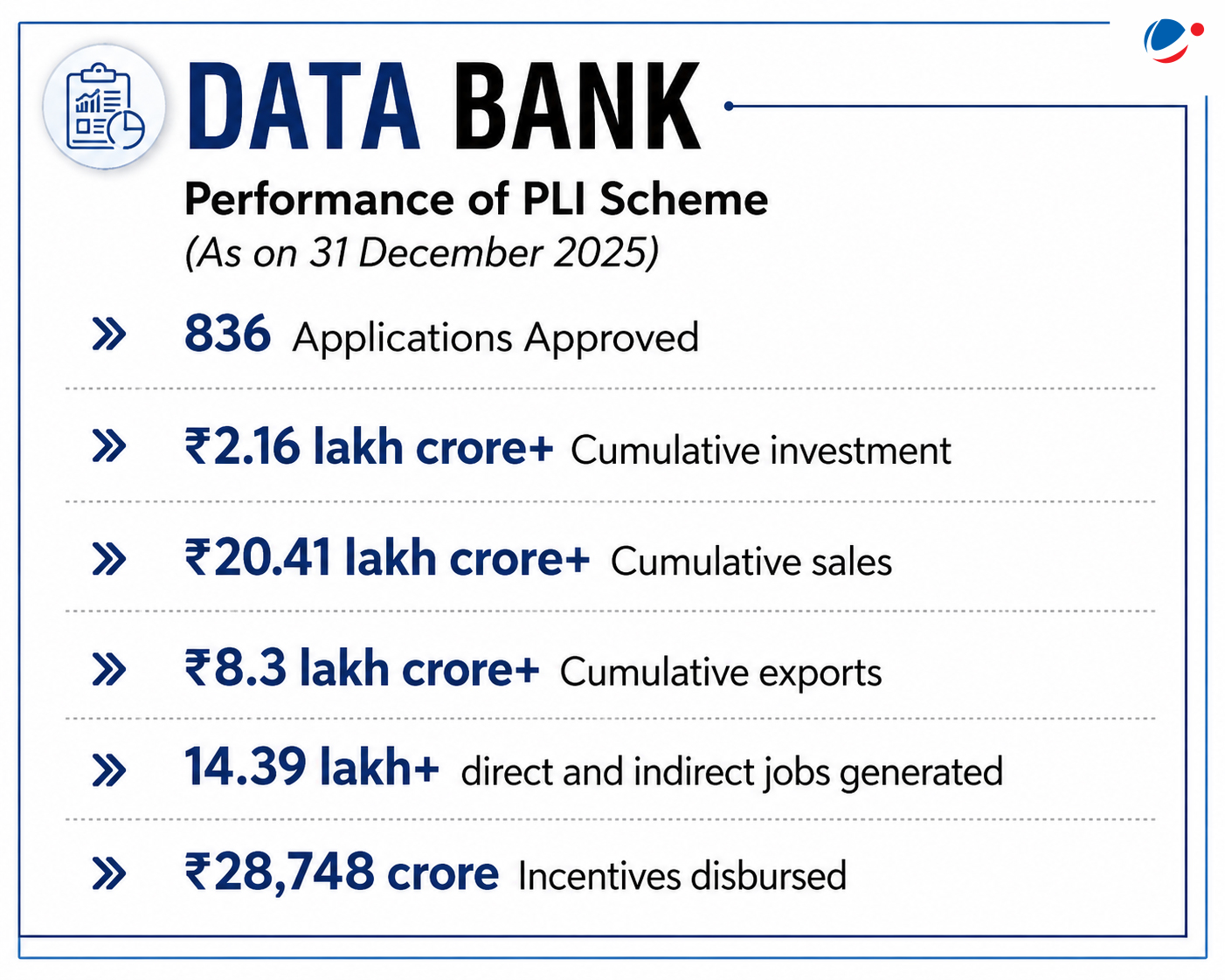
- E.g., India achieved 60% import substitution in telecom products; Penicillin G Potassium now produced domestically.
- Export Promotion: Aids in building an export-oriented manufacturing base.
- E.g., Mobile phones manufacturing has transformed India from a net importer to a netexporter.
- Employment Generation: Generates direct and indirect jobs across manufacturing clusters.
- Promoting MSMEs: E.g., Out of the 165 approved applications under PLISFPI, 69 applicants are MSMEs (as of February 2026).
- Strengthening Atmanirbhar Bharat: Reduces strategic vulnerabilities in sectors like defence electronics, Active Pharmaceutical Ingredients (APIs), and ACC batteries.
Case Study: Telecom Sector (Economic Survey 2025-26)
|
Constraints related to PLI schemes
- Sectoral Variation: Sectors like electronics, solar PV, speciality steel etc. recorded high export growth whereas sectors like automobiles, textiles showed moderate export growth with continued reliance on imported inputs and technology. (Economic Survey 2025-26)
- Limited SME Participation: High investment thresholds effectively exclude Small and Medium Enterprises (SMEs), concentrating benefits among large companies.
- E.g., A recent report said that PLI scheme distorted the 2-wheeler EV market, potentially sidelining the innovation-led manufacturers.
- Inadequate Employment Generation: Capital-intensive and automated manufacturing facilities generate fewer direct jobs than projected.
- Many PLI sectors prioritise supply-chain resilience and import substitution over labour intensity.
- Scheme Complexity: Multiple year-wise targets, product-wise thresholds, and growth benchmarks increases compliance burden.
- E.g., Extensive documentation for audits, certifications, and repeated clarifications.
- Governance Gaps: Lack of uniform criteria, ambiguity in the reward system and timelines, and absence of a centralised database reduce transparency.
- Structural Limitations: PLI scheme is yet to catalyse a shift towards high-complexity exports (advanced machinery, precision engineering goods) as the export basket remains concentrated in low- and mid-complexity goods (refined petroleum, diamonds, rice).
- India ranks 44th on the Economic Complexity Index (ECI), unchanged since 2019.
Way Forward
- Strengthen Implementation Mechanisms: Fast-Track Clearances through dedicated PLI project clearance cells; Single-window systems to reduce bureaucratic delays and provide investor certainty.
- Simplify Scheme Framework: Optimize targets, prioritize automatic verification using GST and customs data to ensure predictable, rules-based disbursement of incentives to investors.
- Expand SME Access: Tiered investment thresholds can be introduced to open PLI benefits to MSMEs in select sectors for broader industrial development and supply-chain deepening.
- Expand to Labour-intensive Sectors: Parliamentary Standing Committee on Commerce recommended extending PLI to labour-intensive sectors like chemicals, leather, apparel, and handicrafts.
- Ensure Geographical Spread: Offer differential incentives to attract manufacturing to less-industrialised states, to support balanced regional development.
- Boost R&D and Innovation Linkages: Link PLI-supported production with domestic innovation ecosystems. E.g. Anusandhan National Research Foundation (ANRF) and Research, Development & Innovation Fund (RDIF)
- This will promote manufacturing and export of high-complexity goods like advanced electronics, chemicals, etc.
Conclusion
The PLI Scheme is one of the major industrial policy interventions in the direction of making India a 5trillion-dollar economy while promoting self-reliance. In the present context of disruptions in global value chains, PLI scheme strengthens India's position in the global economy by leveraging investments (including FDI) and a vibrant domestic market.




