


Why in the News?
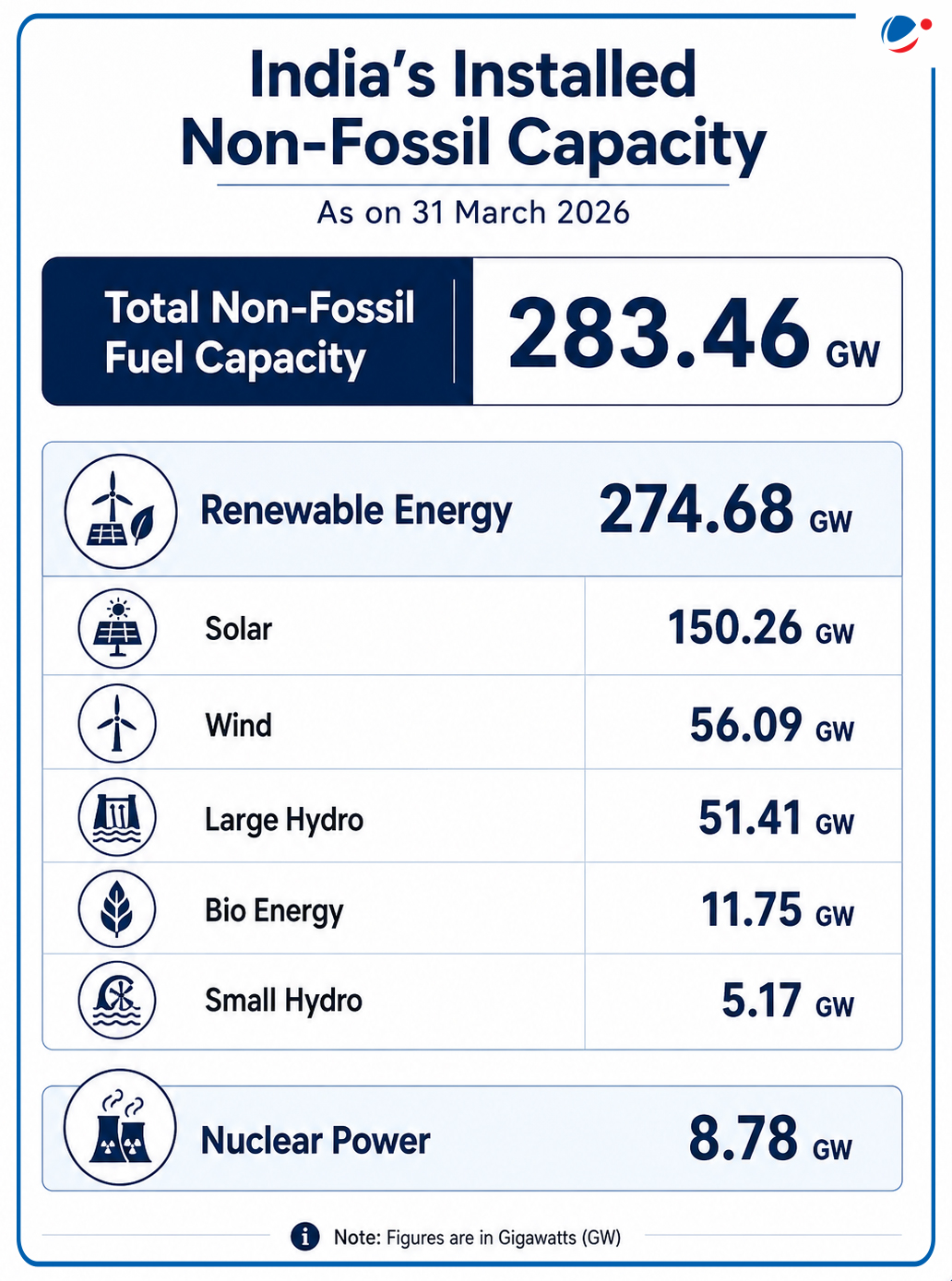
Recently, the International Renewable Energy Agency's Renewable Capacity Statistics 2026 report stated that India has achieved the world's third-largest installed renewable energy capacity.
More in the News
- Global Renewable Energy Capacity: Total global renewable energy installed capacity reached ~5150 GW, led by China (2260 GW) and the USA (470 GW).
- India's Global Rank: India became the third-largest renewable energy producer with an installed capacity of 250.52 GW, ahead of Brazil (228 GW).
- Global Electricity Transition:Renewables overtook coal for the first time in over a century, contributing 33.8% of global electricity generation compared to 33.0% from coal (Ember Global Electricity Review 2026).
Status of renewable energy in India
- Capacity Addition: India added 55.3 GW of non-fossil fuel capacity during FY 2025-26.
- India has achieved highest-ever annual wind energy addition of 6.05 GW in 2025–26.
- India has also recorded highest-ever annual solar capacity addition. India added 45 GW of Solar Energy Capacity in 2025-26, with Rajasthan, Gujarat and Tamil Nadu emerging as top contributing states.
- NDC Target: India achieved 50% installed power capacity from non-fossil sources in June 2025, meeting its 2030 NDC target five years early.
- Power Generation: India generated 1,845.921 BU electricity in 2025-26, with non-fossil sources contributing 538.97 BU (29.2%).
- Electricity Demand: Renewable energy met around 51.5% of India's total electricity demand.
Significance of Renewable Energy
- Energy Security: Reduces vulnerability to external supply shocks, geopolitical conflicts, and global energy price volatility. E.g. West Asia Crisis.
- Climate Commitments: Helps India meet its climate goals like reducing carbon intensity by 47% by 2035 and achieving Net Zero by 2070.
- Example: Lower emission intensity in the power sector due to rising renewable energy use.
- Economic Gains: Attracts large-scale investments, boosts domestic manufacturing, and generates green employment opportunities across sectors.
- Example: Around $23 billion FDI attracted in the non-conventional energy sector between March 2000 and June 2025.
- Inclusive Development: Decentralized renewable energy solutions such as rooftop solar, farm solar, and mini grids help achieve universal energy access.
- Community Empowerment: E.g., The Barefoot Women Solar Engineers Programme trains rural women as "Solar Mamas" to provide solar electricity in their villages.
Reasons behind growth in Renewable energy
- Low-Cost Technology: Falling solar and wind costs boosted adoption. Example: Solar panel prices fell by nearly 90% (2015–2025).
- Government Policies & Schemes: Strong policy support through schemes like National Solar Mission, PM-KUSUM, National Green Hydrogen Mission, and bioenergy programmes.
- Regulatory Reforms: Measures like Renewable Purchase Obligation (RPO), Green Open Access Rules (2022), and the Indian Carbon Market encouraged clean energy use.
- Infrastructure Support: Expansion of the Green Energy Corridor, rooftop solar under PM Surya Ghar Muft Bijli Yojana, and wind-site mapping improved renewable integration.
- Domestic Manufacturing: India boosted local manufacturing through PLI schemes and other incentives. Example: Solar module capacity increased from 38 GW to 74 GW during FY 2024-25.
- Investment & Incentives: Policies like 100% FDI under automatic route, sovereign green bonds, and tax incentives increased private investment in the sector.
- Battery & Storage Growth: Global battery deployment rose by 46%, while battery prices fell by 45%, improving round-the-clock renewable supply.
- Favourable Geography: Many states have 300+ sunny days annually, a long coastline, and strong wind corridors in states like Tamil Nadu and Gujarat.
- International Cooperation: The International Solar Alliance and its One Sun, One World, One Grid (OSOWOG) initiative promoted global solar cooperation and investment.
Key Concerns
- Financial Constraints: India will require over USD 10 trillion by 2070 for achieving its Net Zero target.
- Import Dependence: E.g., In FY 2025, India imported around 35 million solar modules worth USD 1.6 billion, with a majority sourced from China.
- Global Supply Risks: China dominates global rare earth processing, controlling nearly 90% of processing capacity, creating supply-chain vulnerabilities.
- Intermittent Nature of Renewables: Solar and wind power are weather-dependent. Example: Solar generation peaks during the day, but demand is often higher in the evening.
- Transmission Bottlenecks: Grid infrastructure remains inadequate in some renewable-rich states like Tamil Nadu, leading to evacuation constraints.
- Land Acquisition Issues: Large renewable projects require vast land areas, causing delays, local conflicts, and food security concerns.
- Example: Solar energy may require 300 times more land than nuclear energy (Economic Surve 2023-24).
Way forward
- Boost Domestic Manufacturing: Expand local production of solar panels, wind turbines, batteries, and green hydrogen equipment through PLI schemes to reduce import dependence.
- Expand Energy Storage: Increase use of battery storage, pumped-storage hydropower, and hybrid renewable systems for stable power supply.
- Increase Green Financing: Promote funding through green bonds, private investment, and multilateral financing.
- Strengthen Grid Infrastructure: Upgrade transmission networks and develop smart grids using AI/ML technologies for better renewable integration.
- Ease Land Acquisition: Create land banks and improve Centre-State coordination to make land acquisition easier for renewable energy projects.


