Pradhan Mantri Awaas Yojana Grameen (PMAY-G) | Current Affairs | Vision IAS

Upgrade to Premium Today

Start Now
MENU
Home
Quick Links

High-quality MCQs and Mains Answer Writing to sharpen skills and reinforce learning every day.

Watch explainer and thematic concept-building videos under initiatives like Deep Dive, Master Classes, etc., on important UPSC topics.

A short, intensive, and exam-focused programme, insights from the Economic Survey, Union Budget, and UPSC current affairs.

ESC

Pradhan Mantri Awaas Yojana Grameen (PMAY-G)

22 May 2026
3 min

In Summary

  • Pradhan Mantri Awaas Yojana Grameen (PMAY-G), launched in 2016, aims for "Housing for All" in rural areas, providing pucca houses to the poor.
  • The scheme targets 4.95 crore houses by 2029, with beneficiary selection based on SECC 2011 data and prioritization for SC/ST, women, and disabled individuals.
  • Financial aid is ₹1.2 lakh (plain areas) or ₹1.3 lakh (hilly/difficult areas), with convergence for basic amenities and DBT payments.

In Summary

Why in the News?

Pradhan Mantri Awaas Yojana Grameen (PMAY-G) has completed 10 years.

Core Objective of the Scheme

Salient Features of the Scheme

  • Achieve "Housing for All" in rural areas by providing pucca houses with basic amenities to poor and houseless households. 
  • Ensure dignified, safe, and secure living conditions for rural families. 
  • Improve the quality of life and promote inclusive rural development through better housing infrastructure.
  • Launched in 2016, PMAY-G was restructured from Indira Awas Yojana, which was started in 1996.
  • Type:  Centrally Sponsored Scheme
  • Ministry: Ministry of Rural Development.
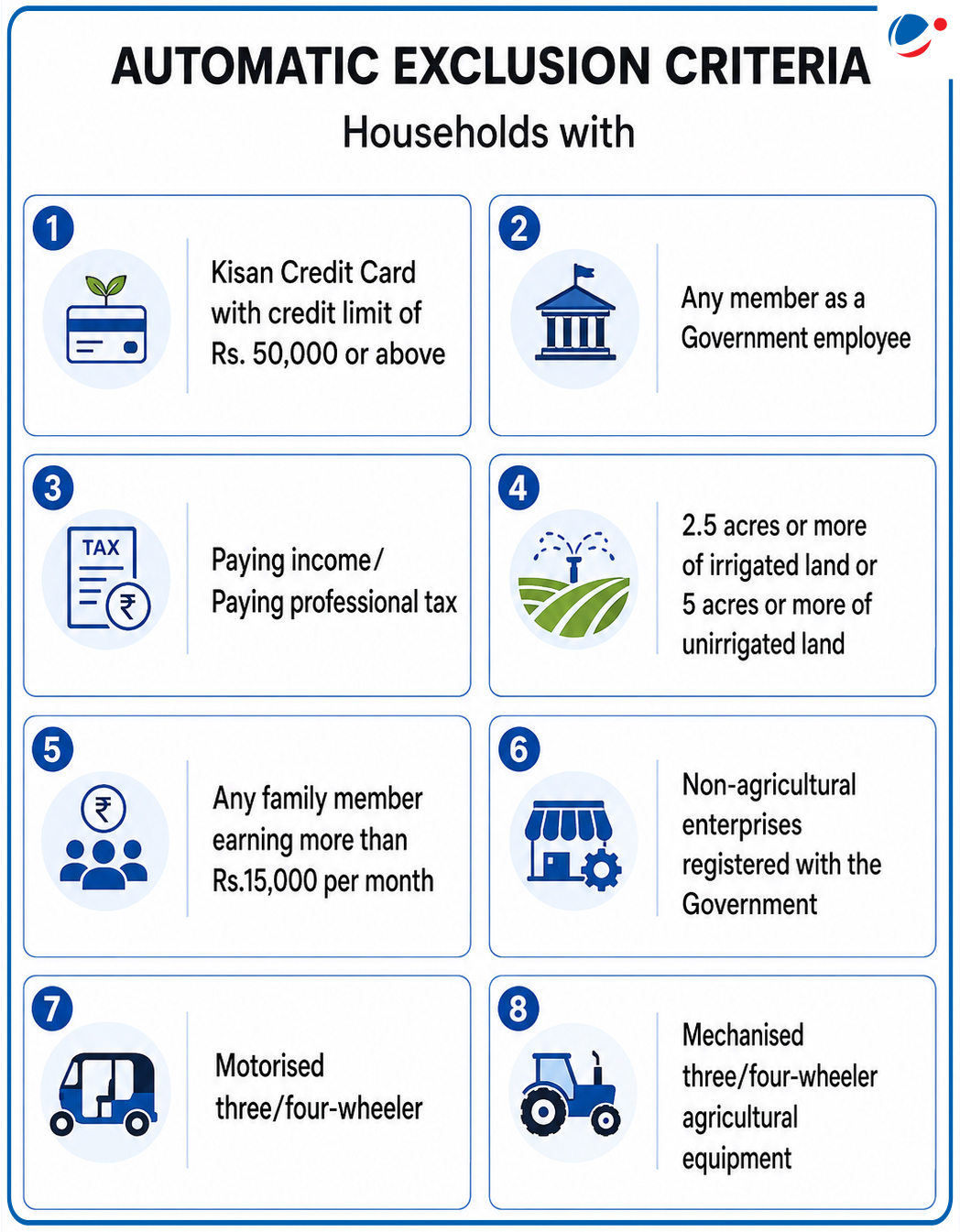
The below infographic shows automatic exclusion criteria.
  • Targets: The government initially set a target of 2.95 crore houses for FY 2016– 17 to FY 2023–24 and approved continuation for another five years (FY 2024–25 to FY 2028–29) with an additional target of 2 crore houses.
  • Beneficiary Selection: Based on Socio Economic and Caste Census (SECC) 2011 housing deprivation data, verified through Gram Sabha approval and geo-tagging under Awaas+ for transparent targeting.
    • Eligible Beneficiaries: Includes houseless households and families living in 0–2 room kutcha houses (as per SECC data); automatic/compulsory inclusion for:
      • Households without shelter, 
      • Destitute/living on alms, 
      • Manual scavengers, 
      • Primitive Tribal Groups.
      • Legally released bonded labourers.
    • Exclusion of pucca houses: All households living in houses with pucca roof and/or pucca wall and households living in houses with more than 2 rooms are filtered out.
    • Automatic exclusion criteria (See infographic)
    • Beneficiary Prioritisation: Based on housing deprivation criteria, with a minimum 60% targets earmarked for SC/ST households and 15% funds for minorities.
      • Preference given to women and persons with benchmark disabilities (minimum 5%, where possible), verified by Gram Sabha/local self-government bodies. 
  • Financial Aid: Minimum house size fixed at 25 sq. m, with financial assistance of ₹1.2 lakh in plain areas and ₹1.3 lakh in hilly states, North-Eastern states, and, difficult areas.
    • Labour Assistance: 90–95 person-days of unskilled labour under MGNREGA and 
  • Swachha Bharat Mission- Grameen: Assistance of ₹12, 000 for toilets.
  • Funding Pattern: Cost shared between Centre and States in the ratio of 60:40 for most states, 90:10 for North-Eastern & Himalayan states, and 100% Central assistance for Union Territories without legislature.
  • All payments to the beneficiary to be made through DBT mode to their Bank/Post office accounts that are linked to Adhaar with consent.
  • Scheme Convergence: For providing basic amenities like LPG (Ujjwala), water (Jal Jeevan Mission), electricity, etc. 
  • Monitoring & Accountability: Grievances addressed within 15 days through CPGRAMS and local bodies, alongside periodic evaluation by NITI Aayog for post-2026 continuation and policy review.
  • Technical Support: National Technical Support Agency (NTSA) to provide technical support.
    • Rural Mason Training (RMT) Program with National Skill Development Corporation (NSDC) to train masons in rural areas.
  • Progress & Achievements: As of March 2026, around 4.15 crore houses allocated, 3.90 crore sanctioned, and 2.99 crore completed, with over ₹4.03 lakh crore transferred to beneficiaries against the target of 4.95 crore houses by 2029.

Explore Related Content

Discover more articles, videos, and terms related to this topic

RELATED TERMS

3

National Skill Development Corporation (NSDC)

A public-private partnership under the MSDE that plays a crucial role in implementing skill development programs like PMKVY. It aims to catalyze skill development by setting up vocational training centers and developing frameworks for skill certification and accreditation.

Rural Mason Training (RMT) Program

A training program conducted in collaboration with the National Skill Development Corporation (NSDC) to equip rural individuals with masonry skills, enhancing the quality of house construction under PMAY-G.

National Technical Support Agency (NTSA)

An agency established to provide technical expertise and support for the implementation of housing schemes like PMAY-G, ensuring quality and adherence to standards.

Title is required. Maximum 500 characters.

Search Notes

Filter Notes

Loading your notes...
Searching your notes...
Loading more notes...
You've reached the end of your notes

No notes yet

Create your first note to get started.

No notes found

Try adjusting your search criteria or clear the search.

Saving...
Saved

Please select a subject.

Referenced Articles

linked

No references added yet