


Introduction
The human civilisation has evolved from mercantilism to financial capitalism (rooted in irrational greed and profit maximization), to present day emergence of powerful digital ecosystems and complex corporate structures. Adoption of conscious capitalism has thus become crucial in the new age with futuristic revolution of Artificial Intelligence, renewable energy transitions, and the climate crisis, presenting varied risks, challenges, and opportunities.
To foster global peace and sustainability, there is a need to promote wealth-making along with fair, ethical, equity principles.
What is Conscious Capitalism?
- It is a philosophy that emphasizes purpose, ethics, and stakeholder value alongside financial success, with the aim to conduct business that creates value for all involved.
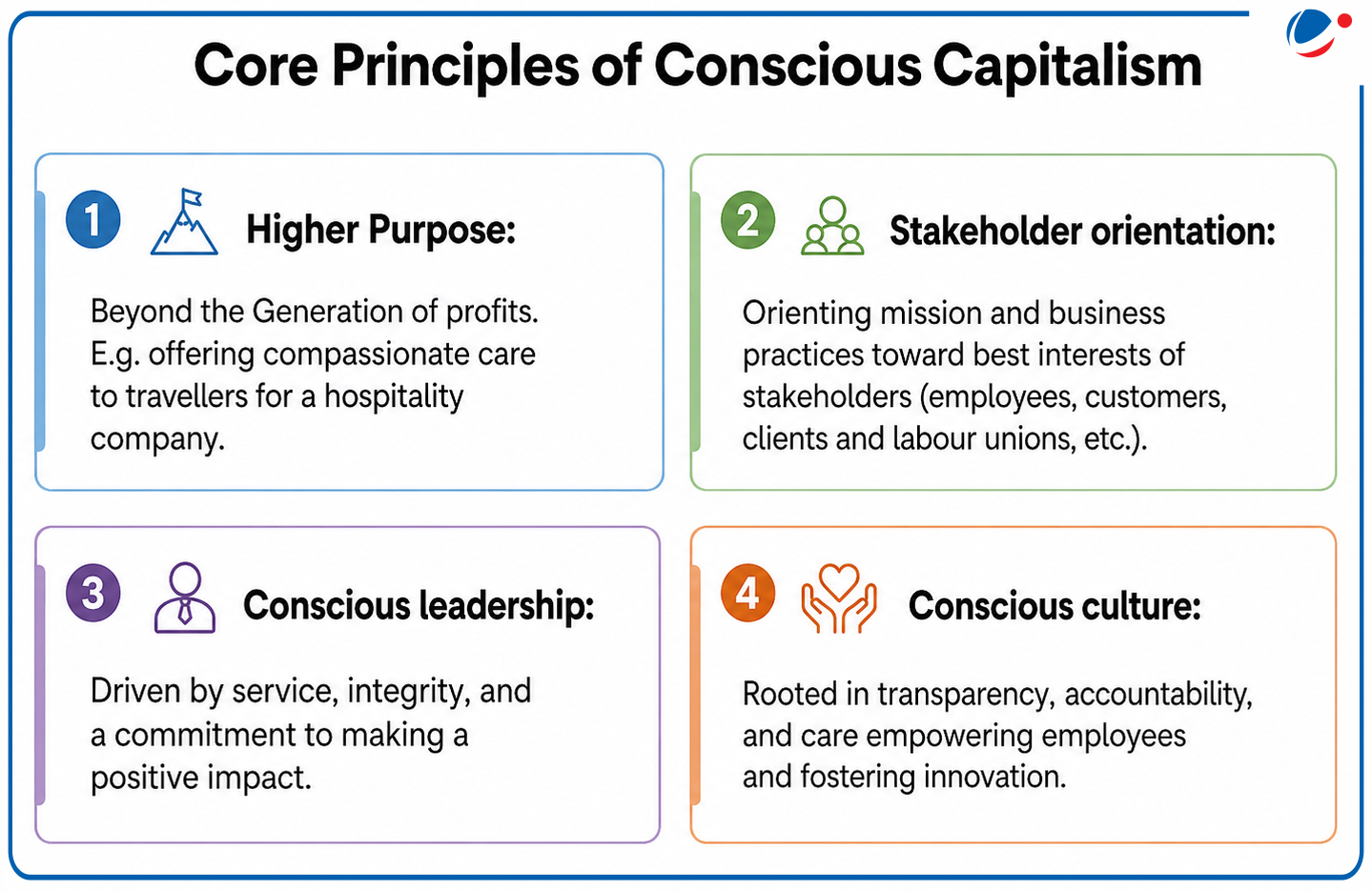
- Values Associated: Universal welfare, Truth, Non-violence (ahimsa), Self-sacrifice, and Economic equality, aiming to create a Just society.
- Business Ethics forms the foundation of Conscious Capitalism.
- Business ethics Deals with moral principles to corporate conduct, promoting fairness, transparency and long-term value creation, prioritizing stakeholder rights, environmental sustainability and social responsibility.
- Indian philosophical ideas aligning with Conscious capitalism:
- Purushartha: Pursuit of wealth and the accumulation of material assets (Artha) must always be guided by moral righteousness and duty (Dharma), ensuring that business practices support social harmony.
- Mahatma Gandhi's Doctrine of Trusteeship: It views business owners not as absolute proprietors of capital, but as trustees responsible for managing wealth on behalf of the wider community.
- Inclusive development: Indian governance models promote Antyodaya (welfare of the last person) and Sarvodaya (universal upliftment) principles.
What are the key differences between Traditional and Conscious Capitalism?
Parameters | Traditional Capitalism | Conscious Capitalism |
Basic Tenet |
|
|
Directive |
|
|
Profit Focus |
|
|
Long-Term Sustainability |
|
|
Economic Model |
|
|
Approach towards CSR (Corporate Social Responsibility) |
|
|
Why is Conscious Capitalism gaining momentum in present times?
- Promotion of Ethical Business Practices: Ethical capitalism is at heart of conscious capitalism.
- It positions companies as a force for good and instigators of positive change and like all humans have ethical obligations to each other, businesses too have ethical obligations to humanity and their environments.
- Realisation of True Nature of Capitalism: Market efficiency, unnerving nature of finance, and pursuit of profits and wealth maximisation for benefit of few over others has created disparities with poor outcomes with respect to peace and sustainability.
- Changing Consumer Preferences: Consumers are increasingly integrating ethical values with their purchasing decisions and prefer to support businesses that align with their values.
- Transparency Era: In the age of digital media, corporate actions are constantly under scrutiny and companies must operate with authenticity and accountability, or risk reputational damage.
- Long-Term Value Creation: There is increased focused on purpose and stakeholders by building trust and loyalty, creating a sustainable competitive advantages.
- Contemporary Developments: Developments like rapid adoption of Artificial Intelligence, renewable energy transitions, etc. have raised concerns about their ethical and social impacts.
Key Challenges in applying Conscious Capitalism practices
- Balancing Short-Term and Long-Term Goals: Pressure to deliver immediate financial results come in conflict with long-term, purpose-driven initiatives.
- Cultural Transformation: Shifting organizational culture requires time, effort, and commitment from all levels of business.
- Measuring Impact: Quantifying social and environmental impact could be complex, making it difficult to assess progress.
- Risk of Greenwashing and Woke-Washing: Some businesses adopt conscious terminology purely as a marketing shield, using progressive branding to hide extractive, unchanged business-as-usual operations.
- Resistance to Change: Not all stakeholders may embrace shift, particularly in traditional or profit-centric industries.
Ways to apply Conscious Capitalism towards Business Ethics
- Imbibing Principles of Ethical profit: Ensuring that business activities create a spectrum of positive externalities like supporting local initiatives, environmental sustainability, economic development, etc.
- Supportive Work Environment: Through fair wages, opportunities for growth for employees to promote faster loyalty, increased productivity, and an inclusive culture.
- Building Adaptable Model: Focussing on slow, sustainable growth over quick gains and scaling at expense of ethical considerations like cutting corners, exploiting labour, etc.
- Socially Responsible Investing (SRI): Also referred to as "values-based investing" by not investing in companies with questionable practices.
- Role of Leadership: Shift from traditional, command-and-control management to more empathetic and purpose-driven approach focussing on ethical decision making.
Conscious Capitalism: Best Practices
|
Conclusion
While new development in AI (Artificial Intelligence) age would fundamentally change human relations, global partnerships, and international trade, yet Indian initiatives like Atmanirbhar Bharat, Viksit Bharat, Made in India, Start Up India, Net Zero 2070 vision stand as a test of time and can be regarded as a torchbearer of conscious capitalism, to foster future peace and sustainability.
Check your Ethical AptitudeYou have been recently appointed as Chief Operating Officer (COO) of an leading textile company in North India. Your main task is to supervise the supply chain department dealing with procurement of raw materials and vendor management. Most of the raw material is sourced from a remote village in Eastern Africa and you recently came across reports about prevalence of extractive and oppressive policies adopted by most of big companies to source their raw materials at a cheaper price. Further investigation leads to the conclusion that your representatives working in that region do indulge in such practices with a view to earn profit and increase personal prospects of promotion. You come from an humble background and have struggled hard to achieve your current professional position. Being made a part of such practices though indirectly has nudged your consciousness and have made you adamant about resolving the issue. Against this backdrop, answer the following questions.
|
