


Why in the News?
A global One Health summit on the UN-backed "One Health" approach was held in Lyon, France with participation of world leaders, scientists, and environmental experts.
More on the News
- The Summit aims to promote action-oriented multilateralism and accelerate the translation of One Health commitments.
- At the summit, WHO announces four major One Health actions
- A new global network of institutions on One Health: It will enhance translation of global guidance into practical tools and on-the-ground support, strengthening training through the WHO Academy, creating a country-focused delivery model for One Health implementation.
- Stronger science to guide global action: WHO and Quadripartite partners (FAO, UNEP, WHO and WOAH) announced the extension and expansion of the One health high level expert panel (OHHLEP) the world's leading scientific advisory body on One Health.
- A new push to eliminate rabies by 2030
- A unified strategy to tackle avian influenza threats
What is One Health Approach?
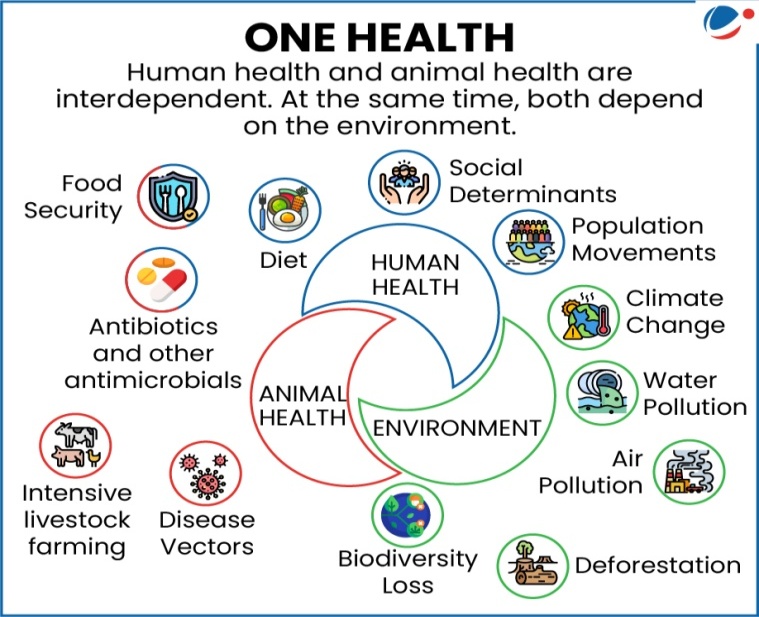
- One Health is a collaborative, multisectoral, and transdisciplinary approach with the goal of achieving optimal health outcomes recognizing the interconnection between people, animals, plants, and their shared environment.
- The approach can be applied at the community, subnational, national, regional and global levels, and relies on shared and effective governance, communication, collaboration and coordination.
- By linking humans, animals and the environment, One Health can help to address the full spectrum of disease control – from prevention to detection, preparedness, response and management – and contribute to global health security.
Need of One Health Approach in India
- Zoonotic Disease Prevention: Around 60% of emerging infectious diseases in humans originate from wild or domestic animals. E.g. COVID-19, Nipah etc.
- Livestock Protection: India holds one of the largest livestock populations globally. Diseases like brucellosis, foot and mouth disease (FMD), lumpy skin disease, etc. devastate the agrarian economy.
- Climate change Impact: An excess of 250 000 deaths per year can be attributed to climate change
- Rise of Antimicrobial resistance (AMR): Overuse of antibiotics in humans and livestock is creating drug-resistant pathogens.
- Ecosystem degradation: Crop losses vary from 10-35% annually due to weeds, pests and diseases across the country.
- Economic losses: The associated potential income lost from labour capacity reduction due to extreme heat was US$194 billion in 2024.
Challenges to One Health Approach in India
- Siloed ministries: Health, Agriculture, Environment, and Forests operate independently with conflicting departmental priorities.
- Surveillance Gaps: Existing platforms like Integrated Disease Surveillance Programme mainly focus on reporting rather than coordinated response.
- Low Public Awareness: This was evident during recurring outbreaks of swine flu and rabies in several states.
- Capacity Building Constraints: Training programs for doctors, veterinarians, ASHA workers, and environmental officers on zoonotic disease management remain insufficient.
- For example, many frontline workers lacked specialized preparedness during the COVID-19 pandemic.
- Research and Innovation Deficit: For example, Research on bat-borne viruses such as Nipah and coronavirus reservoirs is still evolving.
- Weak Local-Level Governance: For instance, poor waste management and unregulated livestock markets in urban fringes increase disease spillover risks.
Initiatives taken in India
|
Way Forward
- Integrated Surveillance System: Develop a unified human-animal-environment disease surveillance network with real-time data sharing among ministries and states.
- Inter-Ministerial Coordination: Create a permanent coordination mechanism among health, agriculture, environment, fisheries, and urban development ministries.
- Research & Innovation: Promote multidisciplinary research on zoonotic diseases, climate-health linkages, and AMR through institutions like Indian Council of Medical Research and Indian Council of Agricultural Research.
- Community Participation: Involve Panchayats, self-help groups, and local communities in disease awareness, sanitation, and livestock management practices.
- Capacity Building: Introduce One Health training modules for doctors, veterinarians, environmental scientists, and frontline health workers.
- Climate-Resilient Health Planning: Integrate climate adaptation measures into public health and disaster management strategies to address vector-borne and water-borne diseases.
- Biodiversity Conservation: Promote afforestation, habitat restoration, and sustainable land-use planning to reduce human-wildlife conflict and disease spillovers.
- International Collaboration: Strengthen cooperation with global agencies such as World Health Organization, Food and Agriculture Organization for Animal Health for technical support and best practices.
Conclusion
The One Health approach recognizes that human, animal, and environmental health are deeply interconnected, making collaborative action essential in an era of emerging pandemics, climate change, and biodiversity loss. Strengthening integrated surveillance, institutional coordination, and community participation will be crucial to building a resilient and sustainable public health system.
