


Why in the News
Artemis II astronauts returned to Earth after historic NASA mission to the Moon.
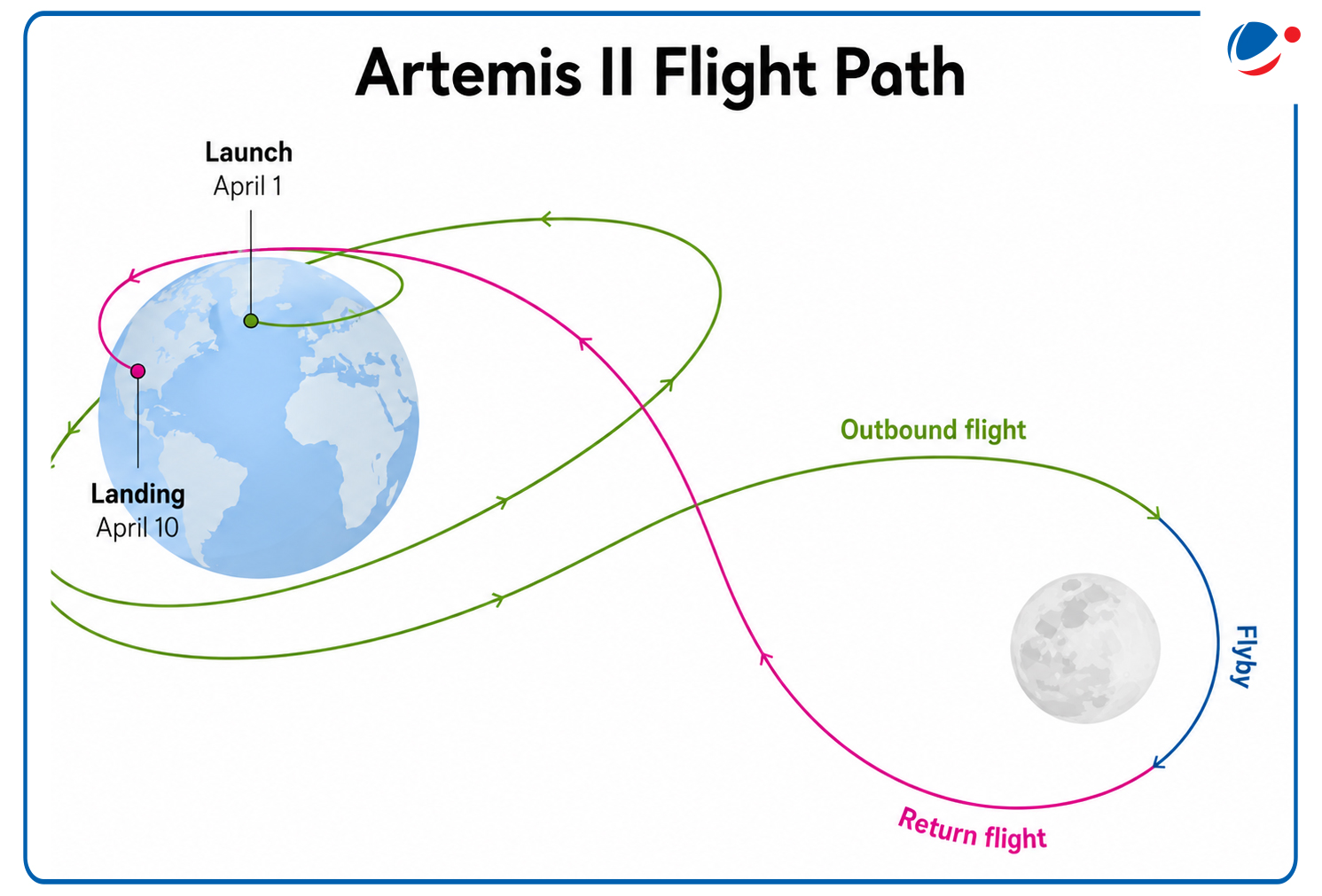
About Artemis II Moon Mission
- Mission Type: Crewed Lunar Flyby Mission under the NASA's Artemis Program.
- Launch Date: 1 April 2026.
- Duration: 10 days
- Launch Vehicle: Space Launch System (SLS)
- Space Launch System (SLS) is NASA's super heavy-lift rocket that is capable of sending the Orion spacecraft, astronauts and cargo directly to the Moon in a single mission.
- Spacecraft: Orion spacecraft
- Built by NASA and Lockheed Martin, Orion is capable of carrying astronauts into deep space and safely returning them to Earth from the Moon's vicinity at high speed.
- Key Mission Objectives:
- Crew: Demonstrate the ability of systems and teams to sustain the flight crew in the flight environment, and through their return to Earth.
- Systems: Demonstrate systems and operations essential to a crewed lunar campaign. This ranges from ground systems to hardware in space, and operations spanning from development to launch, flight, and recovery.
- Emergency Operations: Demonstrate emergency system capabilities and validate associated operations to the extent practical, such as abort operations and rescue procedures, as needed.
Artemis Program
The Artemis Missions
The Artemis Accords
Appollo vs Artemis
|
Scientific Experiments
- Astronaut Health Studies
- ARCHeR: To monitor astronauts' well-being, activity, and sleep patterns to gather data on human health and performance in deep space.
- AVATAR: Uses organ-on-a-chip devices to study the effects of microgravity and increased radiation on the health of the crew.
- Immune Biomarkers: To analyze blood and saliva samples to determine how deep space travel alters the immune system.
- Artemis II Standard Measures: To provide a consistent set of health data to a bank to assist future researchers in studying astronaut health.
- Radiation Studies: To monitor radiation levels inside and outside the Orion capsule to characterize the deep space environment.
- Lunar Science
- Geological Observations: The crew studied and photographed lava flows and impact craters to understand the region's geological history during a three-hour flyby of the Moon's far side.
- International CubeSat Experiments
- ATENEA (Argentina's CONAE): To measure Earth's radiation spectrum, assess radiation shielding methods, collect GPS data, and validate a long-range communications link.
- TACHELES (German Aerospace Center): To measure how the space environment affects electrical components to help design future lunar vehicle technologies.
- K-Rad Cube (South Korea's KASA): To measure biological effects and space radiation across the Van Allen radiation belts.
- SHMS (Saudi Space Agency): To measure space weather at a range of distances from Earth.
Significance
- Historic Milestone: It is the first crewed mission to the Moon in 50 years since the Apollo 17 in 1972.
- Human Safety in Deep Space: It rigorously tests the European Space Agency Service Module and Orion life-support systems, paving the way for sustained, long-term human space exploration.
- Historic Crew Representation: The flight breaks barriers by sending the first woman (Christina Koch), the first person of colour (Victor Glover) and the first non-American astronaut (Canadian Space Agency's Jeremy Hansen) to the Moon's vicinity.
- Extreme Distances: The trajectory takes the four-person crew farther into deep space—closer to the Moon and beyond the far side—than any humans have travelled in history.
- Future Missions: The mission serves as a gateway for future crewed lunar missions.
Conclusion
Artemis II marks a pivotal transition from lunar exploration to long-term residence. By successfully testing crewed deep-space systems , it solidifies the foundation for a permanent South Pole base and future Martian voyages. This mission proves that international cooperation and diversity are now the driving forces of humanity's celestial expansion.


