


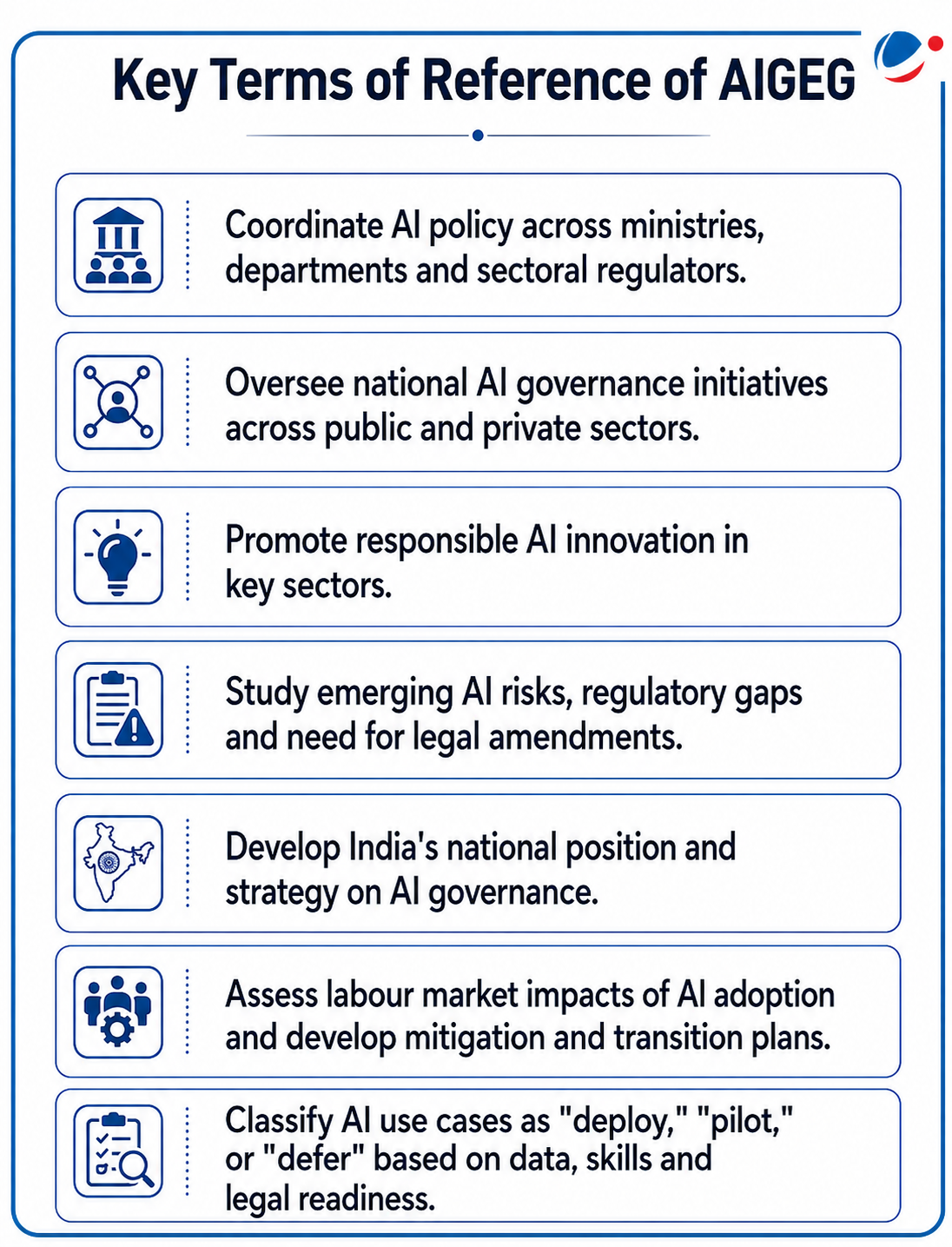
Ministry of Electronics and Information Technology (MeitY) has constituted the AI Governance and Economic Group (AIGEG) as a high-level inter-ministerial body.
- It will serve as India’s central institutional mechanism for AI governance policy development and coordination.
- Constitution of the AIGEG gives formal effect to institutional recommendations made in India’s AI Governance Guidelines and the Economic Survey.
- The Guidelines emphasized a "whole-of-government" approach to AI governance.
- Economic Survey highlighted the need for a central authority to align AI deployment with India's unique labor market realities and social stability.
About AIGEG
- Composition (10-member body)
- Chairperson: Minister of Electronics & IT
- Vice-Chairperson: Minister of State for Electronics & IT
- Other Members: Stakeholders across policy development, science and technology, security and economic affairs. E.g. Principal Scientific Advisor, Chief Economic Advisor (CEA), CEO (NITI Aayog) etc.
- Expert Support: By a Technology and Policy Expert Committee (TPEC), which provides technical advice on global trends, emerging risks, and regulatory gaps.
India’s AI Governance Strategy
- National Strategy for AI by NITI Aayog (2018): ‘AI for All’ vision, focus on inclusive development and democratisation of the AI ecosystem through initiatives like IndiaAI Mission.
- Seven Principles or Sutras: Trust, people-centricity, responsible innovation, equity, accountability, understandability, and safety, resilience and sustainability.
- Integration with Digital Public Infrastructure (DPI), building Institutional architecture like AI Governance Group etc.
Article Sources
1 sourceThe bill failed to secure the 2/3rd majority required to pass a constitutional amendment bill.
- Following the defeat of the Constitution Amendment Bill, the government withdrew the Delimitation Bill 2026 and the Union Territories Laws (Amendment) Bill 2026.
- The bill was opposed as it will disproportionately reduce the representation of the southern and north-eastern states on the basis of the 2011 Census.
About the 131st Amendment Bill
- Increases the strength of the Lok Sabha: From the existing 543 members to 850 members (815 from states and 35 from UTs).
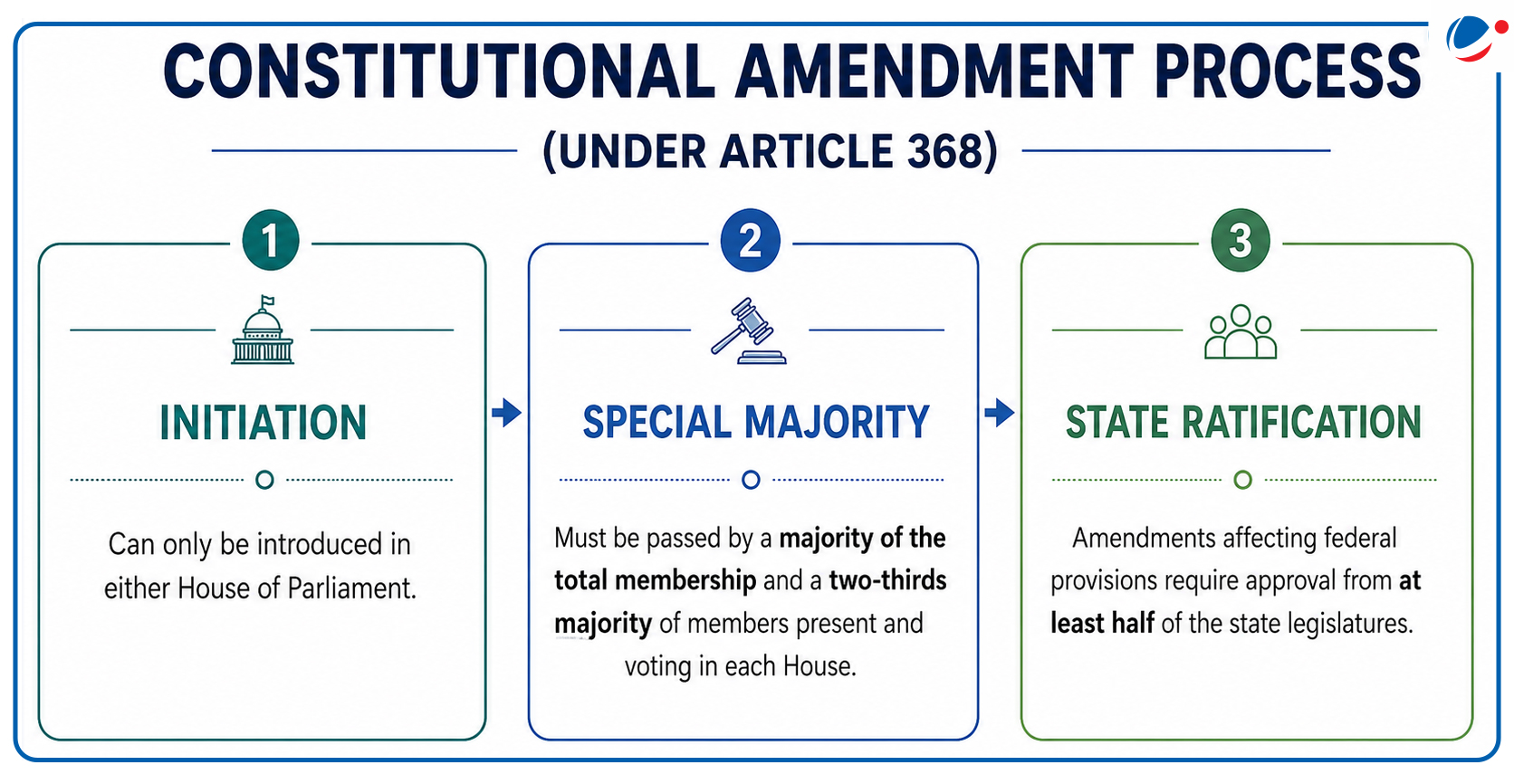
- Amend Article 334A: Allow implementation of one-third women's reservation in Lok Sabha and State Assemblies immediately after delimitation.
- It was introduced through 106th Constitution (Amendment) Act, 2023 (Nari Shakti Vandan Adhiniyam).
- Amend Article 82: Bill proposes to delete the third provision of Article 82, which mandates that the next delimitation exercise shall be undertaken based on the first Census conducted after the year 2026.
- This will enable delimitation to be carried out using Census data available before the 2026–27 Census.
About Delimitation Bill 2026
- It aimed to repeal and replace the Delimitation Act, 2002.
- Delimitation Commission (DC): Union Government to constitute the DC, which will be chaired by a person who is or has been a Judge of the Supreme Court.
- It specified that the delimitation would be based on the latest published census at the time of the Commission's formation, meaning the 2011 census would be used.
The Union Territories Laws (Amendment) Bill, 2026 extends similar changes to Delhi, Puducherry and Jammu and Kashmir.
Article Sources
1 sourceThe Rules, prepared by the Ministry of Electronics and Information Technology (MeitY), provide for the operational architectureof the Promotion and Regulation of Online Gaming (PROG) Act, 2025.
Key Highlights of Rules
- Online Gaming Authority of India: Constituted as an attached office of MeitY.
- Head office: NCT of Delhi
- Composition: six members, chaired by the Additional Secretary of MeitY.
- Functions: inquiring into complaints, issuing compliance orders, and publishing a list of determined online money games.
- Determination of an Online Game: Rules prescribe a determination test to classify whether an online game constitutes an online money game. E.g. whether game involves payment of fees, expectation of winning monetary enrichment, etc.
- Registration of Online Games: Not universally required; mandatory only for notified online games based on risk, scale, transactions, origin and for all e-sports offerings.
- User Safety Features: technical, procedural, operational, behavioural or system-related safeguards introduced to protect vulnerable users (especially children).
- Two-Tier Grievance Redressal Mechanism: Aggrieved users can appeal to the internal grievance redressal systems (est. by service providers).
- And further to the Appellate Authority (Secretary, MeitY), with each level aiming to resolve the matter within 30 days.
- Penalties and Enforcement: Proceedings are conducted digitally (unless physical presence is needed) and must be completed within 90 days of receiving a complaint.
About PROG Act, 2025
|
Article Sources
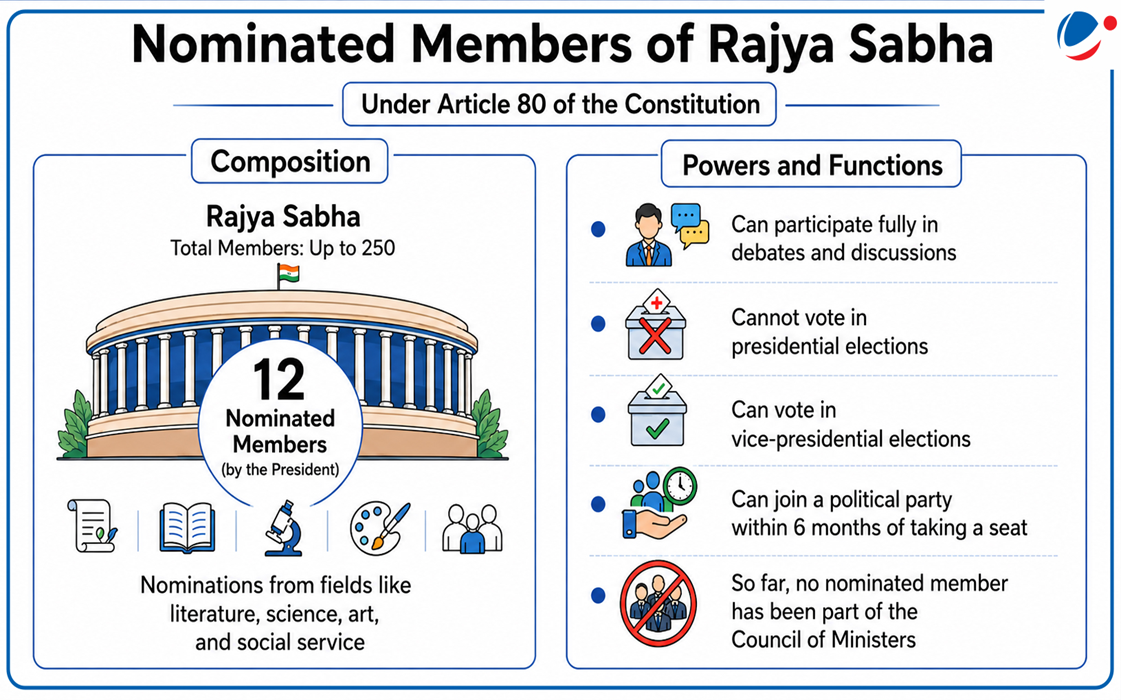
1 sourceFor the first time, a nominated member was elected as Deputy Chairman of the Rajya Sabha for the third consecutive term.
About Deputy Chairman
- Under Article 89 of the Constitution deputy chairman is elected by the Rajya Sabha itself from amongst its members.
- The Deputy Chairman performs the duty of the Chairman’s office when it is vacant or when the Vice-President acts as a President.
Justice Yashwant Varma submitted his resignation to the President, withdrawing from the proceedings of impeachment process instituted against him.
- No judge has been impeached till now.
Removal of Judges
- Article 124 and Article 218 provides for the removal of supreme court judge and high court judge through impeachment.
- Removal process is regulated by the Judges Enquiry Act (1968).
- Impeachment Process:
- Initiation: Removal motion requires signature of 100 members (for Lok Sabha) or 50 members (For Rajya Sabha) to be submitted to Speaker/Chairman.
- Investigation: On admission of motion, a 3-member committee investigates the charges.
- If committee finds the judge guilty, both the Houses pass the removal motion with special majority.
- The President then passes an order for removal.
Former Delhi Chief Minister sought Recusal of Delhi High Court Justice in a matter.
About Recusal of Judges
- Meaning: It is a judge's withdrawal from a case due to a potential conflict of interest or perceived bias.
- Purpose: Promote a fair process, public confidence in administration of justice, Judicial impartiality, etc.
- Underlying Principle: Rule Against Bias (No person should be a judge on a case in which they have interest).
- Regulation: India has no codified rules governing it.
- Legal Precedents: Ranjit Thakur v Union of India (1987), Chandraprabha v. Union of India (2025) etc.
Article Sources
1 sourceRecently, the first Conference of CPA India Region (Zone – VII) concluded.
About CPA (HQ: London)
- Founded in 1911, it is an international inter-parliamentary organization within the Commonwealth.
- Objective: advancement of parliamentary democracy and good governance
- Membership: 180 national, state or provincial legislatures divided up between 9 geographic regions of the Commonwealth.
- Key publication: The Parliamentarian journal.
Article Sources
1 sourceGovernment declared NCERT as a deemed to be university.
- Institutions that are ‘deemed-to-be-university’ enjoy academic status and privileges of a university.
- Can be declared by Central Government on advice of UGC.
About NCERT (Hq: New Delhi)
- Genesis: Autonomous organisation set up in 1961.
- Ministry: Ministry of Education
- As per National Education Policy 2020, it is nodal agency to develop National Curriculum Frameworks (NCFs) for Early Childhood Care and Education (ECCE), School Education, and Adult Education.



