


Why in the news?
Recently, UN University Institute for Water, Environment and Health (UNU- INWEH) report 'Global Water Bankruptcy' declares that the world has entered a state of water bankruptcy.
About UNU-INWEH
- UNU-INWEH is one of 13 institutions comprising the UNU, the academic arm of the United Nations.
- Established in 1996 through an agreement with the Government of Canada, UNU-INWEH is headquartered in the City of Richmond Hill, Ontario.
- UNU-INWEH specializes in addressing critical global security and development challenges at the intersection of water, environment, and health.
What is Water Bankruptcy?
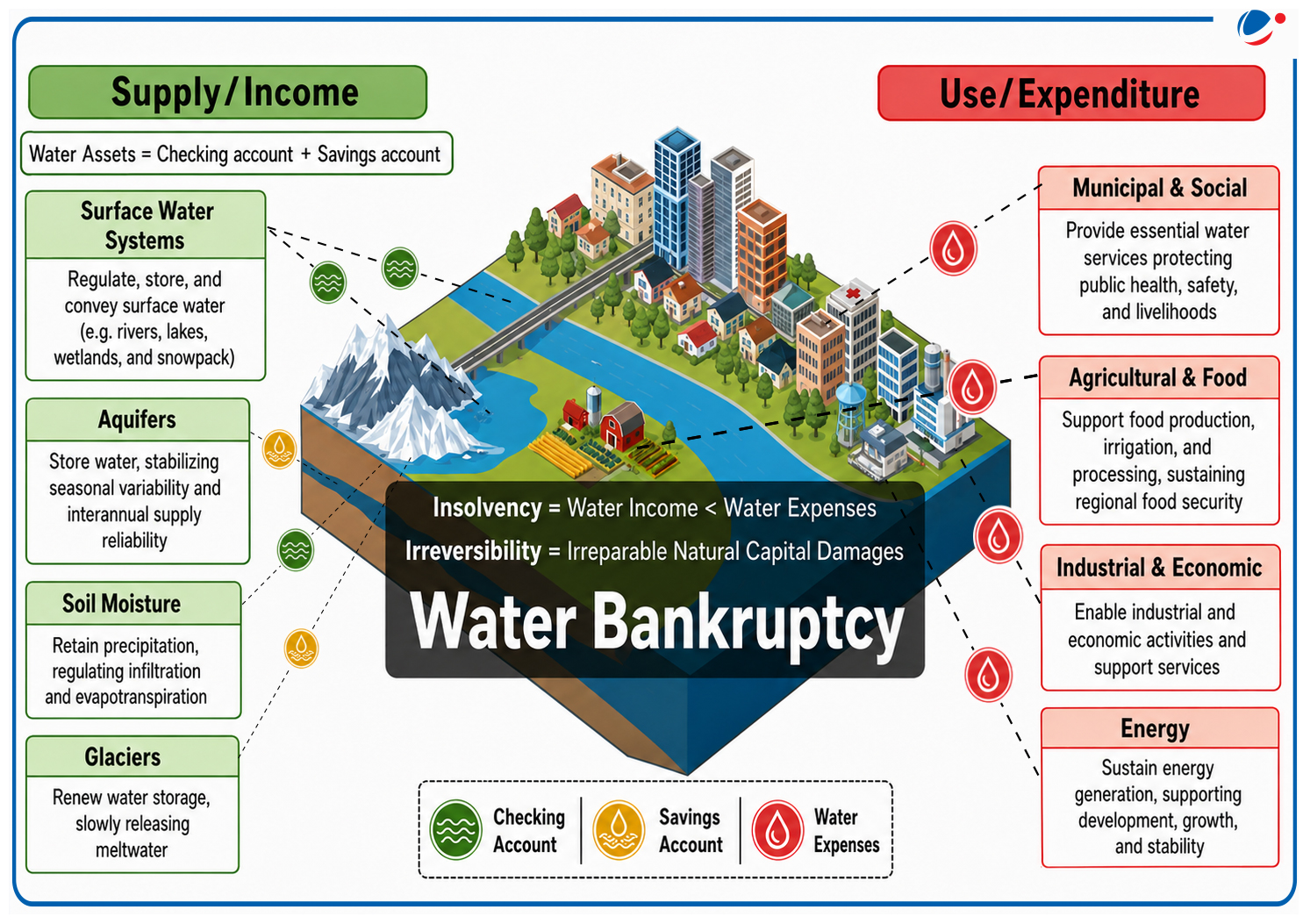
Water bankruptcy is a persistent post-crisis condition of human water system in which long term water use has exceeded renewable freshwater inflows and safe depletion limits, causing irreversible or effectively irreversible degradation.
- Such water bankruptcy results in the severe depletion of both 'checking accounts' and 'savings accounts' of natural resource.
- Checking accounts refer to natural replenishment of rivers, wetlands, and reservoirs over time.
- Savings accounts refer primarily to groundwater sources, including glaciers, and aquifers, where replenishment often occurs over several decades to even millennia.
- Water bankruptcy is the outcome of both insolvency and irreversibility conditions. (refer image)
- Water bankruptcy is different from both Water stress and Water crisis.
- Water stress is a condition of high-water demand relative to supply but impacts are largely reversible.
- Water crisis is an acute, time-bounded disruption often triggered by a shock such as drought, flood, contamination, infrastructure failure that temporarily push water systems beyond capacity but which can be restored through emergency and restoration measures.
Reasons for Global Water Bankruptcy
- Over Extraction: Global water use has exceeded renewable limits.
- About 70% of the world's major aquifers showing long-term declining trends.
- Agricultural practices: Inefficient irrigation methods along with cultivation of water-intensive crops like rice and wheat in arid region, has aggravated water scarcity in already stressed basins.
- Over 170 million hectares of irrigated cropland are under high or very high water stress.
- Ecosystem degradation: Wetlands, rivers, forests, and soils, together function as natural regulators and storage systems of water.
- However, their decline has reduced infiltration, groundwater recharge, and water purification capacity, accelerating hydrological instability.
- Water Pollution: Industrial discharge, agricultural runoff, and untreated sewage have led to widespread contamination of freshwater sources, thus reducing the effective availability of potable water.
- Infrastructure-driven overshoot: Large-scale dams, diversions, and inter-basin transfers enable expansion of irrigation, cities, and industries beyond sustainable levels.
- Climate-induced hydrological disruptions: Climate change is altering precipitation cycles, increasing evapotranspiration, and accelerating glacier and snowpack loss.
- This results in greater variability (floods and droughts) and long-term decline in reliable water availability, worsening systemic stress.
- Institutional inertia and denial: Despite rising evidence of water stress, institutions assume old normal will return.
- The world has already lost over 30% of its glacier mass since 1970 in multiple locations.
Status of India's Water Crisis
|
Recommendations of report for managing Water Bankruptcy
- New Global Water Agenda needed: Use 2026 and 2028 UN Water Conferences, International Decade for Action "Water for Sustainable Development" in 2028, 2030 deadline for SDG 6 as turning points to-
- Recognize Global Water Bankruptcy in political declarations;
- Scale up dedicated global and regional water funds;
- Recognizes water as both a constraint and an opportunity for meeting climate, biodiversity, and land commitments;
- Increase share of climate and environmental finance directed to water-related action; and
- Strengthen the links between water, peace-building, and conflict prevention.
- Recognize Global Water Bankruptcy explicitly: Integrate stress–crisis–bankruptcy framework into Rio Conventions, SDG follow-up and review, UN-Water coordination by treating water as a core structuring factor rather than a downstream impact.
- Develop Global Water Bankruptcy monitoring framework: Build on existing UN and partner efforts to track groundwater depletion, wetland and glacier loss, using Earth observation, satellite technologies, etc.
- Water Diagnostics: Support national and basin-level assessments to identify stress, crisis, or bankruptcy, thus enabling countries to design mitigation and adaptation strategies that align water demand.
- Transform water-intensive sectors including agriculture and industry: Through changes in crop choices (using millets), irrigated area, production systems, virtual water trade, and regional economic strategies that decouple prosperity from ever-increasing water use.
- Address water-quality degradation: Bring unregulated wells, and discharges into transparent, enforceable frameworks.


