


Why in the news?
Recently, the Material Recycling Association of India (MRAI) has advocated for establishing a centralised nodal agency or a dedicated ministry to promote the circular economy.
Circular Economy
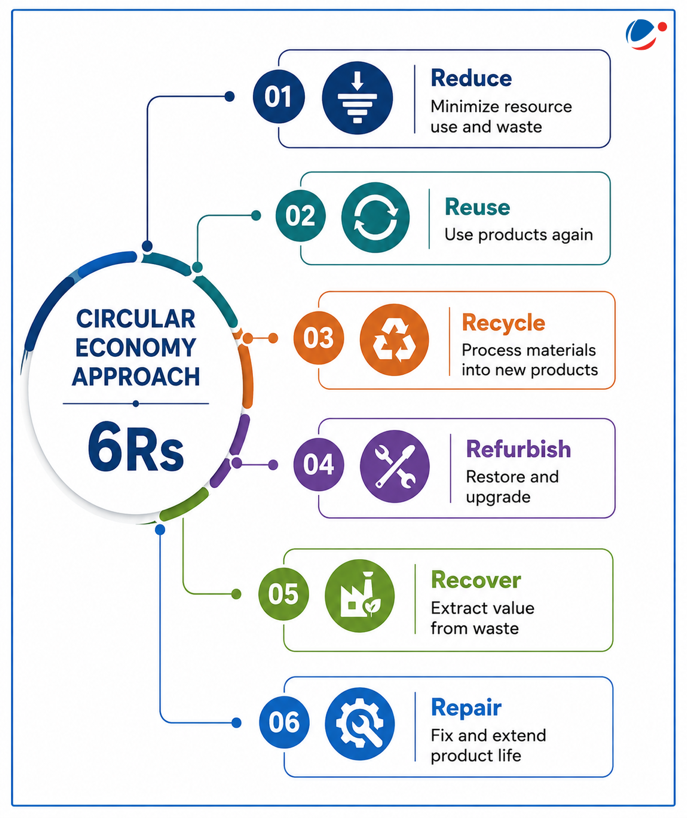
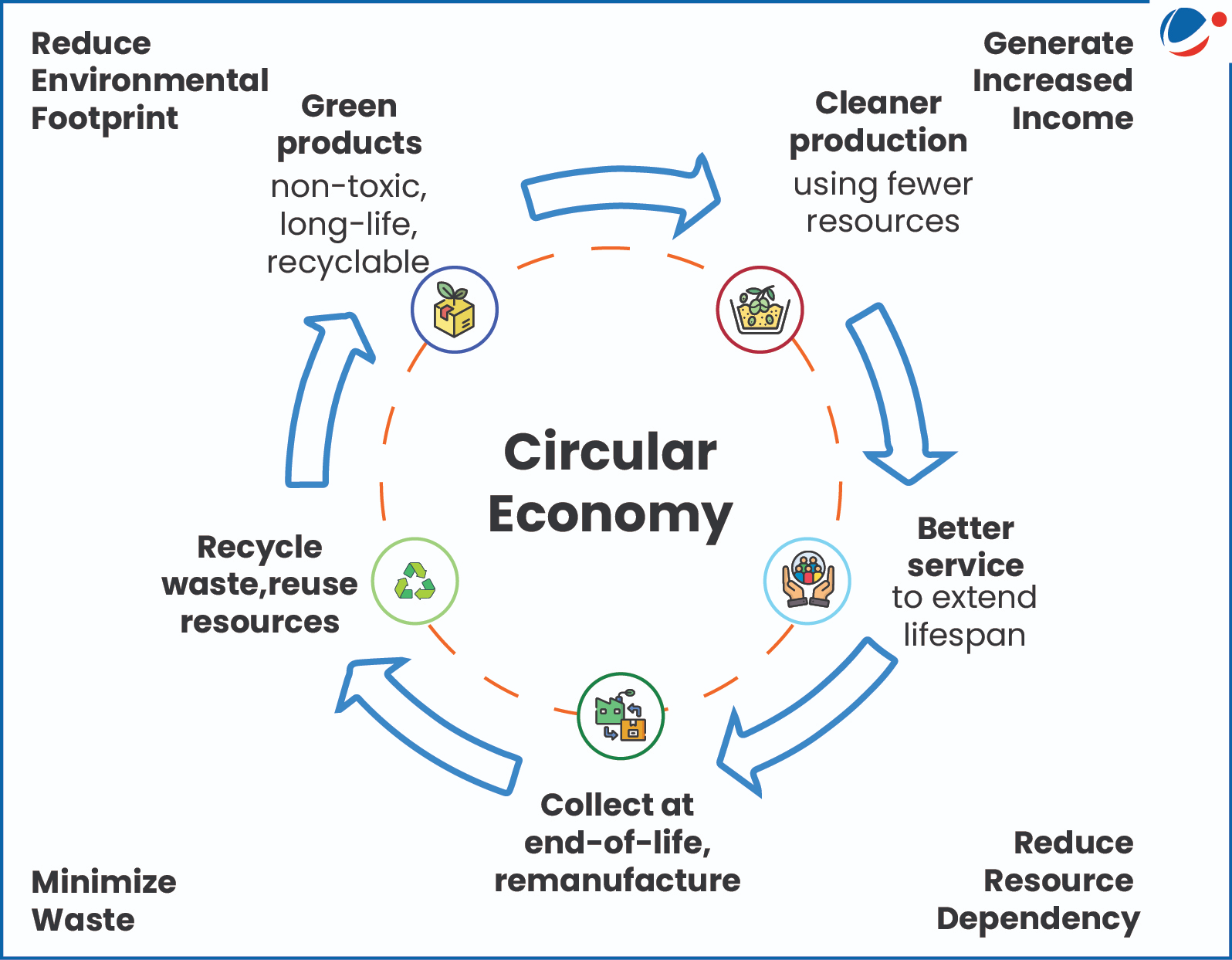
- It is a model of production and consumption, which involves sharing, leasing, reusing, repairing, refurbishing, and recycling existing materials and products as long as possible.
- It follows a strategy that departs from the traditional linear "take-make-dispose" model, where raw materials are extracted, turned into products, and then discarded as waste.
- E.g., electronic goods are refurbished, animal waste is processed into biogas for cooking, heating and lighting, etc.
Need of Promoting Circular economy in India
- Mounting Waste Management Crisis: India generates around 62 million tonnes of waste annually, with plastic, electronic, and hazardous waste growing rapidly.
- For instance, India leads the world in plastic waste generation (as of 2024) and is world's third-largest E-waste generator (7% of global volumes).
- Untapped Economic Value and Job Creation (Waste-to-Wealth): It is projected to generate a market value of over $2 trillion and create up to 10 million jobs in India by 2050.
- Mitigating Environmental and Climate Damage: Annual greenhouse gas emissions from municipal solid waste alone are projected to reach 41.09 million tonnes by 2030.
- Agricultural Sustainability: India generates an estimated 350 million tonnes of agricultural waste annually, much of which is burned, leading to soil nutrient depletion and severe air pollution.
- Blocked land: It is estimated that more than 10,000 hectares of urban land is locked in dumpsites.
Challenges
- Fragmented Governance and Institutional Bottlenecks: The recycling and waste sector is governed by multiple ministries and regulatory bodies, leading to fragmented oversight and operational inefficiencies.
- E.g., MoEFCC drafts environmental protection and waste regulations, while MoHUA manages urban planning and municipal implementation.
- Financial and Infrastructural Gaps: E.g., there are severe infrastructural deficits, such as inadequate systems to transport segregated wet waste to processing facilities.
- Informal Sector Disconnect: Despite handling a vast majority of material recovery, the informal sector remains without formal recognition.
- Low recycling rate: E.g., India's e-waste recycling rate is 10%, compared to the global average (~22%), and USA (56%).
- Policy Limitations and Compliance Issues: E.g., in the e-waste and battery sectors, policies primarily incentivise the extraction of high-value metals (like gold, copper, and aluminium) while excluding a wider basket of critical minerals.
- Other issues: Weak Traceability, informal nature of recycling industry, poor data collection and verification mechanisms, low skills, limited access to advanced recycling processes, collection inefficiencies, low consumer awareness, etc.
Initiative Taken
- Strengthening Regulatory Frameworks and Enforcement
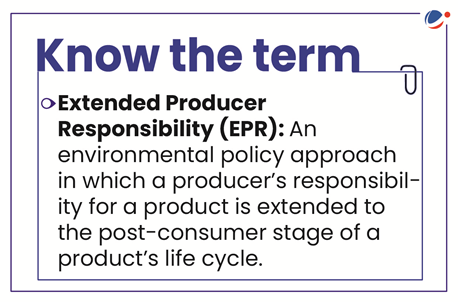
- Extended Producer Responsibility (EPR): EPR is transitioning from collection-based to recycling-based frameworks.
- Solid Waste Management (SWM) Rules, 2026: SWM Rules mandate four-stream segregation at the source and enforce strict obligations on Bulk Waste Generators to process their own waste.
- E-Waste Management Rules 2022: Strengthened EPR framework for producers and recyclers.
- Battery Waste Management Rules (BWMR), 2022: Mandates collection, recycling, and refurbishment targets, prohibiting landfill disposal and incineration.
- National Critical Mineral Mission (NCMM), 2025: Aims to develop domestic recycling capacity for critical minerals from lithium-ion batteries, e-waste and industrial scrap.
- Digitization and Traceability: The Ministry of Environment, Forest and Climate Change (MoEFCC) is developing a unified EPR portal expected to onboard up to 5 million users across the solid waste management ecosystem.
- Agricultural Waste-to-Wealth Initiatives: E.g., GOBARdhan Scheme, Crop Residue Management (CRM), etc.
- Other: Circular Economy Cell (CE Cell) constituted in NITI Aayog, LiFE Mission (Lifestyle for Environment), Swachh Bharat Mission (Urban & Rural), promoting Right to Repair, etc.
Ways to Promote the Circular Economy
- Material-specific regulatory approach: Implement sector-specific EPR frameworks, particularly in high-value recycling segments such as metals. Avoid a "one-size-fits-all" regulatory model.
- Infrastructure Development: Developing efficient waste management and logistics systems is vital to facilitate the systematic collection, processing, recycling, and recovery of resources, particularly in underserved and remote areas.
- Establish a decentralized cluster-based approach for recycling waste.
- Advancing Recycling Technologies and Innovation: E.g., Conversion of Plastic Waste into Fuel oil (Refuse derived Fuel (RDF)) and Utilization of Plastic Waste in Road Construction
- Circular by Design: Minimise waste by integrating circular economy principles at the design stage of products, with emphasis on durability, reuse, repair, recovery, and recycling.
- Enforce Binding Commitment: E.g., mandate the use of a certain % of recycled waste in the construction sector.
- Set Targets: E.g., Countries like Netherlands aim for 100% circularity by 2050.
Conclusion
A transition towards a circular economy in India requires strong institutional coordination, technological innovation, and inclusive participation across sectors. With effective policies, infrastructure, and behavioural change, it can simultaneously address waste management challenges, resource security, and climate goals.



