
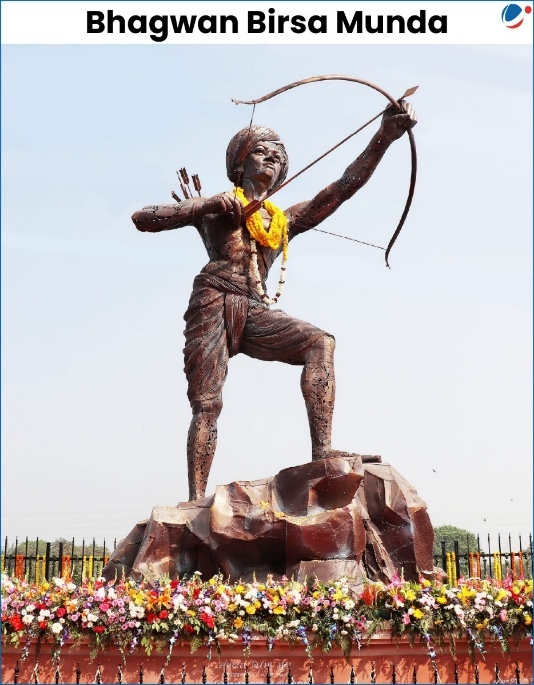
Bhagwan Birsa Munda | Current Affairs | Vision IAS
MENU
Home

Periodically curated articles and updates on national and international developments relevant for UPSC Civil Services Examination.

Quick Links

High-quality MCQs and Mains Answer Writing to sharpen skills and reinforce learning every day.

Watch explainer and thematic concept-building videos under initiatives like Deep Dive, Master Classes, etc., on important UPSC topics.

ESC

Bhagwan Birsa Munda

23 Dec 2025
2 min

In Summary

Janjatiya Gaurav Divas commemorates Birsa Munda's 150th birth anniversary; he was a tribal leader, religious reformer, and led the Munda rebellion for land rights and independence from colonial rule.

In Summary

Why in the News?

Recently, the nation observed Janjatiya Gaurav Divas to commemorate the 150th birth anniversary of the freedom fighter and tribal leader Bhagwan Birsa Munda. 

About Birsa Munda:

  • Early Life:
    • Born in Ulihatu Khunti district, Jharkhand in 1875.
    • Belonged to the Munda tribe of the Chhotanagpur plateau area, present day Jharkhand.
  • Teachings and Beliefs:
    • Monotheism: Founded a new sect known as the Birsait, Birsa preached belief in one God.
    • Revival of Tribal Faith: He rejected the influence of Christian missionaries and sought to reform traditional Munda religious practices.
    • Moral Discipline: He emphasized cleanliness, hard work, avoiding alcohol and purity in personal and social life.
  • Death & Legacy:
    • Died in Ranchi Jail due to cholera in 1900.
    • He is remembered as Bhagwan (God) and was given the title of Dharti Aaba (Father of Earth).
    • In honor of his legacy, November 15 is celebrated as Janjatiya Gaurav Divas (Tribal Pride Day) across India.
  • Contribution to Colonial Resistance:
    • Munda Rebellion: Birsa Munda launched the Ulgulan (or Great Tumult) movement (Munda rebellion) in 1899.
    • Slogan against British Raj: "Abua Raj Setarjana, Maharani Raj Tundujana" (Let the kingdom of the queen be ended and our kingdom be established.)

About Munda Rebellion

  • Causes of the Revolt
    • Permanent Settlement Act, 1793: It abolished the traditional "khuntkatti" system (joint landholdings/ clan-based communal ownership by forest clearers).​
    • Breakdown of traditional systems and institutions: Replacement of traditional clan councils with colonial courts, eroding customary justice.​
    • Economic and social exploitation:
      • Beth Begari: Forced/unpaid labour imposed on tribals.​
      • Dependence on moneylenders for credit, leading to debt and land alienation.​
  • Objectives of the Revolt:
    • Overthrow British rule in the region and end colonial oppression.
    • Expel dikus (outsiders) -zamindars, moneylenders and other exploiters – from Munda areas.
    • Restore traditional Munda control over land, effectively reviving or protecting the khuntkatti system.
    • Establish an independent Munda state under "Birsa Raj", free from British laws.
  • Outcomes of the Revolt:
    • Repeal of Begar System: It reduced rganizati forced labour.
    • Chotanagpur Tenancy Act (1908): This law prohibits the transfer of tribal land to non-tribal people and protects their ownership rights over land.

Explore Related Content

Discover more articles, videos, and terms related to this topic

RELATED VIDEOS

2
Personality in Focus | Birsa Munda

Personality in Focus | Birsa Munda

YouTube HD
In conversation:  Meaning of Living Heritage

In conversation: Meaning of Living Heritage

YouTube HD
Title is required. Maximum 500 characters.

Search Notes

Filter Notes

Loading your notes...
Searching your notes...
Loading more notes...
You've reached the end of your notes

No notes yet

Create your first note to get started.

No notes found

Try adjusting your search criteria or clear the search.

Saving...
Saved

Please select a subject.

Referenced Articles

linked

No references added yet

Subscribe for Premium Features