
GSAT-7R | Current Affairs | Vision IAS
MENU
Home

Periodically curated articles and updates on national and international developments relevant for UPSC Civil Services Examination.

Quick Links

High-quality MCQs and Mains Answer Writing to sharpen skills and reinforce learning every day.

Watch explainer and thematic concept-building videos under initiatives like Deep Dive, Master Classes, etc., on important UPSC topics.

ESC

GSAT-7R

23 Dec 2025
2 min

In Summary

India launched GSAT-7R satellite to enhance naval communication, maritime surveillance, and national security, strengthening space-based defense capabilities and strategic maritime interests.

In Summary

Why in the News?

GSAT-7R (CMS-03) Satellite was successfully launched aboard the LVM3 (India's heaviest operational rocket) from the Satish Dhawan Space Centre, Sriharikota.

More on the News

  • CMS-03 is launched by Indian Space Research Organisation (ISRO).
  • GSAT-7R represents Indian Navy's determination to protect the nation's maritime interests leveraging advanced satellite communication in Defence through Aatmanirbharta.

About GSAT-7R (CMS-03) Satellite Communication

  • It is a part of India's advanced defence satellite communication series GSAT-7.
    • Satellite Communication refers to any communication link that involves the use of an artificial satellite in its propagation path.
    • It is a form of wireless communication where satellites serve as relay stations in space, enabling the transfer of data over vast distances.
  • Weight: ~4,400 kg.
  • Orbit: Launched into the Geosynchronous Transfer Orbit (GTO), it will eventually settle into Geostationary Orbit (35,786 kilometers above Earth).
  • Coverage: Provides multi-band telecommunication services across the Indian Ocean Region and Indian landmass up to 2,000 kms from India's coastline.
  • Multiple Communication channels: The satellite operates on multiple frequency bands, which include UHF, S, C, and Ku. The system enables the transmission of voice, video and data.
  • Lifespan: 15 years and will replace the multi-band communication satellite GSAT-7/INSAT-4F Rukmini.
  • Purpose: Strengthens space-based communication, maritime domain awareness, and secure links among Navy ships, submarines, aircraft, and Maritime Operations Centres.
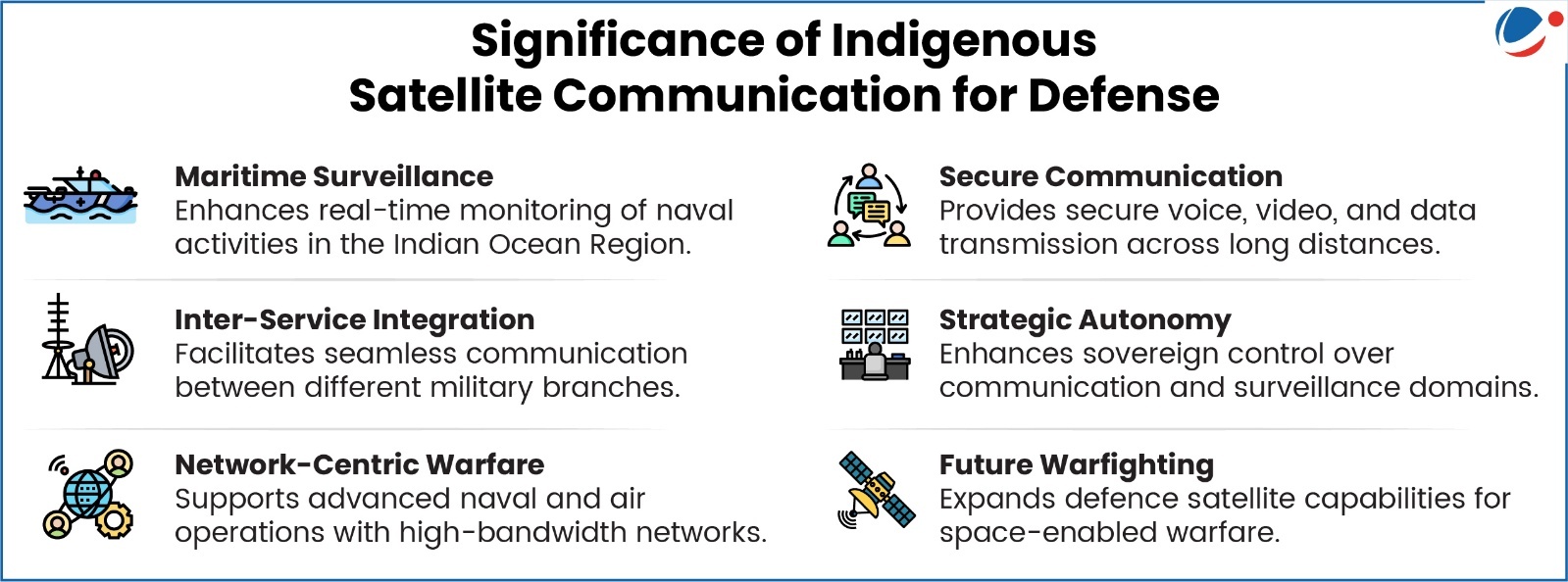
Other Satellites in the GSAT-7 Series

  • For Navy:
    • GSAT-7 (Rukmini): Operational since 2013; provides maritime communication and surveillance.
    • It is India's first officially dedicated military satellite
    • Rukmini satellite reportedly picked up the movement of China's Yuan-class conventional diesel-electric submarines during the Doklam Crisis.
    • It has reduced the navy's dependence on foreign satellites like Inmarsat (British) to communicate with Indian ship
  • For Air Force:
    • GSAT-7A (Angry Bird): Launched in 2018; strengthens network-centric operations and data link connectivity.
      • It helps the IAF connect various platforms like aircraft, helicopters, UAVs, Airborne early warning and control (AWACS) aircraft, missile units and radars.
    • GSAT-7C: To be developed and includes ground hubs for real-time, secure communication.
  • For Army:
    • GSAT-7B: To be developed to enhance surveillance and communication in border areas.

Conclusion

Satellite communication has become an indispensable pillar of India's defence preparedness, enabling secure connectivity, real-time surveillance and seamless coordination across land, air and sea. As threats grow more complex and space becomes a critical warfighting domain, strengthening SATCOM capabilities is essential for safeguarding national security and ensuring strategic superiority. 

Tags:

Explore Related Content

Discover more articles, videos, and terms related to this topic

Title is required. Maximum 500 characters.

Search Notes

Filter Notes

Loading your notes...
Searching your notes...
Loading more notes...
You've reached the end of your notes

No notes yet

Create your first note to get started.

No notes found

Try adjusting your search criteria or clear the search.

Saving...
Saved

Please select a subject.

Referenced Articles

linked

No references added yet