


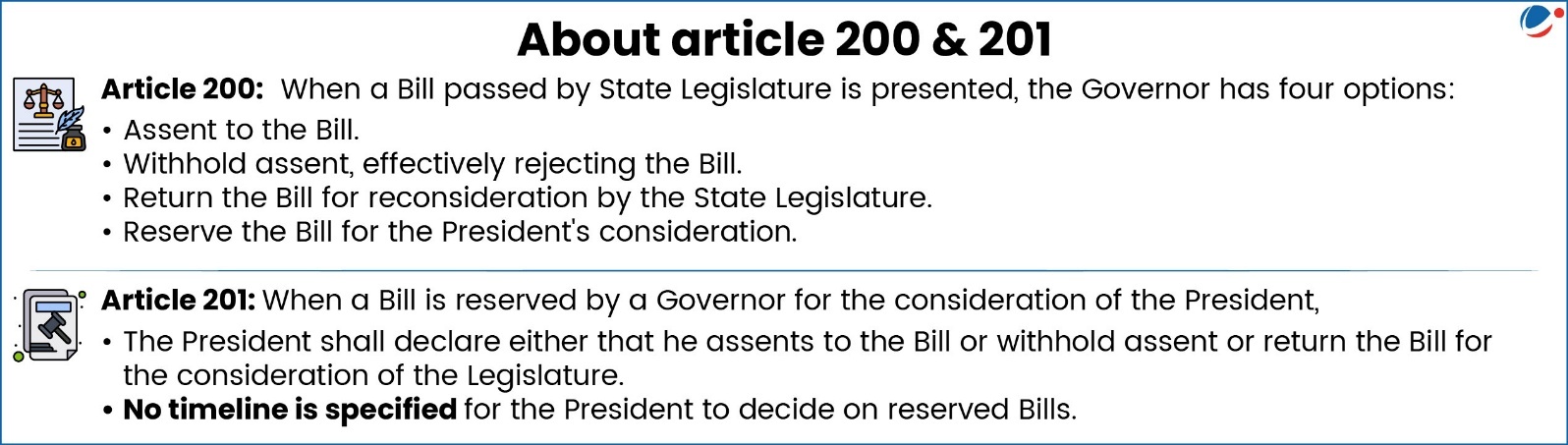
A 5-Judge bench of the Supreme Court in the 16th Presidential Reference (under Article 143) held that Court cannot impose any timelines for decisions of the President and the Governor on granting assent to Bills under Articles 200/201 of the Constitution.
- Previously, in April 2025, the Supreme Court prescribed specific time-limits for the Governor and President to act on Bills under Article 200 and 201.
- Article 143 allows the President to seek the opinion of the Supreme Court on significant legal or factual questions.
Other Key Highlights of the Judgment
- ‘Deemed Assent’ is alien to the Constitution: Courts cannot assume that a Bill is approved merely because the court-ordered time has lapsed.
- It would amount to judicial usurpation of constitutional powers of the President/Governor and violates Separation of Powers and Constitutional scheme of federal governance.
- Governors/President Cannot Sit on Bills Indefinitely: As it violates federalism, legislature’s will and constitutional morality.
- Limited Judicial Review: Courts can intervene if the Governor/President acts with malafide intent.
- Review limited to process, not merits of assent.
- The President is not required to seek advice of the Supreme Court whenever a Governor reserves a Bill for her assent as the subjective satisfaction of the President is sufficient.
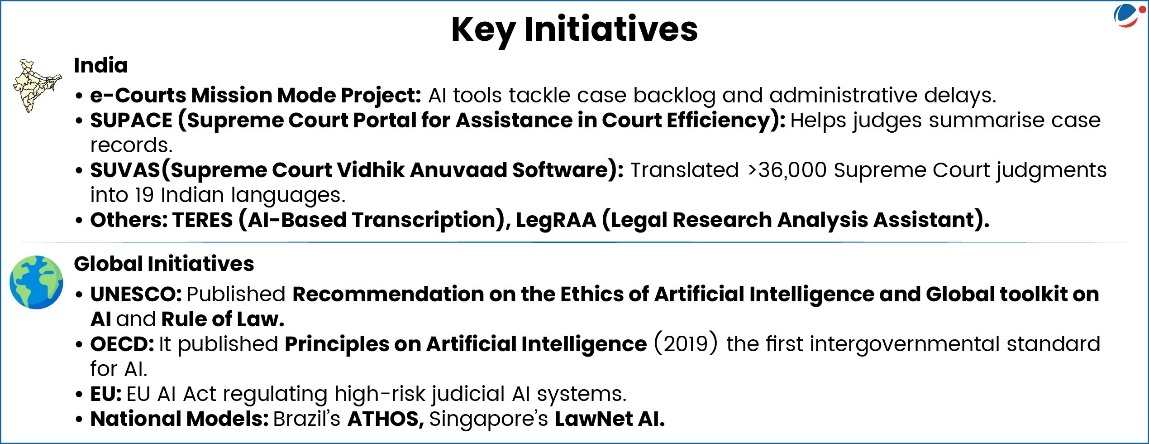
The Supreme Court’s Centre for Research and Planning released White Paper on Artificial Intelligence and the Judiciary.
The paper reviews the safe use of AI in the judiciary, outlines key ethical challenges, offers recommendations, and draws on international case studies to illustrate emerging risks.
Key Highlights of the Report
Risks and Ethical Challenges of AI (Artificial Intelligence)
- Overreliance and Loss of Human Judgement: It can weaken judicial discretion, and the opaque nature of models reduces accountability.
- Hallucinations and Fabricated Content: It may produce false information or non-existent citations. E.g.US case “Roberto Mata v. Avianca and Coomer v. Lindell”.
- Algorithmic Bias: E.g. The US COMPAS tool, challenged in State v. Loomis showed potential racial bias.
- Others: Deepfakes and Evidence Manipulation, Privacy and Confidentiality Risks, Intellectual Property Concerns etc.
Key Recommendations
- Create AI Ethics Committees: Courts should establish bodies with technical and legal experts to review AI tools and set deployment standards.
- Prefer Secure In-House AI Systems: Developing internal tools reduces confidentiality, security and data-exposure risks.
- Adopt a Formal Ethical AI Policy: A clear framework must define authorised uses, responsibilities and accountability mechanisms.
- Others: Mandate Disclosure and Audit Trails, Provide Comprehensive Training etc.
Article Sources
1 sourcePublished by Centre for Research & Planning, Supreme Court of India, this report examines prison manuals, stereotypes, mental health support, wages, and technological reforms, proposing a human-rights-based approach to prison administration.
Key Issues in Indian Prisons
- Governance: There is diversity in prison governance as prisons fall in the legislative and administrative domain of the States under List II, Schedule 7 of the Constitution.
- India follows the United Nations Standard Minimum Rules for the Treatment of Prisoners, known as ‘The Nelson Mandela Rules’, which advocates the humanisation of prison institutions.
- Overcrowding: Prisons have an occupancy rate of 131.4% and 3 out of every 4 prisoners are undertrials.
- Open prisons remain underutilised with an occupancy rate of 74%.
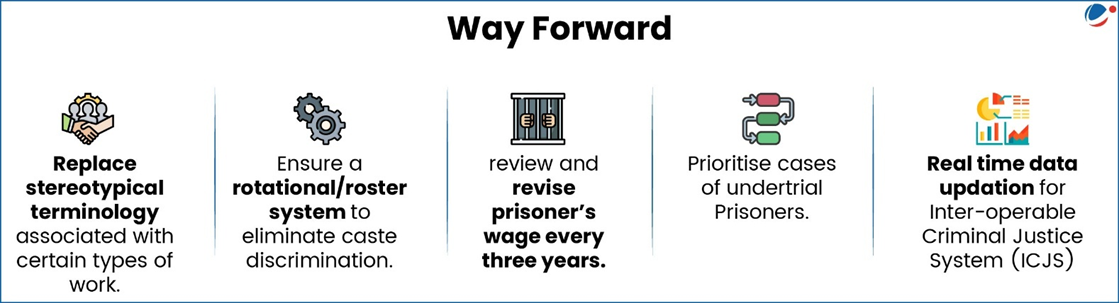
- Stereotypes: Many prison manuals refer to prison work related to conservancy and sanitation as ‘menial’ or ‘work of degrading character’, which perpetuates a hierarchical view of labour.
- Caste Bias: Some prison manuals continue to retain provisions assign prison work based on caste identity.
- This has been held unconstitutional in Sukanya Shantha Case.
- Wage Disparity: Disparity ranges from Rs. 20 (much lower than lowest minimum wage) in Mizoram to Rs. 524 in Karnataka.
- Women Prisoners: Prison manuals do not explicitly provide for the right to reproductive choice and limit women prisoners to predominantly domestic tasks like cooking, denying them equal access to work.
- Ineffective legal aid: Quality of legal aid for prisoners suffers due to the lack of physical and digital infrastructure.
Article Sources
1 source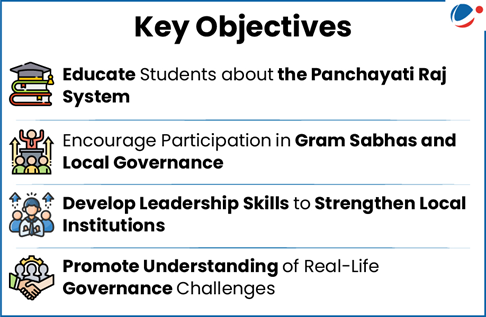
Ministry of Panchayati Raj, in collaboration with the Ministry of Education and Ministry of Tribal Affairs, launched MYGS initiative.
About MYGS
- It is a pioneering initiative to strengthen Janbhagidari and promote participatory local governance by engaging students in simulated Gram Sabha sessions.
- It is aligned with National Education Policy 2020, and will be implemented across Jawahar Navodaya Vidyalayas (JNVs), Eklavya Model Residential Schools (EMRSs), and State Government Schools.
- JNVs are residential schools established under NEP 1986 to provide education to rural children irrespective of their socio economic status.
- EMRSs aim to provide quality education to Scheduled Tribes (ST) students in areas having more than 50% ST population and at least 20,000 tribal persons.


