


Why in the News?
The Department of Agriculture and Farmers Welfare has released the Draft Seeds Bill, 2025.
About Draft Seeds Bill, 2025
- The Proposed Legislation seeks to replace the Seeds Act, 1966, and Seeds (Control) Order, 1983,
- Objective: It will regulate the quality of seeds and planting materials available in the market.
Key Highlights of the Bill
- Mandatory Registration: No seed, except farmers' variety and the one produced exclusively for export purposes, shall be sold unless registered.
- Mandatory boarding on SATHI portal: It is a national portal created by the Ministry of Agriculture and Farmers' Welfare, in partnership with National Informatics Centre (NIC) to provide complete traceability of the seeds from the point of origin till they reach the farmer.
- Regulation of the sale of seeds: Seed varieties to conform to the Indian Minimum Seed Certification Standards.
- Seed Committees: Central and State Seed Committees to be constituted by the Central Government and State Governments, respectively.
- The Central Seed Committee shall offer advice on matters relating to seed programming, planning, seed development, production, storage, processing, export, and imports, etc.
- Registration Sub-Committees: To recommend kinds or varieties of seeds for registration after scrutinizing their claims.
- National Register on Seed Varieties: It is a register of all Kinds or Varieties of seed kept under the control and management of the Registrar.
- Protect Farmer's rights: protect farmers' rights to save, use, exchange, or sell their seeds (like traditional varieties) without needing brand registration, but they can't sell them under a brand name.
- Establishment of Central and State Seed Testing Laboratories: Equipped with Seed Analysts and Inspectors.
Comparative Analysis of Seeds act, 1966 and draft seeds bill, 2025 | ||
Aspect | Seeds Act, 1966 | Draft Seeds Bill, 2025 |
Regulatory Scope | Limited to Notified Varieties, leaving a large part of the seed market unregulated | Covers all commercially sold seed varieties, creating a uniform regulatory landscape |
Seed Registration | Registration depended on government notification and wasn't Mandatory for every variety. | Mandatory registration for every seed variety before trade; old notified varieties are deemed registered. |
Quality Assurance Mechanisms | Basic standards for germination and chastity, with limited testing structure. | Stricter quality marks, digital labelling, QR traceability, and expanded accredited laboratories. |
Farmer Rights | Limited protections; Farmers had no structured compensation avenue. | Farmers can save, exchange, and sell their seeds. |
Market Responsibility | Weak oversight allowed limited seeds to circulate. | Stronger monitoring through enrolment, labelling, and traceability conditions. |
Penalty | Fines were low and out-dated | Three tier penalty system (Trivial, minor and major) with significantly advanced fines. |
Technological adaptation | Did not aim to regard hybrids, GM seeds, or biotechnology advancements. | Incorporates biotech norms, regulated seed imports, and oversight mechanisms for modern technologies. |
Overview of India's Seed Sector
- India is the 5th largest Seed Industry in the World (the USA has the largest industry).
- Seed exports amount to USD 150 million within a global export market valued at USD 15 billion (less than 1%) in 2023-24.
- The seed programme follows the limited generations' system for seed multiplication in a phased manner.
- It recognizes three generations, namely breeder, foundation and certified seeds.
Three Generations of Seeds | |
Breeder Seed: Progeny of the nucleus seed of a variety and is produced by the originating breeder or by a sponsored breeder.
| Foundation Seed: Progeny of breeder seed. |
Certified Seed: It is the progeny of foundation seed. | |
Existing Challenges in the Seed Sector
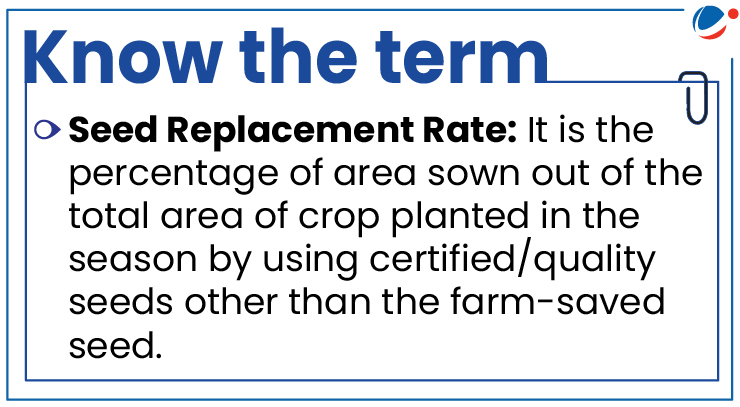
- Low Seed Replacement Rate (SRR): In India, many open pollinated crops in food grains and oilseeds, the SRR is less than 25%-30%.
- Seed Market Monopoly: Multinational companies (e.g., Bayer, Monsanto) dominate seed markets, limiting access to local seeds.
- Seed Production Constraints: Ensuring adequate and timely seed production to meet the requirements of India's highly diverse cropping system remains a major challenge.
- Seed Availability: Farmers primarily meet their seed requirements through farm-saved seeds, with approximately 65% relying on their own saved seeds or those distributed among them.
- Poor Quality Seeds: Inferior quality seeds result in low germination rates and suboptimal crop performance.
- Other: Inefficient post-harvest seed management, including storage, processing, and distribution, further affects seed quality and availability.
Key Initiatives Taken
|
Way Forward
- Promoting Biotech-Innovation: For high-yielding, stress-tolerant, and nutrient-rich seed varieties to address climate change and food security concerns. E.g. ICAR recently developed two genome-edited rice varieties (DRR Rice 100 (Kamala), based on Samba Mahsuri, and Pusa DST Rice 1, based on MTU 1010).
- Establishing Community Seed Banks: It will help in preserving and promoting local seed varieties.
- Identify seed hubs: They can produce and supply seeds to farmers in specific areas.
- This approach not only minimizes transportation costs but also helps reduce the overall cost of seed supply for farmers.
- Increasing SRR: Timely replacement of seeds to progressively increase the SRR, particularly for regionally important varieties
- Improve Seed Quality Assurance: Upgrade seed testing laboratories, promote digital traceability, and enforce strict quality standards to ensure high germination and varietal purity.
- Other: Establishing safe storage facilities to ensure post-harvest management of seed, etc.
Conclusion
The Draft Seeds Bill, 2025 seeks to strengthen India's seed system by improving quality standards, ensuring farmer access to affordable certified seeds, and promoting innovation. By tackling persistent gaps in regulation and seed availability, it can enhance productivity and support a more resilient agricultural sector.



