


Why in the News?
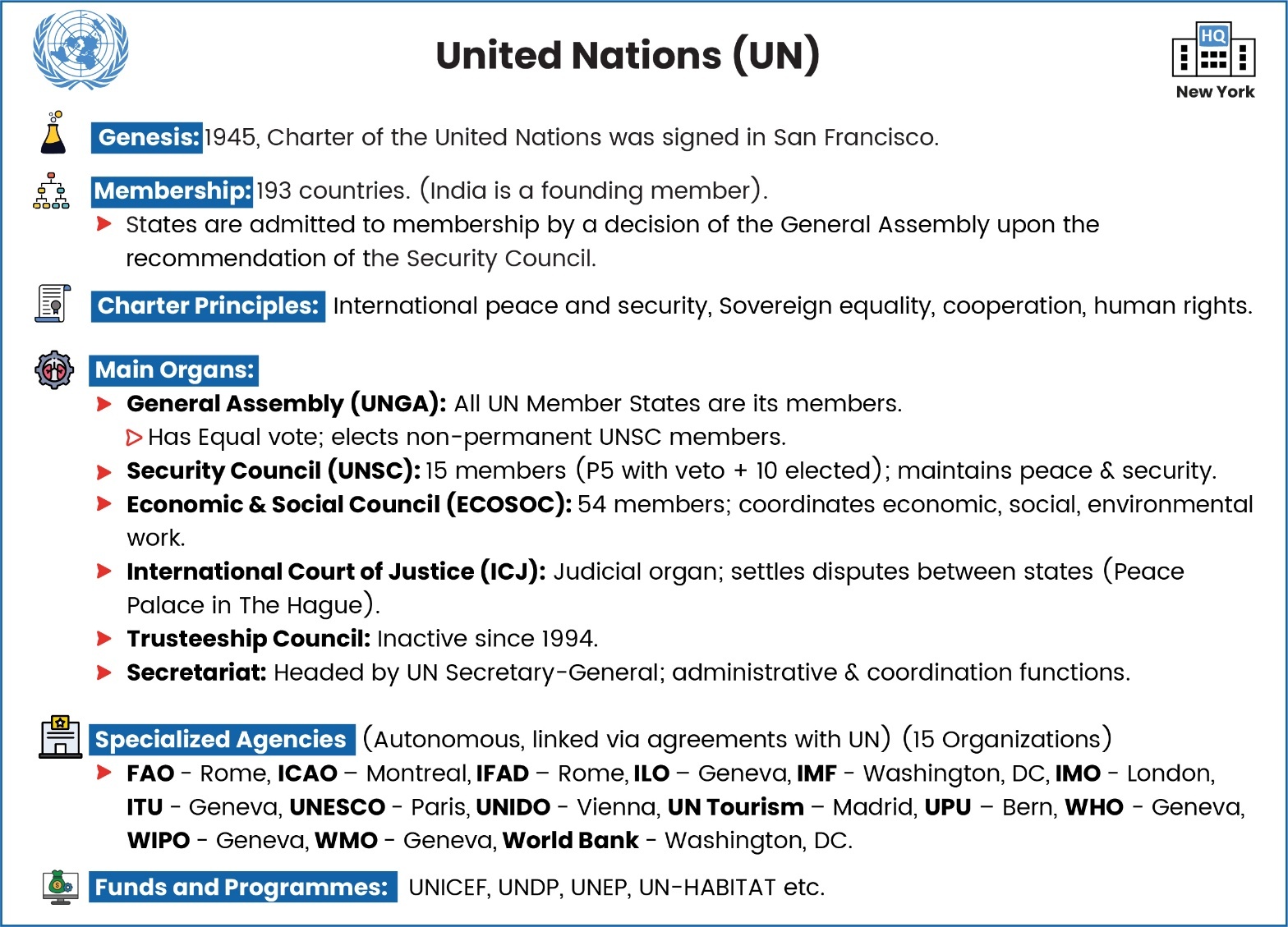
The United Nations (UN) recently presented the UN80 Initiative Action Plan, a coordinated roadmap to carry out system-wide reforms.
About UN80 Initiative
- It is an ambitious, system-wide reform effort, launched in March 2025 to celebrate 80th anniversary of UN.
- Objective: Make the UN more agile, integrated, efficient, and impactful, especially amid shrinking resources.
- It has three main work streams:
- Identifying efficiencies and improvements in the way the UN works.
- Reviewing the implementation of mandates received from Member States.
- Examining possible structural changes and programme realignments in UN system.
- Timeline assigned: November 2025 to December 2026
- Key Reform Areas (Work Packages)
- Peace & Security: New models for peace operations that delegate tasks more efficiently.
- Humanitarian Response: A New Humanitarian Compact for simpler emergency plans and integrated supply chains.
- Development System: Reconfiguration of UN Country Teams and regional structures for cost-effectiveness.
- Institutional Mergers: Assessing possible mergers of entities with overlapping work for greater coherence and savings.
- E.g., UNDP (United Nations Development Programme) and UNOPS (United Nations Office for Project Services).
- Operational Enablers: Common data, shared technology platforms, unified supply chains, and simplified training systems.
Need for UN reforms
- Structural challenges
- Outdated representation: UNSC reflects post-WWII geopolitics, not 21st-century realities, with no permanent seats for countries such as India (one of the largest contributors to UN peacekeeping).
- Loss of Credibility and Global Trust: Prolonged conflict deadlocks, selective enforcement of human rights, and perceived unequal treatment of nations have eroded trust in UN's authority.
- E.g., UNSC deadlock due to veto power in case of Russia–Ukraine war, Israel–Palestine conflict etc.
- Governance challenge
- New global challenges: UN lack of specialized bodies and adequate resources to respond effectively to new issues like cyber security, AI ethics, etc.
- Mandate overload: 40,000+ mandates overwhelm the system, creating duplication and inefficient resource use.
- Institutional challenges
- Resource Constraints: System resources are estimated to fall 25% (from $66 to $50 billion) in 2026, compared to 2024.
- About 80% of UN system funds come from voluntary contributions.
- Outdated systems: Poor digital tracking and manual processes slow down mandate management.
- Institutional fragmentation: Multiple entities operate in the same thematic spaces, increasing transaction costs for countries and partners
- E.g., UN-Women and UNFPA (the United Nations Population Fund) do overlapping work.
- Ambition–resource mismatch: Member States assign more tasks than the UN has capacity or funds to execute.
- Resource Constraints: System resources are estimated to fall 25% (from $66 to $50 billion) in 2026, compared to 2024.
Conclusion
Reforms envisioned under UN80 will strengthen the UN's ability to respond to emerging global crises by modernizing multilateral governance, improving efficiency, and reducing costs. They also reinforce the UN Development System, enabling more effective delivery of the Sustainable Development Goals.


