


Why in News?
Recently, World Inequality Lab released World Inequality Report 2026.
Key Highlights of the Report
Global
- Global Wealth Share:
- Global Top 10% of population owns ~75% of total wealth &
- Bottom 50% holds a mere 2%.
- Income Divide:
- Global top 10% of income-earners earns more than remaining 90% combined &
- Poorest half of the global population receives <10% of total global earnings.
- Climate Inequality (The Carbon Divide)
- Stark Disparity: Poorest half of global population accounts for a mere 3% of private capital-related carbon emissions, while the wealthiest 10% are responsible for approximately 77% of these emissions.
- Unequal Distribution of Risk: A clear climate injustice exists, where those who emit the least (often in low-income countries) are the most vulnerable and exposed to climate shocks.
- Systemic Global Financial Inequality
- The "Exorbitant Privilege": The global financial system reinforces inequality by allowing rich economies to borrow cheaply and receive higher returns on foreign investments.
- Wealth Transfer: This system results in a net income transfer of approximately 1% of global GDP flowing annually from poorer to richer nations, an amount nearly three times the total global development aid.
India
- High Income Inequality:
- Top 10% of earners capture 58% of the national income &
- Bottom 50% receives only 15% of the national income.
- Extreme Wealth Inequality:
- Richest 10% hold ~65% of the total national wealth &
- Top 1% alone holds approximately 40% of the total national wealth.
Measurement of InequalityGini Index
Kuznets Ratio
|
Consequences of High Inequality
- Economic inefficiency and stagnation: Inequality reduces overall economic performance as inadequate healthcare, nutrition & education among large population limits productivity and leads to the wastage of talent. Eg: Anaemia impacts workforce participation, reducing household incomes and impeding economic growth. (NFHS-5)
- Intergenerational poverty traps: Unequal outcomes reinforce unequal opportunities, with parental income and education strongly predicting children's life prospects, thereby reducing social mobility.
- Undermined climate action: Excessive consumption and carbon emissions by the very rich drive climate change, which harms the global economy and disproportionately affects the poor. Eg. Per Capita Carbon emissions are low in developing countries.
- Increased vulnerability and debt: Low-income and informal sector households face high risks from economic shocks and carry increased debts, threatening broader economic stability. Eg: Impact of COVID-19 lockdown on migrant workers and street vendors.
- Erosion of trust and democracy: Economic inequalities translate into political inequalities, creating a cycle wherein rules are shaped to favour the rich, deepening economic divides and social polarization. Eg: Oil wealth concentration in the hands of elites in Nigeria.
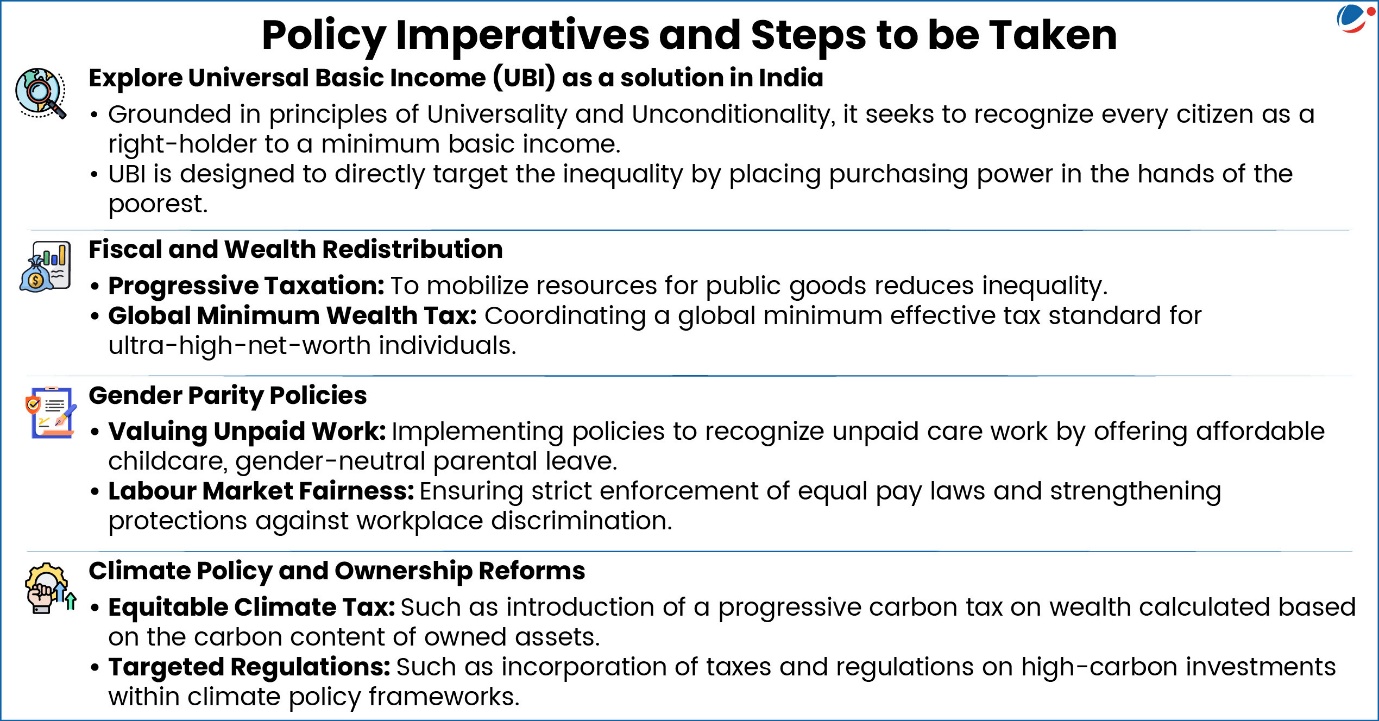
Conclusion
According to the World Bank, India ranks fourth globally in income equality with a Gini Index of 25.5. India's extreme poverty also fell to 2.3% in 2022–23, with 171 million people moving out of extreme poverty between 2011–23. It has been supported by schemes such as PM Jan Dhan Yojana, Direct Benefit Transfer, Ayushman Bharat and Pradhan Mantri Garib Kalyan Anna Yojana (PMGKAY). This reflects progress in the right direction, though stronger measures in employment generation, education, skilling and social protection are needed to sustain and deepen equity gains.



