


Why in the News?
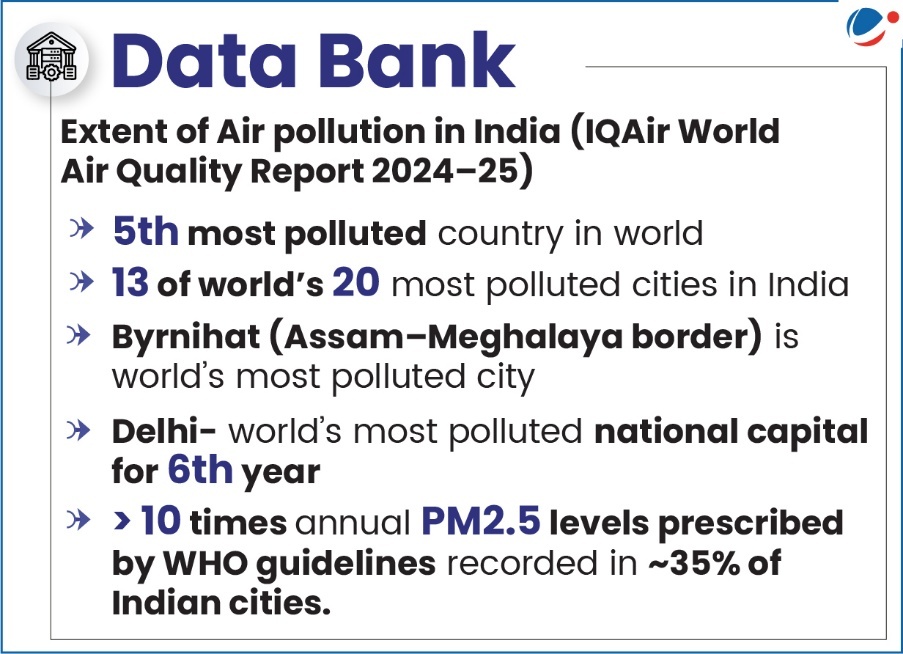
Commission for Air Quality Management (CAQM) implemented Stage-III Graded Response Action Plan (GRAP) across the entire NCR highlighting the issue of urban air pollution in India.
About Graded Response Action Plan (GRAP)
- It is an emergency response mechanism based on AQI level of Delhi implemented by Commission for Air Quality Management (CAQM).
- It was first created on Supreme Court directions (M. C. Mehta vs. Union of India).
- It has four stages, based on AQI levels-
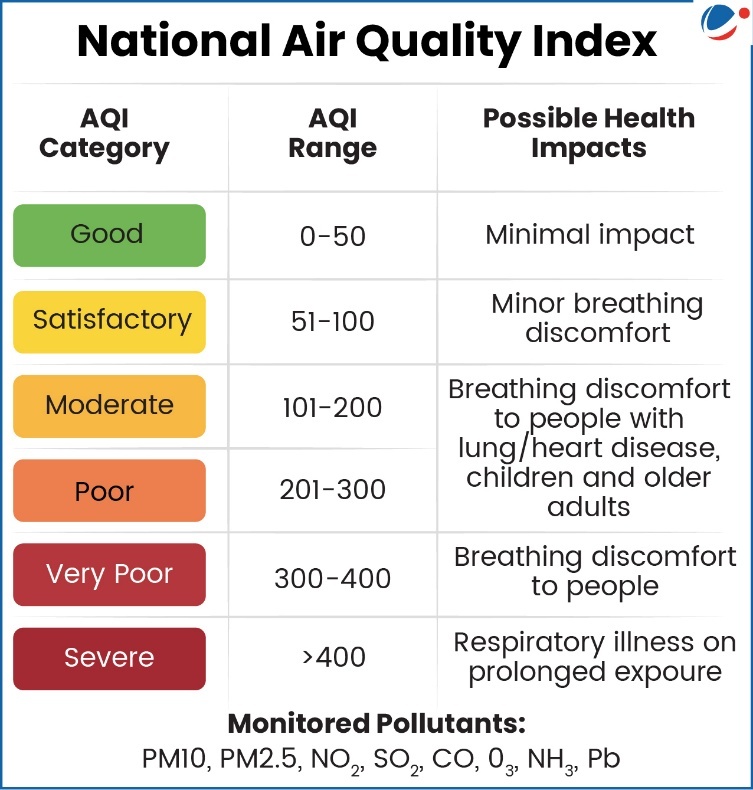
- Stage 1: Poor category (AQI 201 to 300).
- Stage 2: Very poor category (AQI 301-400).
- Stage 3: Severe category (AQI 401-450).
- Stage 4: Severe + category (AQI 451+)
Causes of Urban air pollution in India
- Meteorological Factors:
- Winter weather conditions like temperature inversion and low wind speeds trap pollutants near the ground and prevent their dispersion in cities like Delhi.
- Pre-Monsoon Dust Transport from Thar Desert and Middle East into Indian cities, in northern regions like Delhi.
- Urban and Industrial Factors: Pollution from Industries like cement, steel, refineries, brick kilns (e.g., refineries and chemical industries in Mumbai's Chembur area), Vehicles (Delhi's vehicles doubled since 2005), Construction and Demolition Activities (e.g., rapid construction along Gurugram's Golf Course Road) etc.
- Urban layout: Narrow streets with tall buildings (street-canyon effect) trapping pollutants; Shrinking green/blue spaces due to unplanned urban expansion reduces natural filtration etc.
- Transboundary pollution: Pollution in Delhi due to seasonal stubble burning in neighboring states; Worsened air quality over Chennai due to Aerosols transported from north India etc.
- Other sources: Ground-level ozone (forms when NOx and VOCs react under strong sunlight); Burning firecrackers during festivals; open waste burning, frequent landfill fires (e.g., Delhi, Ghaziabad, Bhalswa–Ghazipur landfills) etc.
Impact of Air Pollution
- Health Impacts: Cardiovascular disease, respiratory infections, irritation in eyes etc.
- E.g., Air pollution linked to ~15% of all deaths in Delhi in 2023 (Centre for Research on Energy and Clean Air).
- Environmental Impacts
- Climate Change: Pollutants like black carbon and ground-level ozone contribute to global warming.
- Acid Rain: Emissions of SO₂ and NOx react with water vapour to form acids, damaging soils, crops, forests, monuments and aquatic ecosystems.
- E.g., yellowing and surface corrosion in Taj Mahal.
- Economic Losses: India lost economic output equivalent to 9.5% of GDP in 2022 due to air pollution. (The Lancet Countdown on Health and Climate Change report, 2025)
- Social Impacts:
- Reduced quality of life due to poor visibility, closure of schools and offices.
- Disproportionate impact on vulnerable groups like Children, elderly, and poor.
Steps taken to curb the Air Pollution
- National Clean Air Programme (NCAP): Aims to reduce particulate matter concentrations by 40% by 2026 in 131 cities
- Graded Response Action Plan (GRAP): Emergency measures to combat air pollution in Delhi-NCR.
- Commission for Air Quality Management (CAQM), 2021: Statutory body established for improved air quality management in the National Capital Region.
- Measures for Vehicular Emission Control
- Leapfrogging to BS-VI fuel and vehicle standards (2020 nationwide).
- Transition to 20% Ethanol Blended Petrol (E-20)
- RFID system for toll & Environment Compensation Charge on commercial vehicles entering Delhi.
- Promotion of electric mobility under PM E-DRIVE Scheme, Electric Mobility Promotion Scheme 2024 (EMPS 2024).
- SATAT initiative for creating Compressed Bio-Gas (CBG) ecosystem.
- Air Quality Monitoring & Data Systems
- National Air Quality Index (AQI) launched in 2015 (see infographic).
- Installation of Online Continuous Emission Monitoring System (OCEMS) in red category air polluting industries in Delhi-NC.
- System of Air Quality and Weather Forecasting and Research (SAFAR) Portal provides air quality updates.
- Municipal Solid Waste (MSW) & Construction Dust Control
- Guidelines for C&D waste management and dust mitigation (2017).
- Biomining and bioremediation of legacy waste to prevent landfill fires.
- Shifting of all operational brick kilns to zig-zag technology in Delhi and NCR.
Challenges in curbing Air Pollution in India
- Policy & Governance Challenges
- Transboundary pollution: About 30% of urban pollution originates outside city limits yet National Clean Air Programme (NCAP) city plans operate in silos.
- Reactive measures: Focus on crisis-time and temporary actions like GRAP, smog towers, rather than continuous, long-term pollution control.
- Fragmented governance: Involvement of multiple agencies (Central government, Delhi government, multiple NCR state governments, CPCB) with differing responsibilities and budgetary resources.
- Poor enforcement: Persistent Stubble burning; Unregulated construction; outdated industrial boilers etc.
- Monitoring & Data Limitations
- Sparse Network: Many smaller towns and rural areas lack PM2.5/PM10 monitors.
- Lax National Standards: India's air pollution standards are more relaxed in comparison to WHO's prescribed guidelines.
Pollutant | WHO 2021 Guideline | India (NAAQS) |
PM2.5 | 5 µg/m³ | 40 µg/m³ |
PM10 | 15 µg/m³ | 60 µg/m³ |
NO2 | 10 µg/m³ | 40 µg/m³ |
- Other Challenges:
- Slow EV penetration in public transport compared to China's full electric bus fleets (e.g., Shenzhen).
- Heavy reliance on coal-based energy due to rising power demand.
- Public Apathy and Limited Awareness about chronic health impacts of PM2.5/PM10 exposure.
- MSMEs like small brick kilns and dyeing units lack funds to afford pollution-control equipment.
Way Ahead
- Parliamentary standing committee recommendations to reduce stubble burning:
- Price system like Minimum Support Price (MSP) to guarantee returns when farmers sell stubble.
- Real-time Mapping of Crop Acreage and Forecasting of Crop Maturity to assess district-wise crop yields for better planning.
- Unified National Policy for integrating agricultural residue into bioenergy generation
- Governance & Institutional Measures
- Strengthen Legal and Institutional Framework: Give NCAP statutory backing and empower pollution control boards for strict enforcement.
- Inter-State & Regional Coordination: Adopt airshed-based planning for coordinated action on stubble burning, transport, and industrial emissions.
- Set up regional clean-air councils modelled on international cross-border pollution frameworks.
- Long-Term Planning: Convert GRAP-style triggers into year-round, city-specific clean air action plans.
- Economic & Financial Measures
- Technology-Driven Air Quality Management: Adopt predictive systems using AI/ML to forecast pollution surges and identify real-time sources allowing preventive rather than reactive action.
- Ensure Stable and Adequate Funding: Increase predictable budget allocations and adopt innovative tools like green bonds and pollution taxes.
- De-risk Clean Technology Investments: Support risk-sharing for renewable energy and EV sectors and reform DISCOM finances to lower investment risks.
Best practices
|
Conclusion
India's clean-air journey requires moving from short-term fixes to sustained, technology-driven and well-coordinated action. A multi-sector, data-backed approach is essential for achieving durable, healthier air for all.



