


Why in the News?
The Union Budget 2026–27 has announced an increase in the outlay for the Electronics Components Manufacturing Scheme (ECMS) to ₹40,000 crore.
About ECMS
- Aim: To create a self-sustaining ecosystem for domestic component manufacturing.
- Integrate India's electronic industry with global value chains by encouraging production of essential components, sub-assemblies, and raw materials within the country.
- Ministry: Ministry of Electronics and Information Technology (MeitY).
- Incentives: Scheme provides differentiated fiscal incentive on target segment products in terms of turnover:
- Turnover linked incentive (for 6 years, with one year optional gestation period) for display module, camera module, multilayer printed circuit board, etc.
- Capex incentive for 5 years.
- Hybrid incentive
- Targeted Components: Include display modules, sub-assembly camera modules, printed circuit board assemblies, lithium cell enclosures etc.
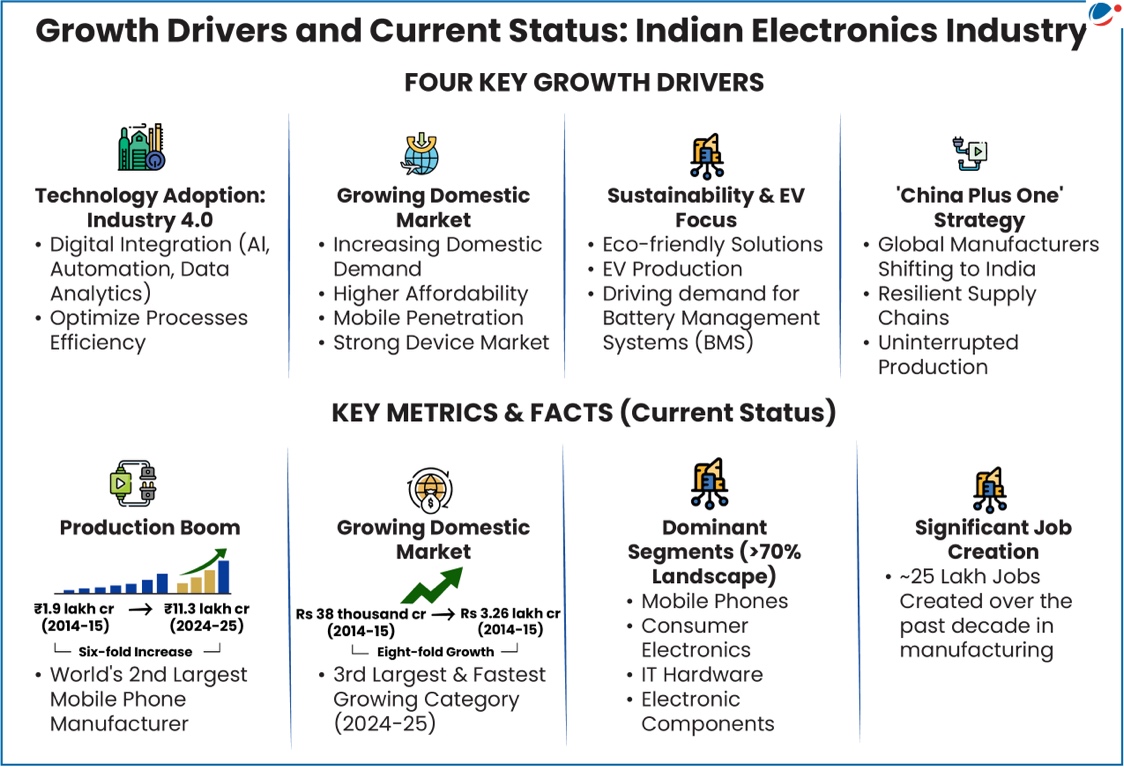
Challenges to Electronics Industry
- Heavy Import Dependency: India remains a "net importer" for core components.
- Sources: Primarily China, South Korea, and Vietnam.
- Components: Semiconductor devices, Printed Circuit Boards (PCBs), and integrated circuits.
- Impact: Increases the trade deficit and creates Supply Chain Vulnerabilities (e.g., disruptions during geopolitical tensions).
- The Cost-Competitiveness Gap: Manufacturing in India is 10–20% more expensive than in China, Vietnam, or Mexico.
- Drivers: High import duties on inputs, expensive raw materials, and high logistics costs.
- Structural Issue: A lack of large-scale domestic corporations (lack of economies of scale).
- Indigenous R&D Deficit: India's electronics sector is largely assembly-oriented rather than design-oriented.
- A weak R&D infrastructure limits the domestic design of high-value advanced components.
- The E-Waste Crisis: Global e-waste is set to hit 82 million metric tons by 2030; India's share is expected to surge to 5 million metric tons.
- Challenge: Lack of formal recycling infrastructure and environmental hazards.
Initiatives to boost electronics sector
The Government of India has adopted a "Plug-and-Play" and "Incentive-Linked" approach to transform India into an ESDM (Electronics System Design and Manufacturing) hub.
- Fiscal & Manufacturing Incentives
- Production-Linked Incentive (PLI) Scheme: It covers 14 sectors, focusing on mobile phones and IT hardware to boost exports and technology adoption.
- SPECS (Scheme for Promotion of Manufacturing of Electronic Components and Semiconductors): Offers a 25% financial incentive on capital expenditure. It aims to move India from "assembly" to "high-value component manufacturing."
- Modified Electronics Manufacturing Clusters (EMC 2.0): Provides financial aid to create "world-class infrastructure" and common facility centres for electronics companies.
- Semicon India Program (2021): A flagship program providing financial support for Semiconductor Fabs, Display Fabs, Design Linked Incentive (DLI) etc. for domestic semiconductor industry.
- Investment & Policy Framework
- National Policy on Electronics (NPE) 2019: to position India as a global ESDM hub.
- 100% FDI: Automatic route for 100% Foreign Direct Investment has attracted over USD 4 billion since FY2020-21.
- Budgetary & Tax Reforms (2026-27)
- Customs Duty Exemptions: Targeted relief on inputs for specific goods like microwave ovens.
- Social Welfare Surcharge (SWS) Waivers: Exemptions on parts used for manufacturing electronic toys to promote domestic toy manufacturing.
Conclusion
With a strategic focus on reducing import dependency, lowering production costs, and fostering innovation, India is well-positioned to build a competitive and sustainable ecosystem. As India moves towards a USD 300 billion electronics production target by 2026, its robust policies and skilled workforce are paving the way for sustained growth, positioning the nation as a key player in the global electronics and semiconductor industry.



