


Why in the News?
Recently, the Union Home Minister emphasised the need to adopt advanced technological solutions to effectively address the new challenges posed by adversaries along borders.
Need for Advanced Technology in Border Management
- Countering New Infiltration Tactics (Drones and Tunnels): Physical fences and traditional border outposts are no longer sufficient to stop infiltration, as criminals and terrorists actively bypass them.
- E.g., a surge in drone incursions dropping narcotics and weapons, particularly in the western sector.
- Organized criminal networks are highly adaptable, frequently using encrypted communications and advanced surveillance to elude detection.
- Terrain: Managing unfenced gaps in difficult terrain like the shifting eastern riverine borders and marshes of Gujarat.
- Cyber & Electronic Warfare: E.g., attacks on border surveillance infrastructure and communication networks.
- Relieving Troop Fatigue and Centralizing Command: Traditional border guarding is incredibly manpower-intensive, which tires out troops and reduces operational efficiency.
- Protecting the Maritime and Underwater Domain: Border security is expanding beyond land and airspace into the maritime and subsea environments. E.g. 26/11 attacks
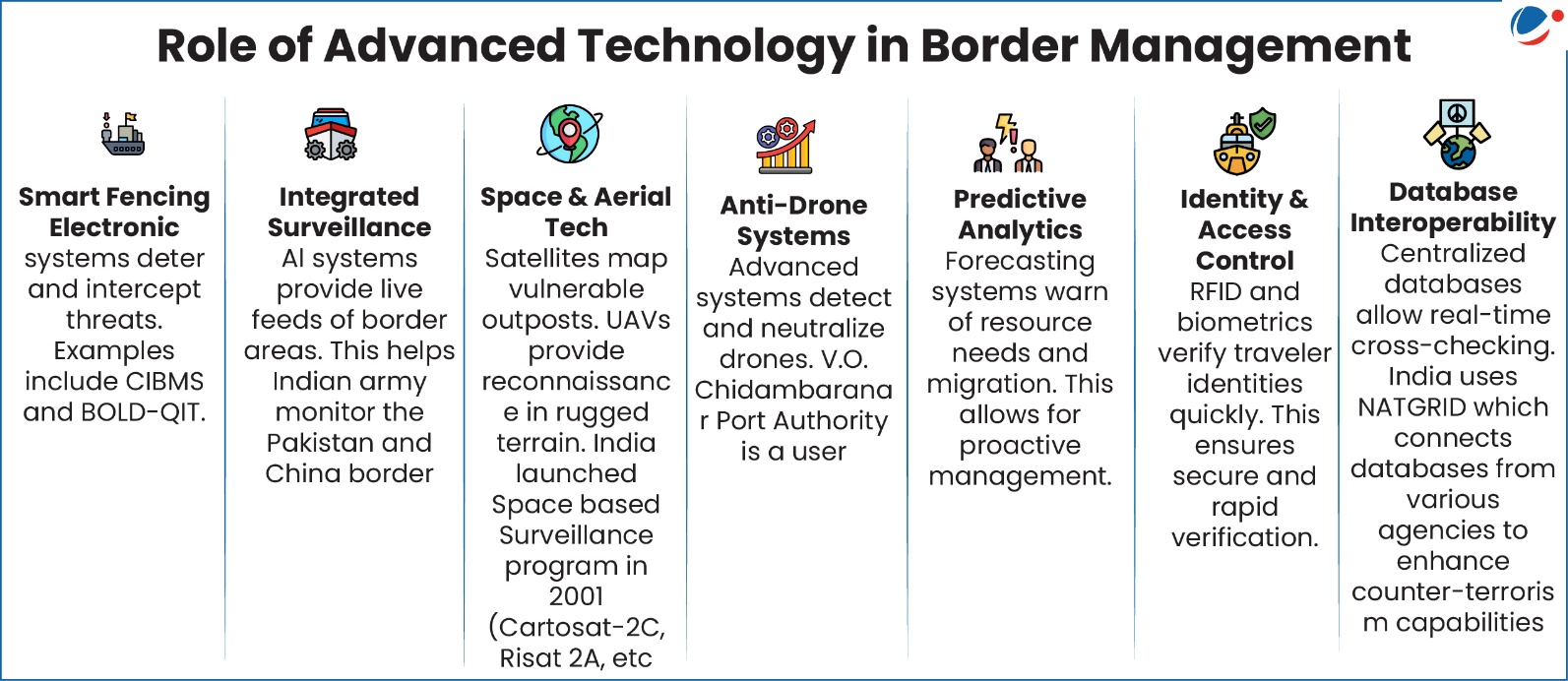
Measures to promote Integration of Technology in Border Management
- Expanding Existing Surveillance Infrastructure
- Wider Rollout of CIBMS: Following pilot projects like BOLD-QIT, the Stage II and Stage III of the CIBMS shall be implemented, which will cover approximately 1,955 kilometers of vulnerable borders.
- AI-Powered Monitoring: E.g., The Border Security Force (BSF) is planning to introduce a unified "smart border observation and monitoring system".
- Other: Invest in solar-powered surveillance towers, satellite-based communication, and automated drone monitoring to overcome the severe lack of digital infrastructure, reliable power, and high-speed internet in remote border regions.
- Operational Enhancements: E.g., Establish a unified digital command and control system to overcome inter-agency fragmentation.
- This system should integrate all border security agencies into a centralized network.
- Create a Border Security Technology Oversight Authority: It shall be tasked with reviewing and auditing surveillance operations to ensure they comply with legal frameworks and prevent misuse.
Conclusion
Effective border management in India increasingly requires the integration of advanced technologies such as smart fencing, AI-based surveillance, and anti-drone systems. Learning from global systems like Israel's Smart Fence, US's Integrated Fixed Towers, we need to strengthen our indigenous innovation, infrastructure, and inter-agency coordination which will be crucial to tackle emerging threats and safeguard India's territorial integrity.

