


Why in news?
Under the National Quantum Mission, the foundation stone of the Quantum Valley project was recently laid in Amaravati, Andhra Pradesh.
More on news
- The Project seeks to make Amravati a global hub for quantum technologies and to install India's first 133-qubit quantum computer by 2026.
- It is an example of a 'Triple Helix Model' involving a tripartite alliance between the Government, industry leaders (IBM, TCS, L&T), and academia.
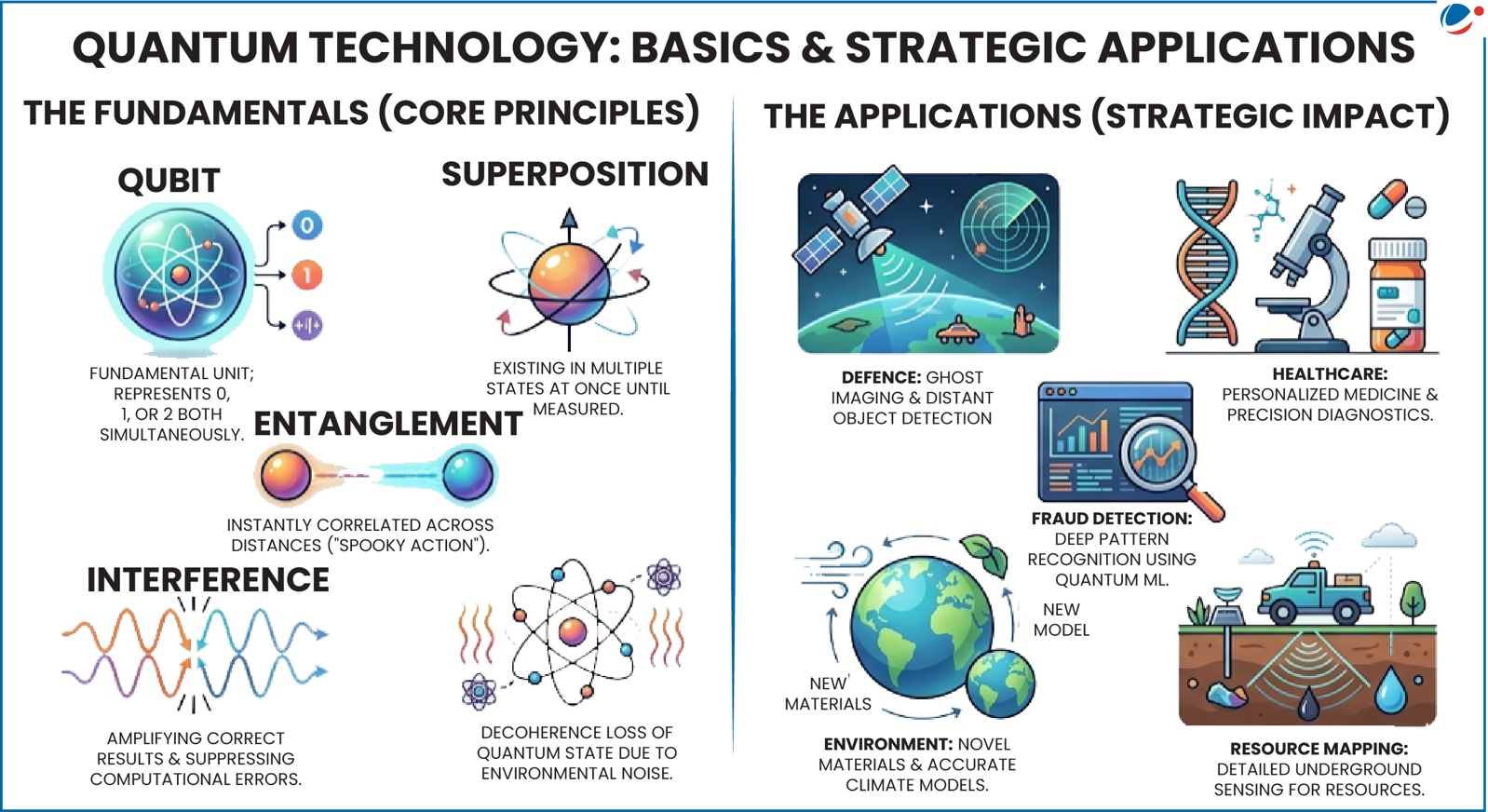
About National Quantum Mission (2023 to 2030-31)
- Global Standing: India is the 7th country to launch a dedicated quantum mission (after USA, China, Finland, Austria, France, and Canada).
- Governance: An 8-year mission under the Ministry of Science and Technology; it is one of the 9 missions governed by the PM-STIAC.
- Implementation Strategy: Thematic Hubs : The mission established 4 specialized hubs at leading institutions following the Hub-Spoke-Spike model.
Vertical | Lead Institution | Key Output |
|---|---|---|
Quantum Computing | IISc, Bengaluru | 20-50 physical qubits, 50-100 physical qubits and 50-1000 physical qubits in 3 years, 5 years and 8 years, respectively. |
Quantum Communication | IIT Madras | Satellite-based secure links and (Quantum Key Distribution) QKD over 2,000 km |
Sensing & Metrology | IIT Bombay | Precision navigation & timing |
Materials & Devices | IIT Delhi | Next-gen quantum substrates, Superconductors, 2D materials |
Other Initiatives taken by India
Global Initiatives
|
Significance of NQM for India
- Strategic advantage: Countries such as the US, China, members of the EU, and Canada have already made major investments in quantum technologies, making it essential for India to move early to avoid long-term strategic dependence.
- Security: Current encryption methods are vulnerable to quantum attacks. Post-Quantum Cryptography (PQC) development under NQM is therefore a sovereign imperative.
- Capacity building: Eg. NQM has introduced QT curriculum in Higher education with All India Council of Technical Education.
- Startup Ecosystem: Eg. Bangaluru based QpiAI under NQM launched QpiAI-Indus, one of India's most powerful quantum computers featuring 25 qubits.
- Economic Growth Eg. QT can unlock $1-2 trillion in value by 2035 (NITI Aayog).
Challenges in Development of Quantum Technologies
- Fragility of Qubits: Quantum states are highly susceptible to "noise" and environmental disturbances, leading to decoherence.
- Hardware Requirements: Building these systems requires extreme isolation and ultracold temperatures near absolute zero.
- Error correction: Superposition produces many possible outcomes, and measurement may give a random result; therefore, error-correction is ongoing areas of active research.
- Ethical risks
- Dual-use dilemma: Quantum technologies have both civilian and military applications, raising weaponization concerns.
- Enhanced Surveillance: Highly sensitive quantum sensors create privacy concerns, as they could intercepting signals that were previously secure.
- "Quantum Divide": Given its capital intensive nature, quantum efforts can be concentrated in a few wealthy nations, deepening existing inequalities.
- Other: Beyond scientific hurdles, India faces ecosystem constraints such as limited fabrication capacity, shortage of interdisciplinary researchers, dependence on imported components, and weak industry-academia translation.
Way Forward
- Global Benchmarking: Engage actively with global standards bodies and take leadership in international standard setting
- R&D Investment: Bridge the GERD gap (currently ~0.7%) to reach the global ~2% benchmark.
- Global collaboration: Eg. With World Economic Forum's Quantum Economy Network which aims to raise awareness and understanding of quantum technology
- Others: Capacity building, easing regulatory cholesterol for lab to market transition, etc.
Conclusion
India aims to be among the top three quantum economies by 2035. To achieve this, we should focus on greater collaborations, capacity building and larger R&D share towards quantum technologies.
