


Why in the News?
Union Budget FY 2026-27 has announced various support measures for capital goods sector.
Provisions of Union Budget FY 2026-27 for Capital Goods Sector
- Public CapEx: Increased by ~9% to ₹12.2 lakh crore.
- Scheme for Enhancement of Construction and Infrastructure Equipment (CIE) Scheme: Initiative to boost domestic manufacturing of advanced construction and infrastructure equipment (e.g., lifts, fire-fighting gear, tunnel-borers).
- Toll & Electronics Manufacturing: 5-year income tax exemption for non-resident entities supplying capital goods/tooling to toll manufacturers in bonded zones.
- Energy Transition: Basic customs duty exemption on capital goods extended to include Lithium-Ion cell manufacturing for battery energy storage systems.
- Hi-Tech Tool Rooms: CPSEs to establish two automated facilities for localized design, testing, and manufacturing of precision components.
- Container Manufacturing: ₹10,000 crore allocated over 5 years.
About Capital Goods Sector
- Capital goods = plant/machinery/equipment needed directly or indirectly for production or service delivery.
- Also covers assets for replacement, modernisation, tech-upgradation, or capacity expansion.
- They are not for direct consumption but create production capacity.
- Sub-Sectors: Sector comprises machine tools, textile machinery, electrical equipment, mining machinery, plastics processing machinery, moulds and press tools, food processing machinery etc.
- Status in India: With a total market size of US$ 92 billion and production valued at US$ 32 billion, Capital Goods sector, contributes to around 12% of India's manufacturing output.
- The Mahalanobis Model, which formed the basis of India's Second Five-Year Plan (1956–1961), prioritised heavy and basic industries to build a robust capital goods sector for long-term economic self-reliance.
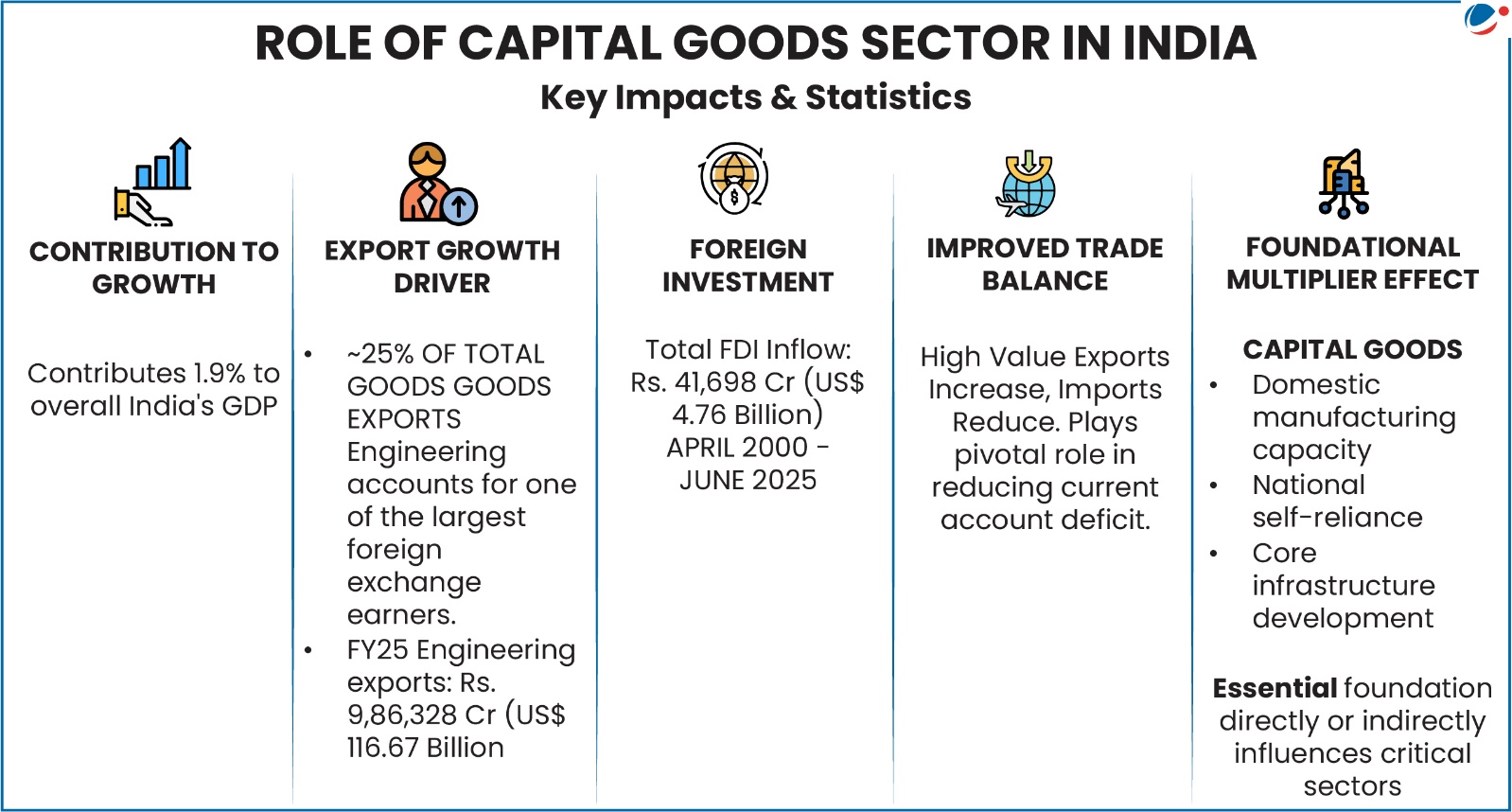
Challenges faced by capital goods sector
- High import dependence in advanced machinery: Due to weak domestic R&D, around 40% capital goods are imported in India.
- R&D Investment in sector is ~0.9% of GDP, well below the National Capital Goods Policy target of 2.8%.
- Infrastructure & Capital Burdens: Infrastructure deficits create ~ 5% cost disadvantage for Indian manufacturers vs. global competitors.
- Precision Ecosystem Deficit: A critical lack of domestic capacity for globally competitive, high-precision manufacturing.
- Tax & Duty Inefficiencies: Inverted duty structures and state-wise tax variations lead to ~ 24% cost disadvantage from indirect taxes.
- Severe Skill Gaps: ~60% of the workforce (aged 15–59) lacks vocational training, causing a shortage of industry-ready labor.
- Sector Fragmentation: The industry is dominated by MSMEs whose small operating scale restricts their ability to acquire technology or develop new products.
- Export Barriers: Untapped export potential hindered by a lack of long-term financing, non-tariff barriers, and inadequate trade incentives.
Policies/Schemes promoting Capital Goods
- National Capital Goods Policy, 2016: It aimed to boost India's capital goods sector by raising its manufacturing share from 12% in 2016 to 20% by 2025.
- However, it couldn't achieve its objectives. To further streamline this, a Draft National Capital Goods Policy 2025 has been formulated.
- Department for Promotion of Industry and Internal Trade (DPIIT): The role of DPIIT is to promote industrial Development of the Country by facilitating investment in new and upcoming technology, accelerate & foreign direct investment and support a balanced development of industries & trade.
- Production Linked Incentive (PLI) Schemes: Attract investment, enable tech adoption, and boost global competitiveness.
- These include PLI Scheme for Automobile, Advanced Chemistry Cell (ACC) Battery Storage etc.
- Scheme for Enhancement of Competitiveness in the Indian Capital Goods Sector: Industry-academia demand-driven model, projects are proposed by industry for govt funding.
- PM Gati Shakti Mission: It is a digital infrastructure development platform integrates planning and execution across 16 key ministries, creating a unified approach to industrial development.
- Liberal Policy: De-licensed engineering sector, 100% FDI under the automatic route (except from land-border nations), unrestricted technology transfer payments, and no import or export restrictions.
- Skill Development: The Capital Goods Skill Council (promoted by FICCI and Dept of Heavy Industries) is a unique initiative for quality training and skill development for the Capital Goods sector.
- Washington Accord (WA): India became a permanent member of the Washington Accord (WA) which is an elite international agreement on engineering studies and the mobility of engineers.
- Make in India: Seeks to increase the manufacturing sector's contribution to GDP, generate employment, and improve technological capabilities.
Conclusion
Capital Goods (CG) sector functions as the foundational multiplier of the Indian economy. Beyond its 1.9% GDP contribution, it determines the technological intensity of the entire manufacturing landscape. With sustained policy support and 0ns away from sole reliance on China, by giving attracting incentives for investments.


