


Why in the News?
Union Ministry of Home Affairs (MHA) unveiled PRAHAAR, India's first-ever national counter-terrorism policy and strategy.
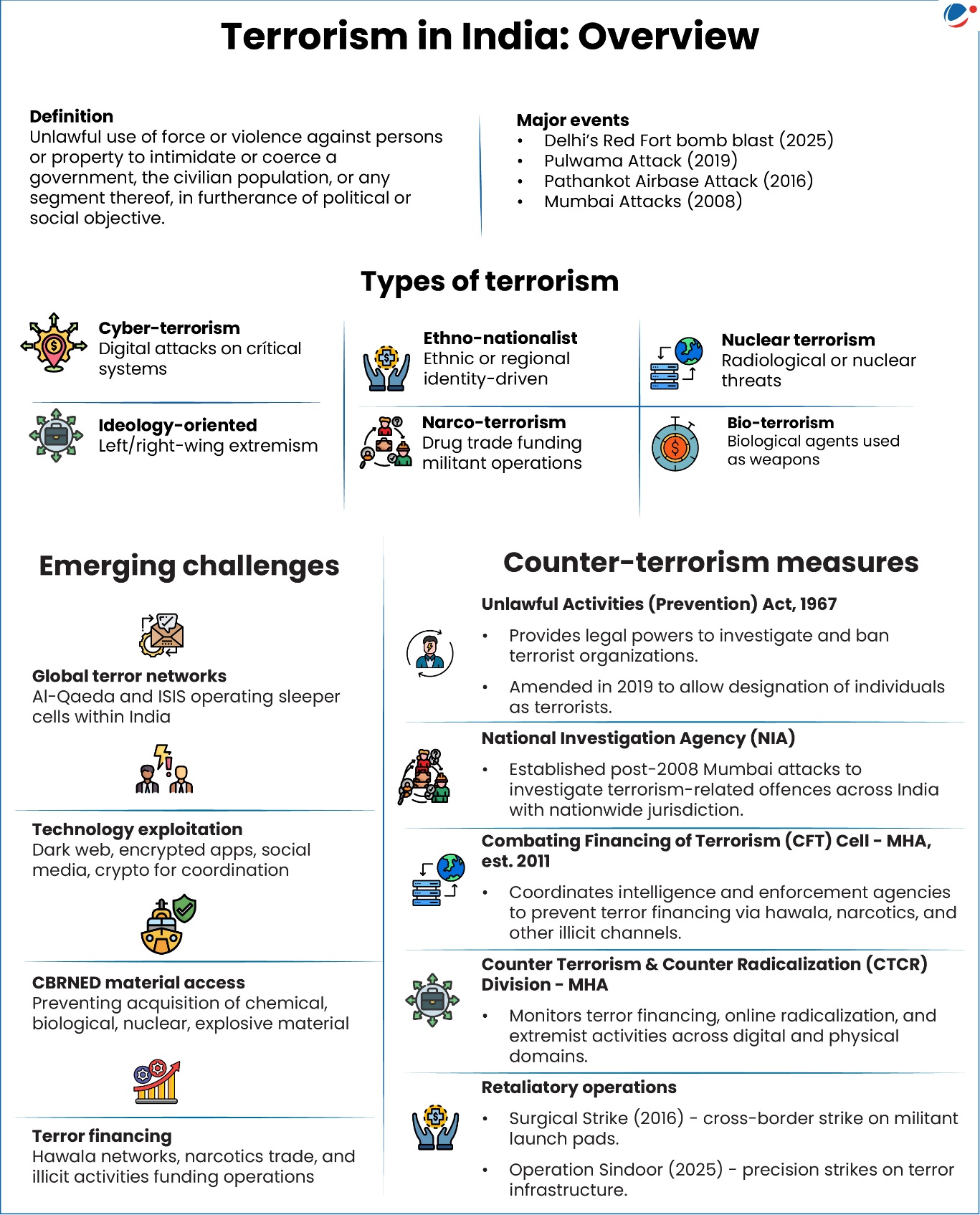
About PRAHAAR
PRAHAAR articulates a seven-pillar framework:
- (P)revention of Terror Attacks:
- Proactive, "intelligence-guided" approach with the Multi Agency Centre (MAC) and Joint Task Force on Intelligence (JTFI) in Intelligence Bureau (IB) serving as the central platforms for real-time intelligence sharing.
- State-of-the-art tools and technologies for Indian border guarding forces (Defence, Central Armed Police Forces), immigration authorities to secure Indian borders.
- Capacities to protect the critical sectors of Indian economy including power, railways, aviation, ports, defence, space and atomic energy from state/non-state actors.
- (R)esponses swift and proportionate to the threat posed:
- Local Police is first responder, assisted by specialized State and Central anti-terror Forces.
- National Security Guard (NSG) is the nodal national Counter-Terror Force under MHA, for assistance to State Forces in responding to major terror attacks.
- Standard Operating Procedure (SOP) issued by MHA, for coordination including intelligence dissemination, analysis and follow up action, through the platform of MAC
- (A)ggregating internal capacities in a whole-of-government approach: It emphasizes the modernization of security and law enforcement agencies by acquiring the latest tools, technologies, and weaponry.
- Also, agencies undergo specialized tactical training led by institutions like the Bureau of Police Research & Development (BPR&D) and the NSG.
- (H)uman Rights and Rule of Law Based Processes:
- Threat mitigation is handled through just legal processes that protect fundamental human right with Protection of Human Rights Act, 1993 specifically dealing with cases of violation of human rights.
- Special laws to tackle terrorism related crimes- Unlawful Activities (Prevention) Act, 1967, Explosives Substance Act, 1908, Arms Act 1959 and Prevention of Money Laundering Act, 2002.
- (A)ttenuating the conditions conducive to Terrorism:
- Indian intelligence and law enforcement agencies continuously disrupting the designs of terrorist groups.
- Radicalized youths undergo a graded police response, aimed at comprehensively addressing the problem of radicalization and violent extremism in a multi-stakeholder setting
- Active engagement with community leaders, NGOs, and moderate preachers to counter extremist narratives.
- (A)ligning and Shaping the International Efforts: India has entered into various agreements like Mutual Legal Assistance Treaty (MLAT), Extradition Treaty/Extradition Arrangement (ET/EA), Joint Working Group (JWG) with foreign partners for information/evidence sharing and other legal cooperation.
- (R)ecovery and Resilience through a whole-of-society approach: The government engages a team of doctors, psychologists, lawyers and other members of civil society, including NGOs, religious and community leaders, to sensitize and reintegrate the affected community.
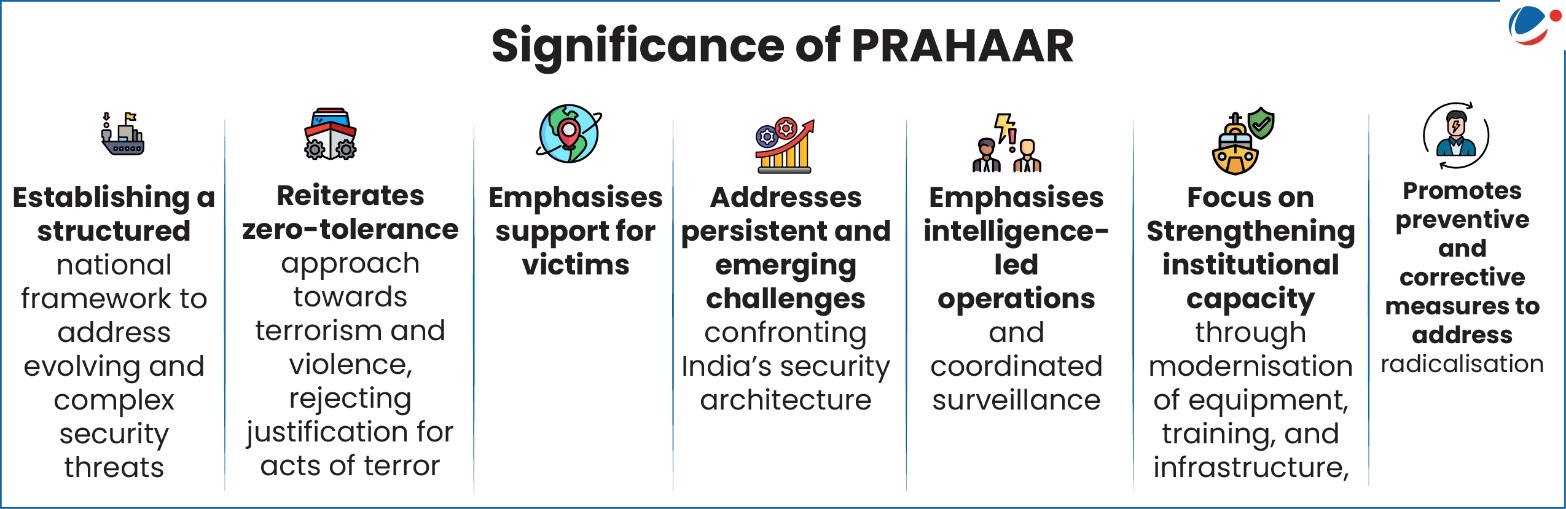
Further reforms needed
- Strengthen cooperation and collaboration among various agencies for intelligence collection and investigation.
- Amending domestic counter terrorism legal regime from time to time to respond to the emerging challenges.
- Continuous capacity building of State/UT ATS units is needed, with uniform structure, resources, training and investigation methods.
- Legal experts should be involved from FIR registration to prosecution to ensure stronger cases against terrorists.
Conclusion
PRAHAAR shifts India to a proactive, intelligence-driven counter-terror strategy with stronger coordination and safeguards. Its success depends on continued reforms, inter-agency synergy, and adaptive laws to tackle evolving threats.




