


Why in the news?
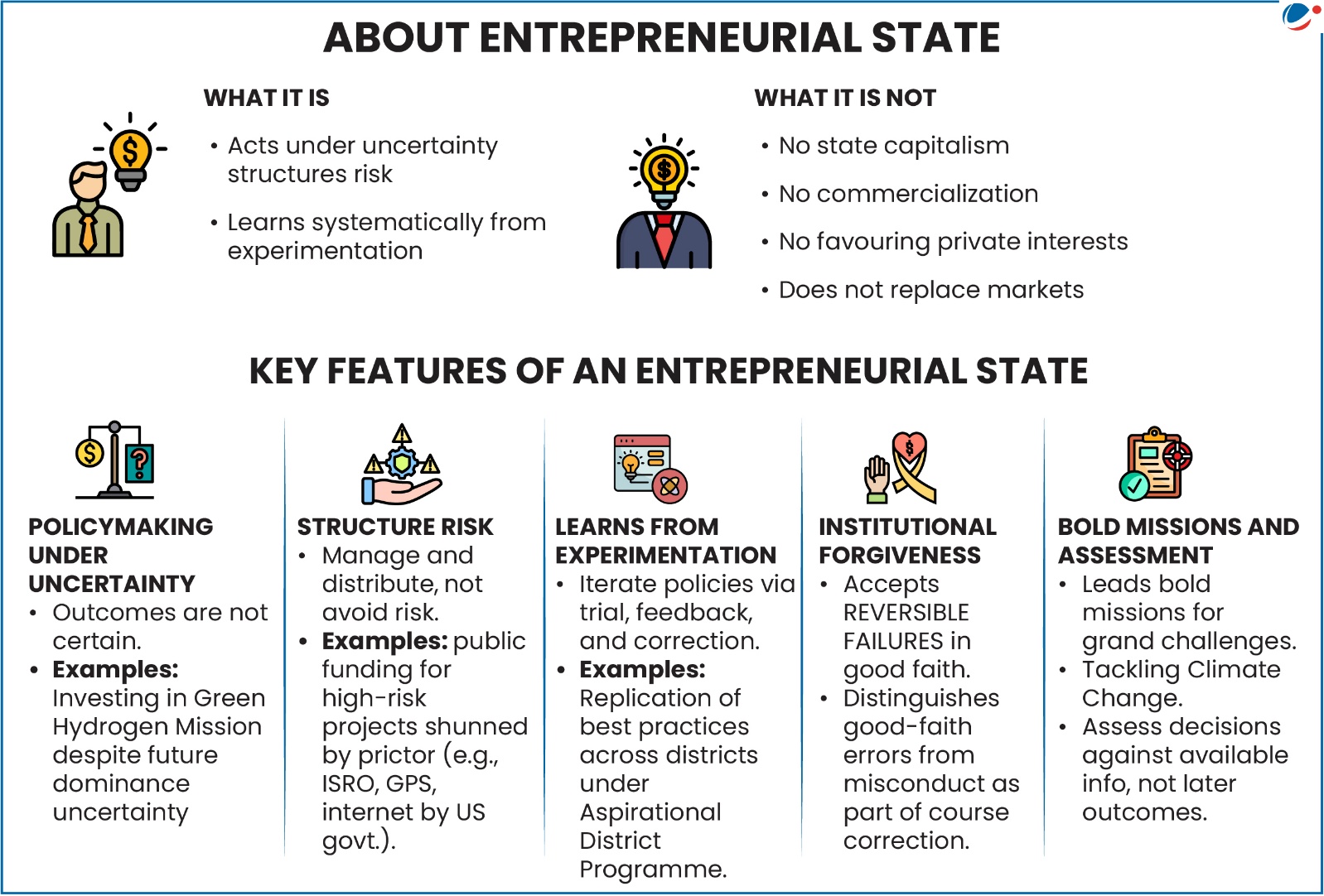
Economic Survey 2025–26 recently called for India's transition towards an 'Entrepreneurial State" a term borrowed from economist Mariana Mazzucato.
More on news
- Survey places entrepreneurial state central to transition towards strategic indispensability.
- Strategic indispensability: To build capabilities that others depend upon, making India a source of stability and value rather than only a participant in global markets.
Barriers to an Entrepreneurial State
- Action is Punished, Inaction is Safe: Officials are more likely to get in trouble for trying a new visible solution than for following an outdated procedure.
- Irreversibility Creep: Temporary measures become permanent, deterring experimentation. (Eg. subsidies/loan waivers harden into commitments).
- Retrospective Scrutiny: Good-faith decisions are later examined through audits, vigilance, and judicial review, often ignoring the uncertainty of the times.
- Eg. In the 2G spectrum case, where licence cancellations amid retrospective scrutiny led to policy paralysis, even though the accused were later acquitted.
- Co-ordination challenge: Populist pressures by politicians and bureaucratic risk-aversion can hinder experimentation and bold policy action.
- Unintended consequences of RTI act: Excessive disclosure of internal deliberations chills candid discussion and risk-taking, leading to cautious, defensive decision-making.
Conclusion
Transforming governance from a culture of rigid procedural compliance to one of dynamic problem-solving requires embracing global best practices in accountability and innovation. By adopting Japan's model of "fair accountability" which prioritizes well-reasoned decisions over flawlessly error-free outcomes and mirroring South Korea's use of bounded safe spaces to judge experimentation based on available information rather than hindsight, administrations can empower officials to take calculated risks.


