


Why in the News?
Artificial intelligence (AI) Impact Summit 2026 was recently held in New Delhi, India.
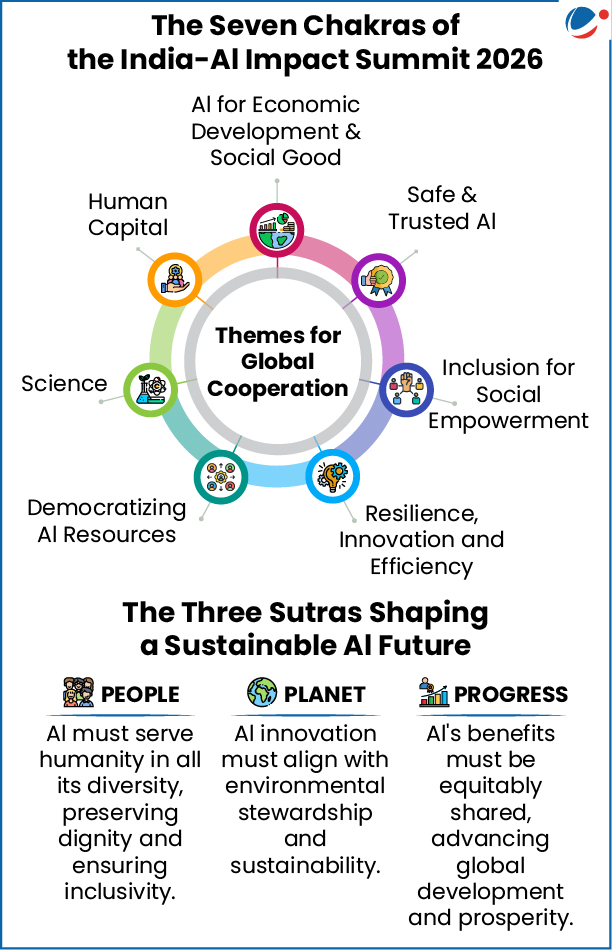
About AI summit 2026
- It is the first-ever global AI summit hosted in the Global South.
- Previous summits: AI Action Summit 2025 (Paris, France), AI Seoul Summit 2024 (South Korea), AI Safety Summit 2023 (Bletchley Park, UK)
- Hosted under: India AI Mission to help drive global collaboration on the Mission's impact goals.
- The summit was structured around 7 Chakras (Working Groups) and 3 Sutras (Core Principles) Articulating the AI Impact. (see infographic)
The summit highlighted India's approach to AI development.
What is India's AI development approach?
Framework: M.A.N.A.V. for Human-centric AI
- M (Moral and Ethical system): It emphasised fairness, transparency, and human oversight as non-negotiable principles in AI design and deployment.
- E.g., National Education Policy 2020 prioritises digital and AI literacy. This ensures early exposure to data-driven decision-making and ethical AI principles.
- A (Accountable Governance): It includes transparency, robust oversight, and clear institutional responsibility.
- E.g. IndiaAI Mission institutionalises standards for responsible development, deployment, and monitoring of AI systems.
- N (National Sovereignty): For India, this means securing critical datasets, strengthening domestic compute capacity, and fostering indigenous AI model development.
- E.g. India Semiconductor Mission to reduced import dependence in semiconductors.
- A (Accessible and Inclusive AI): It ensures that AI must serve as a multiplier for society, not a monopoly of a privileged few.
- E.g., Platforms such as MeghRaj GI Cloud and IndiaAI Compute Portal are democratising access to shared computing resources like Graphics Processing Units (GPUs).
- V (Valid and Legitimate): It places Trust, Safety, and Legality at the centre of AI deployment.
- E.g., The Information Technology (Intermediary Guidelines and Digital Media Ethics Code) Amendment Rules, 2026 formally define and regulate synthetically generated content.
Phased roadmap for India's AI future: Outlined in Economic Survey 2025-26
- Phase 1: Coordination and Early Experimentation
- Expanding Infrastructure: Bottom-up innovation approach by creating a community-curated code repository and pooling access to public datasets.
- Frugal Models: The technological focus will be strictly on resource-efficient, application-specific, small, and open-weight models.
- Data: Data governance will evolve under the Digital Personal Data Protection (DPDP) framework to introduce functional data categorization and auditability for AI training, alongside incentives for retaining domestic value.
- Phase 2: Selective Scaling and Risk-Based Regulation
- Computing Expansion: Large firms will be encouraged to participate voluntarily in exchange for regulatory facilitation and access to public datasets.
- Deepening AI Safety: Establish an AI Safety Institute to conduct scenario-based red-teaming and enforce non-negotiable boundaries around high-risk applications like predictive policing and facial recognition.
- Red teaming is a process for testing cybersecurity effectiveness where ethical hackers conduct a simulated and nondestructive cyberattack.
- Phase 3: Long-Term Resilience and Labor Adaptation
- Strategic Autonomy: To reduce vulnerability to external hardware supply shocks, India will utilize strategic partnerships and diplomacy to secure access to advanced computing hardware.
- Educational Evolution: Primary education will be reformed to prioritize foundational cognitive and socio-emotional skills, while skilling systems will be aligned with both AI-centric and human-centric job requirements
Conclusion
India must align AI development with its developmental goals and long-term economic resilience through deliberate, coordinated policy action before structural dependencies emerge. Its strategy should reflect domestic economic realities rather than copying unsustainable global models, while treating AI not merely as technology but as a strategic priority shaping critical infrastructure, labour markets, foreign policy, and culture.




