


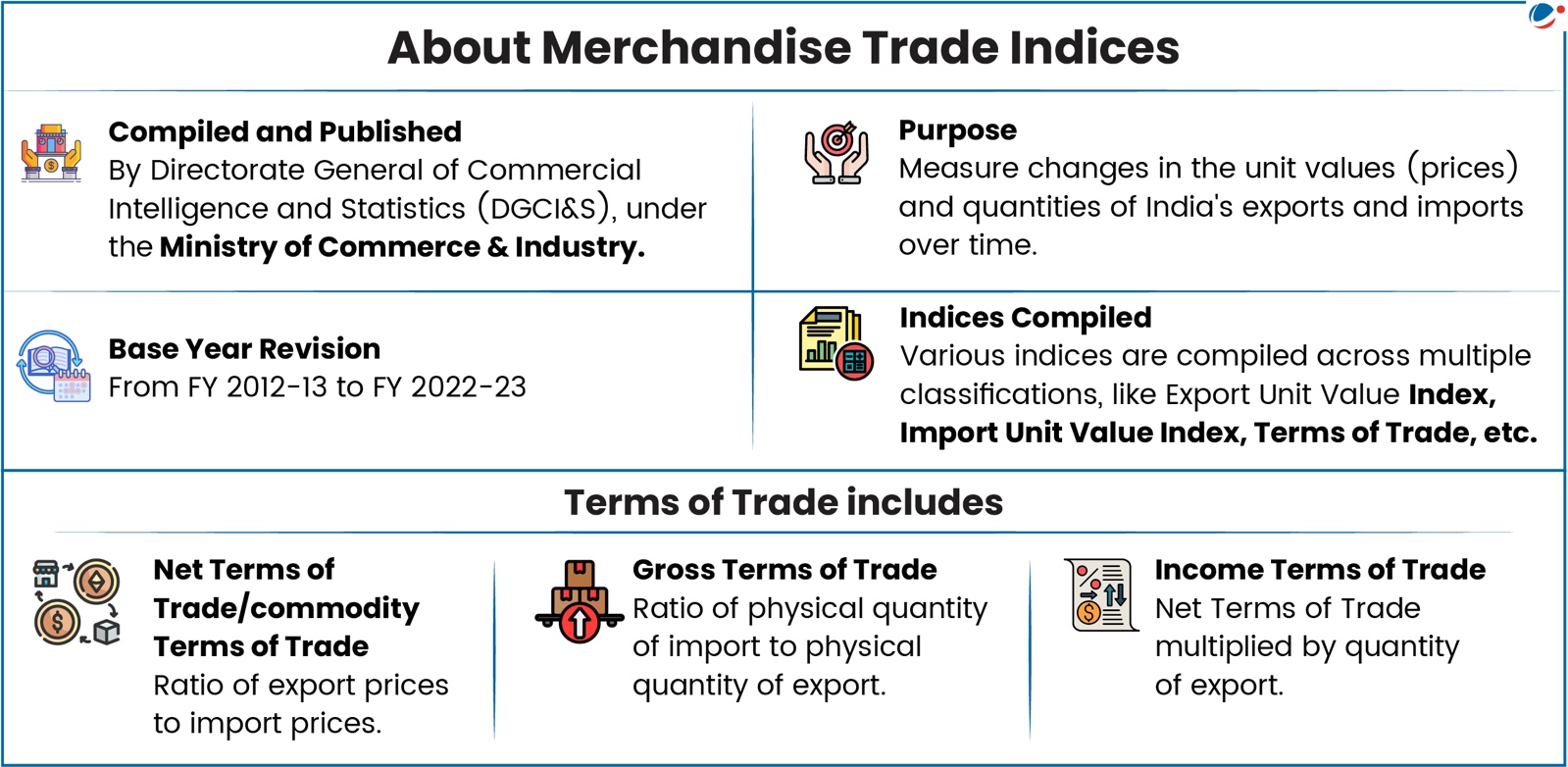
Merchandise Trade Indices have been revised to better reflect the evolving structure of India’s trade and changing global trade patterns.
Article Sources
1 sourceUnion Budget 2026-27 rationalizes Advance Pricing Agreement (APA) rules indicating a more investor-friendly tax regime.
Key Changes for IT sector
- Consolidation of IT services into a single category of Information Technology Services with a uniform safe harbour margin to reduce disputes and litigation.
- Threshold for safe harbour eligibility raised (₹300 crore to ₹2,000 crore); automated, rule-based approvals.
- Advance Pricing Agreement (APA) process fast-tracked to be completed within 2 years (extendable 6 months).
- APA is a pre-emptive arrangement between a taxpayer and tax authorities that determines transfer pricing methodology for specified transactions in advance, ensuring tax certainty and reducing disputes.
- Transfer Pricing means fixing fair prices for transactions between related companies so that profits are not shifted to avoid tax.
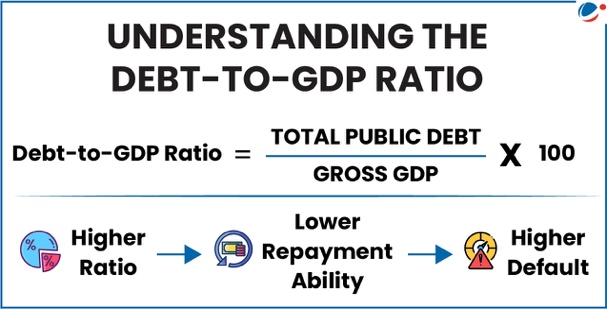
India is on track to reach debt-to-GDP ratio of 50±1 percent by 2030-31 as debt-to-GDP ratio is estimated to be 55.6 % of GDP in Budget Estimates 2026–27.
- Debt-to-GDP ratio is being increasingly used as the primary policy target instead of fiscal deficit–GDP ratio used under Fiscal Responsibility and Budget Management Act, 2003.
- FRBM Act aims to guide the government's fiscal policy towards a sustainable path, thereby promoting economic stability.
Union Budget 2026-27 cut the Tax Collected at Source (TCS) rate for education and medical expenses abroad under the Liberalised Remittance Scheme (LRS).
- TCS is an additional tax collected by sellers from buyers at the time of sale for specific goods/services under Section 206C of the Income Tax Act, 1961.
About Liberalised Remittance Scheme
- Overview: All resident individuals (including minors) are allowed to freely remit up to USD 2,50,000 per financial year for permissible current or capital account transaction or a combination of both.
- It is not available to corporates, partnership firms, Hindu Undivided Family (HUF), Trusts etc.
- Introduced: 2004 by Reserve Bank of India (RBI)
- Prohibited under LRS: Gambling & Lottery, Trading & Speculation
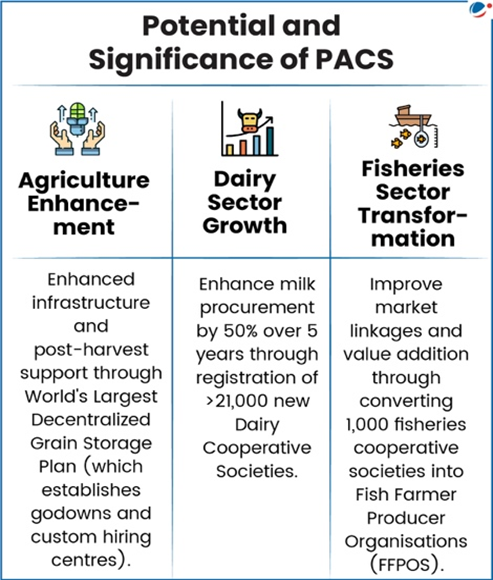
The Government aims to establish new multipurpose PACS/dairy/fisheries cooperatives to cover all panchayats and villages over the next 5 years.
About PACS
- PACS are the grass-root level institutions of the short-term co-operative credit structure and it acts as a last-mile link between borrowers and higher financing institutions such as Scheduled Commercial Banks and RBI/NABARD.
- Status: PACS sanctioned (79,630), new PACS registered (32,802), PACS digitized (61,478).
- Regulation:
- Multi State PACS: Entry 44 of Union List of the Constitution and are centrally administered by Central Registrar of Cooperative Societies (CRCS) under provisions of Multi-State Co-operative Societies Act, 2002.
- Single State PACS: Entry 32 of State List of the Constitution and are administered by the concerned State Registrar of Cooperative Societies (RCS) under respective State Cooperative Societies Act.
Initiatives taken for PACS Promotion
|
Article Sources
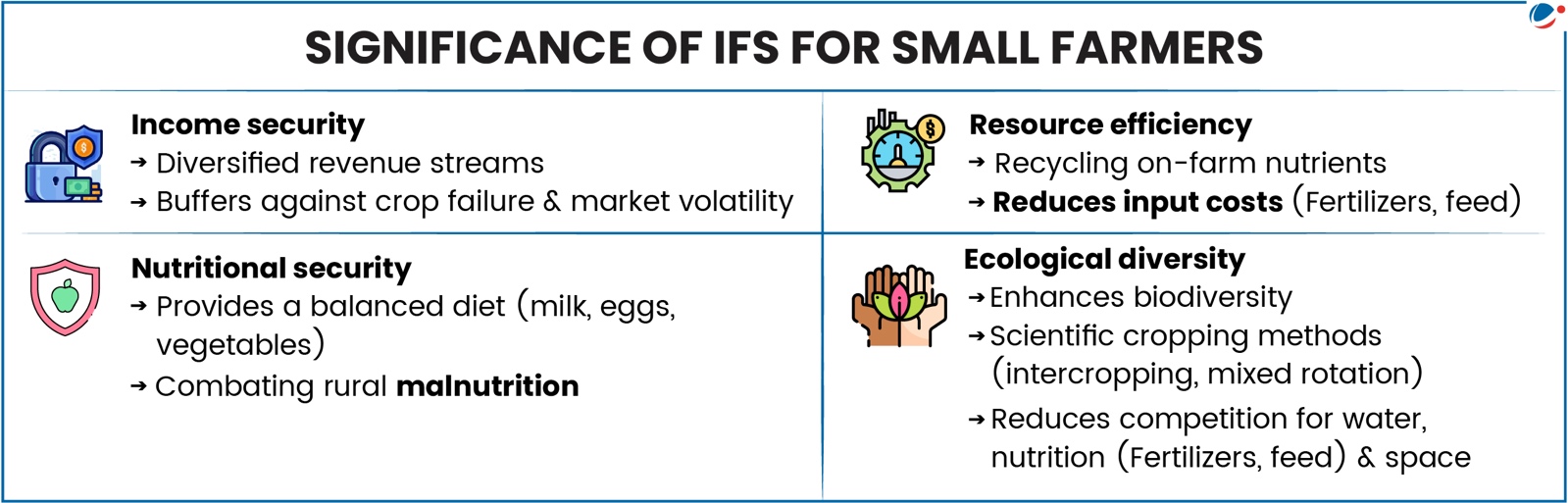
1 sourceThe Union Agriculture Minister urged scientists to develop Integrated Farming Systems for small farmers.
About Integrated Farming System (IFS)
- A synergistic approach integrating multiple components: crops, livestock, horticulture, fishery, poultry, and apiary, on a single farm unit.
- ~89.4% of Indian farmers are operating on small landholdings (<2 hectares).
Challenges
- Capital Intensive: Establishing allied sectors (e.g., cattle sheds, fishponds) requires high initial investment.
- Knowledge Gap: Traditional farmers may lack technical skills to manage complex, multi-layered systems.
- Labour Requirement: IFS is labour-intensive.
Government Initiatives
|
Prime Minister of India inaugurated India’s first Namo Bharat Regional Rapid Transit System (RRTS).
About Namo Bharat RRTS
- It is a new rail-based, semi-high-speed (upto 180 km/ hr), commuter transit system
- It is different from Metro as it caters to longer-distance travel with fewer stops at higher speed.
- It is different from conventional trains as it provides high-frequency, point-to-point regional travel on a dedicated pathway.
- Implementing agency: National Capital Region Transport Corporation (joint venture between the centre and Rajasthan, UP, Haryana, Delhi.
Significance of RRTS
- Addressing urban Congestion: More than 40% urban population to live in urban areas by 2030.
- Reducing travel Time and enhanced labour productivity e.g., Delhi Merrut RRTS to reduce travel time to 60 minutes from 3 hours.
- Balanced Regional development -By encouraging commuters to live in suburban and regional areas it supports polycentric economic development.
- Environmental Sustainability: apart from being electrically-powered, it can reduce reliance on private cars.
- Social Empowerment: The project is a landmark for "Nari-Shakti," with women comprising the majority of train operators and station control staff.
Conclusion
By enabling fast, reliable, and sustainable regional mobility, the Namo Bharat RRTS can become a catalyst for decongesting cities, boosting productivity, and fostering balanced urban growth. With strong multimodal integration, innovative financing, and institutional coordination, it can redefine the future of regional transport and urban development in India.
Article Sources
1 sourceUnion Budget 2026-27 announced dedicated corridors to be developed in Odisha, Kerala, Andhra Pradesh, and Tamil Nadu for mining, processing, research, and manufacturing of Rare Earth Permanent Magnets (REPMs).
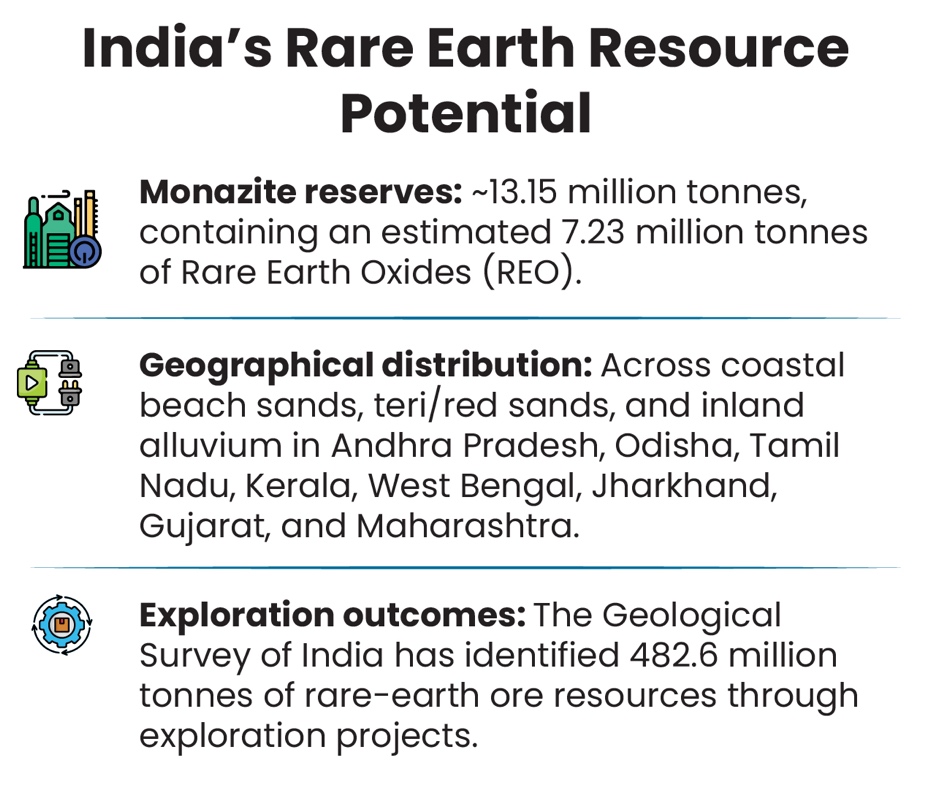
What are REPMs?
- They are amongst the strongest types of permanent magnets with high magnetic strength and stability.
- Applications: Advanced engineering applications such as electric vehicle motors, wind turbine generators etc.
- Significance: REPM demand is expected to double by 2030.
Significance for India
- Strategic Self-Reliance: Ensures access to critical materials reducing India’s heavy dependence on imports, particularly from China.
- India imported 60-80% (value-wise) and 85-90% (quantity-wise) REPMs from China (2022-25).
- Climate Goals: REPMs support India’s clean-energy transition and Net Zero 2070 vision.
- National Security: Ensures reliable domestic supply for defence equipment and precision sensors, reducing vulnerability to global supply chain disruptions.
Key government Initiatives
- REPM Manufacturing Scheme: 7,280 crore Scheme to establish an integrated domestic REPM manufacturing ecosystem with 6,000 MTPA capacity, covering the full value chain from rare-earth oxides to finished magnets.
- National Critical Minerals Mission (NCMM): Creation of a long-term, end-to-end supply chain for critical minerals including rare earths.
- MMDR Amendment Act, 2023 and MMDR Amendment Act, 2025: Amendments to the Mines and Minerals (Development and Regulation) Act, 1957, providing Dedicated list of critical and strategic minerals, Auction of mineral concessions, Establishment of Mineral Exchanges etc.
Article Sources
1 sourceUnion Budget 2026–27 has proposed three New Chemical Parks.
- The initiative, backed by a ₹600 crore allocation, aims to transform India into a global manufacturing hub through a cluster-based, infrastructure-led approach.
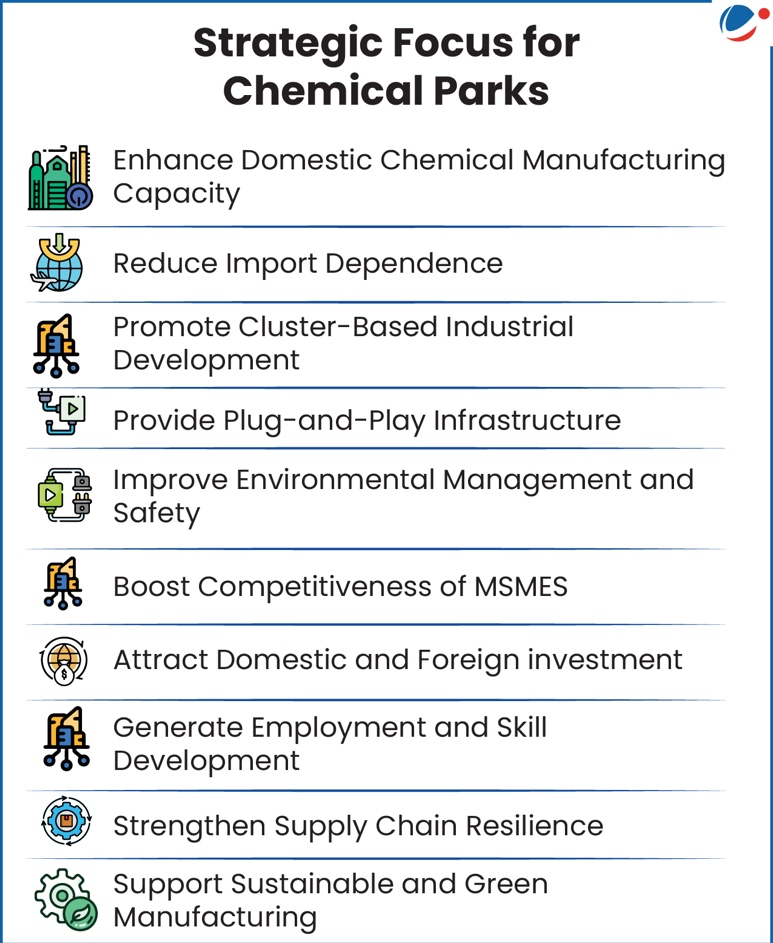
Status of Chemical Industry in India
- Contributes 7% to national GDP.
- Accounts for 8.1% of manufacturing GVA (Gross Value Added) (FY24)
- India is 6th largest chemical producer globally and 3rd largest in Asia.
Challenges faced by Chemical Industry
- Import Dependency: Heavy reliance on imports led to a USD 31 billion trade deficit in 2023.
- Infrastructure & Logistics: Outdated industrial clusters and high logistics costs create a significant price disadvantage compared to global competitors.
- Missed Opportunities: Focusing on bulk production (upstream) instead of high-value specialty products (downstream).
- Low R&D: Investment in R&D stands at only 0.7% (against global average of 2.3%).
- Environmental compliance (EC) hurdles: Long processing times, complex clearance requirements, and overlapping regulatory scrutiny at state and central levels.
- Skill Gap: A 30% shortfall in skilled professionals, particularly in niche areas like green chemistry, nanotechnology, etc.
Other Initiatives for promotion of Chemical Industry:
|


