


About the Trade Agreement
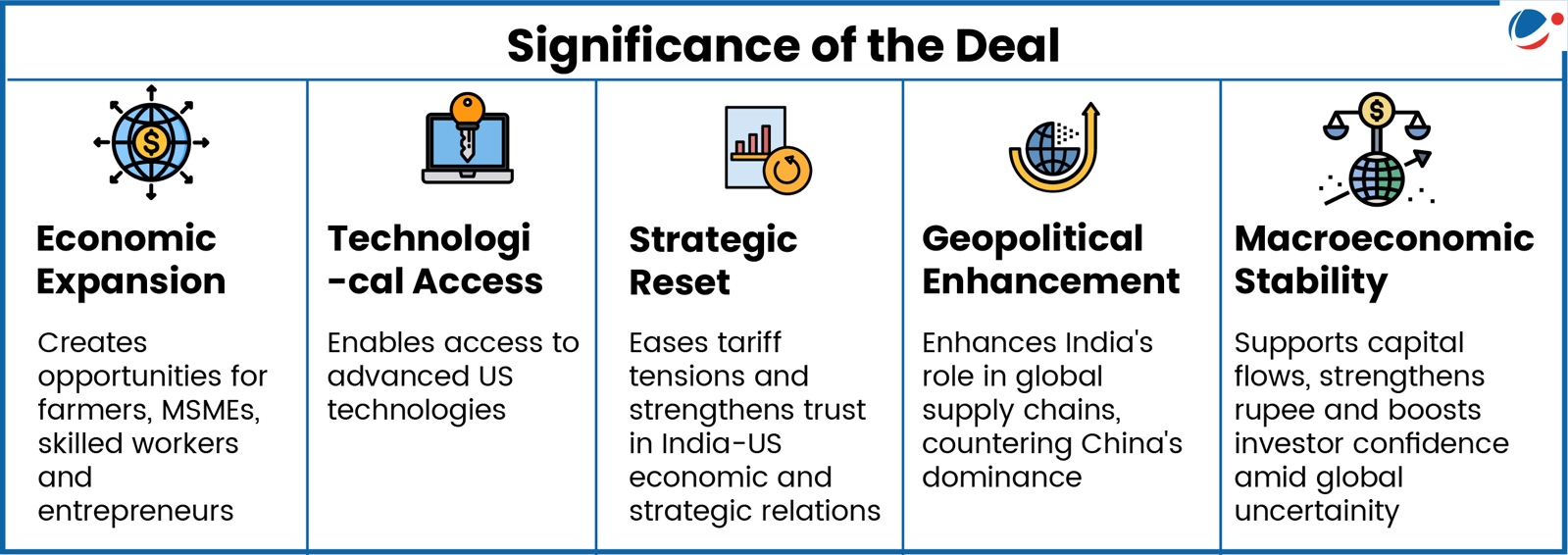
- US reciprocal tariffs on Made in India products will now be reduced from 25% to 18% effective immediately. US has also withdrawn the additional 25% duty.
- In August 2025, the US imposed a tariff ofup to 50% comprising a 25% reciprocal tariff plus an additional 25% duty over Russian oil imports.
- As reported by the US, India has agreed to scale up imports of American goods, including over $500 billion worth of energy, technology products, and nuclear equipment.
- India will progressively reduce its Tariffs and Non-Tariff Barriers against the US.
About India-US trade
|
Article Sources
1 source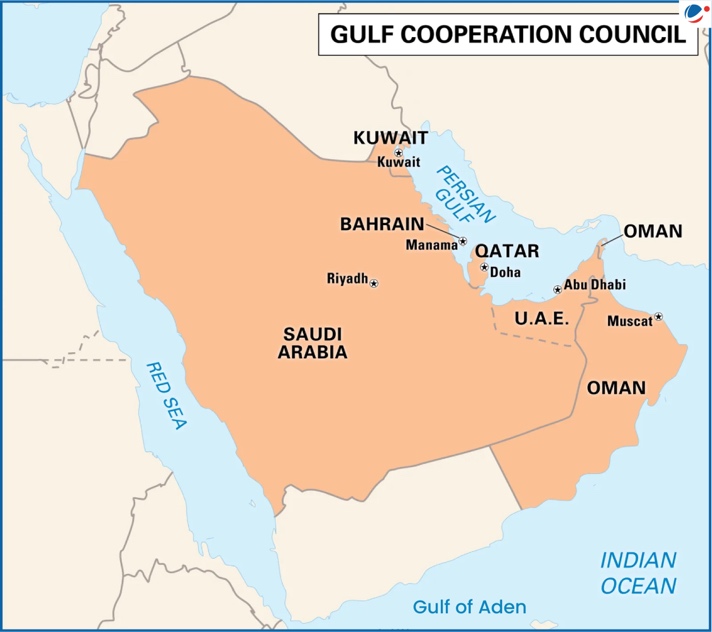
Earlier, Framework Agreement of Economic Cooperation to explore the possibility of FTA between India and GCC was signed in New Delhi in 2004.
Significance of India-GCC FTA for India
- Unlock Full potential of Economic relationship: GCC countries are a market of US$ 2.3 trillion in terms of GDP at current prices.
- Reinforce Relations amidst prevailing global uncertainties: Helping strengthen long-term supply security and trade expansion.
- Diversifying India’s Energy Sources
- Enhance Trade and Investment: India’s trade with GCC stood at USD 178.56 billion in FY 2024-25, (15.42% of India’s global trade).
- Region is also a significant source of Foreign Direct Investment (FDI) with investments exceeding USD 31.14 billion (September 2025).
- Enhance People to people ties: GCC is home to nearly ten million members of Indian community.
About GCC
- Genesis: Cooperative agreement among six-nation bloc, established by an agreement concluded on 25 May 1981.
- Members (6): United Arab Emirates; Kingdom of Bahrain; Kingdom of Saudi Arabia; Oman; Qatar; Kuwait.
- Headquarters: Riyadh, Kingdom of Saudi Arabia.
- Objective: Effect coordination, integration and inter-connection between Member States to achieve unity between them.
- Main Organizations under GCC: Supreme Council with attached Commission for Settlement of Disputes; The Ministerial Council; The Secretariat General.
Article Sources
1 sourceDuring the Prime Minister’s recent visit, India and Israel agreed to further deepen and expand their bilateral cooperation across key strategic and economic sectors.
Key Outcomes of the Visit
- Upgradation of ties: To a “Special Strategic Partnership for Peace, Innovation & Prosperity”.
- New initiative on Critical & Emerging Technologies (CET): Led by National Security Advisors of both countries covering AI, cybersecurity, semiconductors, quantum computing, biotechnology and space.
- MoU on Artificial Intelligence; launch of Horizon Scanning/Strategic Foresight Mechanism.
- Labour mobility: Quota of up to 50,000 Indian workers over next 5 years.
- Cybersecurity Cooperation: Developing Multi-year cybersecurity roadmap; establishment of India–Israel Centre of Excellence in Cybersecurity in India; etc.
- Agriculture & Water Technology Partnership: MoU for establishment of India–Israel Innovation Centre for Agriculture (IINCA); 20 Joint Fellowships in Agricultural Research; etc.
- Others: Exploring UPI–Israel payment linkage; launch of India–Israel Academic Cooperation Forum; India-Israel Parliamentary Friendship Group etc.
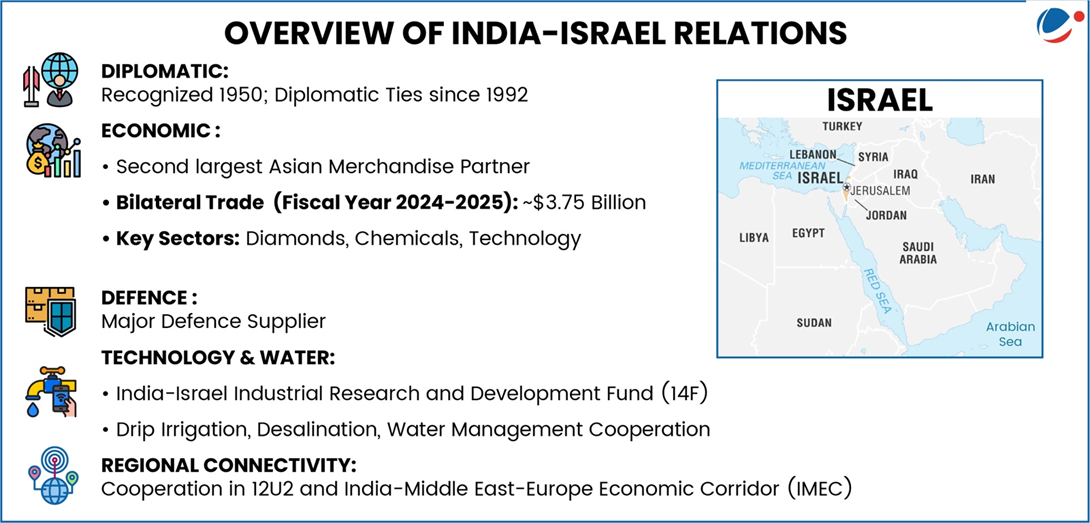
During the Official visit, the joint statement emphasizes a shared commitment to regional stability, economic integration, and technological synergy.
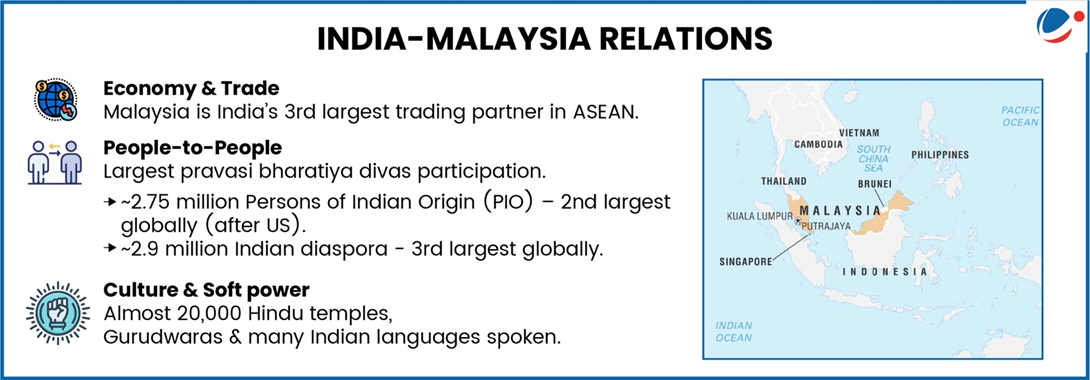
- India-Malaysia diplomatic relations were elevated to a Comprehensive Strategic Partnership (CSP) in August 2024.
Key Highlights of the Joint Statement
- Strategic & Defence Cooperation
- Establishment of Strategic Affairs Working Group (SAWG) and Su-30 Forum for technical/maintenance cooperation between both the air forces.
- Conducted joint military exercise Harimau Shakti (5th edition)
- Energy & Tech: Malaysian companies investment in India’s green energy (solar, hydrogen) and joint workforce development in semiconductors.
- Food Security & Agriculture: Malaysia reaffirmed commitment as a reliable palm oil supplier.
Key Outcomes
- Regional Cooperation: Seychelles to become a full member of the Colombo Security Conclave (CSC).
- CSC is a regional security grouping comprising India, Sri Lanka, Mauritius, Maldives and Bangladesh.
- It aims to promote regional security by addressing transnational threats and challenges of common concern to the Member States.
- Disaster Resilience: Seychelles agreed to join the Coalition for Disaster Resilient Infrastructure (CDRI).
- Health: Seychelles to recognize Indian Pharmacopoeia, book of standards for the drugs, to procure affordable, quality medicines.
- Digital Transformation: India agreed to undertake comprehensive efforts to build Digital Public Infrastructure (DPI) in Seychelles.
- Maritime cooperation: Seychelles will set up a Hydrographic Unit with Indian assistance.
- Special Economic Package: India announced a package totaling USD 175 million,aimed at development projects, capacity building, and maritime security.
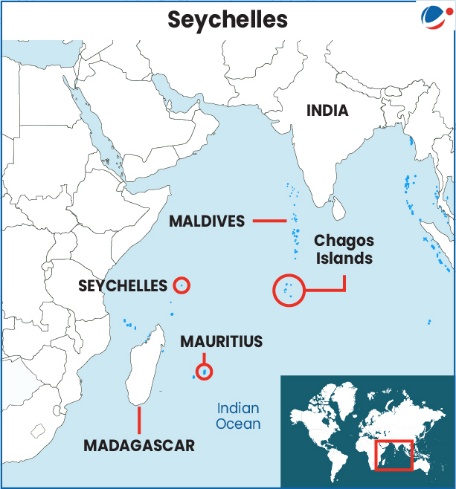 Significance of Seychelles for India
|
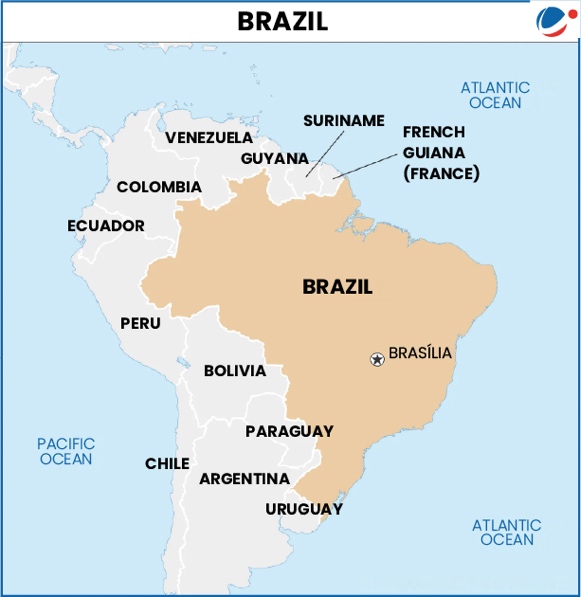
During the visit both nations revised their bilateral trade goal from $20 billion to $30 billion by 2030.
- The nations emphasized enhanced cooperation across diverse sectors, including space, renewable energy, and agriculture.
- Adopted a Joint Declaration/Action Plan on a Digital Partnership for the Future.
India-Brazil relations
- Diplomatic relations established in 1948; upgraded to Strategic Partnership (2006)
- Work closely at plurilateral fora such as BRICS, BASIC, G-20, G-4, IBSA, and larger multilateral bodies such as the UN, WTO, UNESCO, and WIPO
- Trade: In 2025, the bilateral trade grew by over 25% reaching USD 15.21 billion.
- Engagement under India-MERCOSUR Preferential Trade Agreement.
- Renewable Energy: Brazil became the co-founder member of Global Biofuel Alliance.
- Brazil ratified the International Solar Alliance (ISA) Agreement in 2022.
Economic Survey 2025-26 cited the Power Gap Index to show that India is operating below its full strategic potential.
About Power Gap Index
- It is a secondary analysis derived from the Asia Power Index, an annual index produced by the Australia-based Lowy Institute.
- It measures resources and influence to rank the relative power of states in Asia.
- Ranks 27 countries and territories through 131 indicators across 8 thematic measures:
- Military capability and defence networks, Economic capability and relationships, Diplomatic and cultural influence, as well as Resilience and Future resources.
- As per 2025 Edition, India is operating below its full strategic potential with a power gap score of -4.0.
India assumed the first-ever command of Combined Task Force-154, a key multinational training task force under the Combined Maritime Forces (CMF).
About CMF
- Multinational maritime partnership (coalition of the willing) upholding the International Rules-Based Order (IRBO).
- Membership: 47 nations, including India; voluntary and flexible contributions.
- Mandate: Counter illicit non-state actors; ensure maritime security, stability and free flow of global commerce.
Article Sources
1 sourceThe United States announced the launch of the Forum on Resource, Geostrategic Engagement (FORGE) during the inaugural Critical Minerals Ministerial.
- Ministerial was hosted by US in Washington DC, bringing together delegations from over 50 countries (including India) to advance collaboration on securing and diversifying global critical mineral supply chains.
About FORGE
- FORGE has been created as a successor to the Minerals Security Partnership (MSP).
- MSP aimed to bolster critical minerals supply chains to support economic prosperity and climate objectives.
- Objective: FORGE partners will collaborate at the policy and project levels to advance initiatives that strengthen diversified, resilient, and secure critical minerals supply chains.
Article Sources
1 sourceRecently, the United States unveiled Project Vault.
About Project Vault
- It is a supply chain security initiative establishing the U.S. Strategic Critical Minerals Reserve
- It is an independently governed public-private partnership that will buy and store critical minerals and rare earth elements.
Article Sources
1 sourceExperts warn that the expiry of the New START Treaty will remove the last legal restraint on the world’s two largest nuclear arsenals.
New START Treaty (Signed: 2010, Entered into force: 2011)
- It stands for New Strategic Arms Reduction Treaty (New START)
- Limit nuclear warheads: Caps deployed strategic nuclear warheads of the U.S. and Russia at 1,550 each.
- Restrict delivery systems: Limits ICBMs, SLBMs and heavy bombers to prevent arms build-up.
- Strengthen arms control regime: Serves as the last legally binding bilateral nuclear arms control treaty, reinforcing global non-proliferation norms.
Article Sources
1 sourceThe US Department of Energy (DOE) announced the elimination of the "As Low As Reasonably Achievable" (ALARA) philosophy from its directives and regulations for global radiation protection.
- This represents a shift to a risk-informed approach, prioritizing operational efficiency and cost-effectiveness.
- It risks increasing worker exposure by removing the mandate to minimize doses below statutory limits.
Foundations of Radiation Protection
The global framework for radiation safety has historically rested on two primary pillars:
- ALARA: A core safety principle dictating that radiation exposure should be kept as low as reasonably achievable, balancing social and economic factors.
- LNT (Linear No-Threshold): The scientific model behind ALARA, which assumes that any radiation dose, no matter how small, carries some cancer risk.
North Atlantic Treaty Organization (NATO) launched a new mission, Arctic Sentry, to bolster security in the Arctic.
About Arctic Sentry
- Led by: Joint Force Command Norfolk (JFC Norfolk) that serves as a bridge between North America and Europe for NATO.
- Strategic Purpose: Safeguard NATO members, protect territory, and maintain stability in challenging scenarios like increased military activity from Russia and growing interest from China.
Article Sources
1 source- Rafah Crossing (Gaza): Rafah crossing border partially reopened.
- Southernmost post of exit from Gaza and borders Egypt's Sinai Peninsula.
- There are only two other border crossings from and into the Gaza Strip – Erez and Kerem Shalom.
- Donetsk region (Eastern Ukraine):
- One of the two key regions of Donbas (other: Luhansk).
- Borders Sea of Azov (connected to Black Sea through Strait of Kerch) to south and Russia to east.
- Chagos Archipelago: United States urged United Kingdom to not hand overChagos to Mauritus.
- Diego Garcia is the largest island in Chagos archipelago, and is used as joint military base by UK and US.
- Location: Indian Ocean in the northeast of Mauritius.
- Following the 2019 ruling by International Court of Justice and building international pressure, UK signed an agreement with Mauritius in 2025 to return Chagos while keeping Diego Garcia military base on a 99-year lease.
- El-Fasher (Sudan): Reported indications of genocide in the siege of El-Fasher city by a paramilitary group. Major Places affected in Sudan conflict include
- Khartoum (Capital city)
- Darfur Region (West Sudan), El Geneina, Zamzam Displacement Camp etc.
- Other regions: Kordofan region(capital- El Obeid), Blue Nile state
- Communities affected: Masalit, Zaghawa, Fur


