River Pollution in India | Current Affairs | Vision IAS

Upgrade to Premium Today

Start Now
MENU
Home
Quick Links

High-quality MCQs and Mains Answer Writing to sharpen skills and reinforce learning every day.

Watch explainer and thematic concept-building videos under initiatives like Deep Dive, Master Classes, etc., on important UPSC topics.

A short, intensive, and exam-focused programme, insights from the Economic Survey, Union Budget, and UPSC current affairs.

ESC

River Pollution in India

31 Mar 2026
5 min

In Summary

  • SC closed suo motu proceedings on polluted rivers, transferring monitoring to NGT; reaffirmed right to clean environment under Article 21.
  • 43% of India's rivers are polluted, with issues in legal execution, fragmented governance, and deficient sewage infrastructure.
  • Strengthening pollution control boards, upgrading treatment facilities, and encouraging public involvement are key to addressing river pollution.

In Summary

Why in the News?

The Supreme Court (SC) has closed its 2021 suo motu proceedings on polluted rivers and transferred primary monitoring responsibility to the National Green Tribunal (NGT)

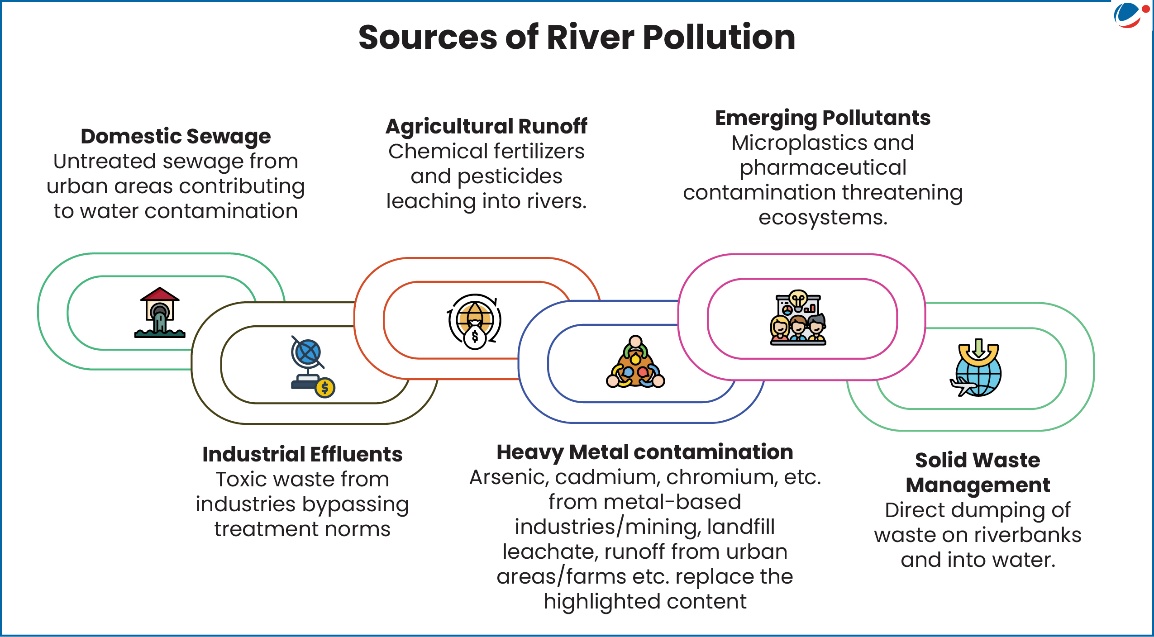
List of major sources of river pollution- Domestic sewage, Agriculture runoff, Industries, Heavy metals, etc.

Key Observations of the Court

  • Specialized tribunals like NGT are better equipped to monitor these situations continuously.
  • It reaffirmed that the right to live in hygienic conditions with human dignity and a clean environment is part of Article 21 of the Constitution. 
    • In M.C. Mehta vs. Union of India, 1987 Supreme Court treated the right to live in pollution free environment as a part of fundamental right to life under Article 21 of the Constitution.
    • Under the case, SC also restrained industries from releasing polluting effluents into the Ganga river until they establish treatment plants.

Status of river pollution in India 

  • 'Polluted River Stretches for Restoration of Water Quality – 2025': By Central Pollution Control Board (CPCB)-
    • 43% rivers polluted: 296 polluted stretches identified on 271 Rivers based on analysis of water quality data of 623 rivers.
    • Only 62% locations complied BOD criteria: Out of 2116 locations monitored during 2022 & 2023, 1312 locations complied with Bio-Chemical Oxygen Demand (BOD) criteria (less than 3.0 mg/L), notified for Outdoor bathing. 
  • Status of Trace and Toxic Metals in Rivers of India, 2024: By Central Water Commission-
    • At 112 stations (out of 434 studied), at least 1 metal (out of 9 trace & toxic metals studied) was found to be beyond limit.
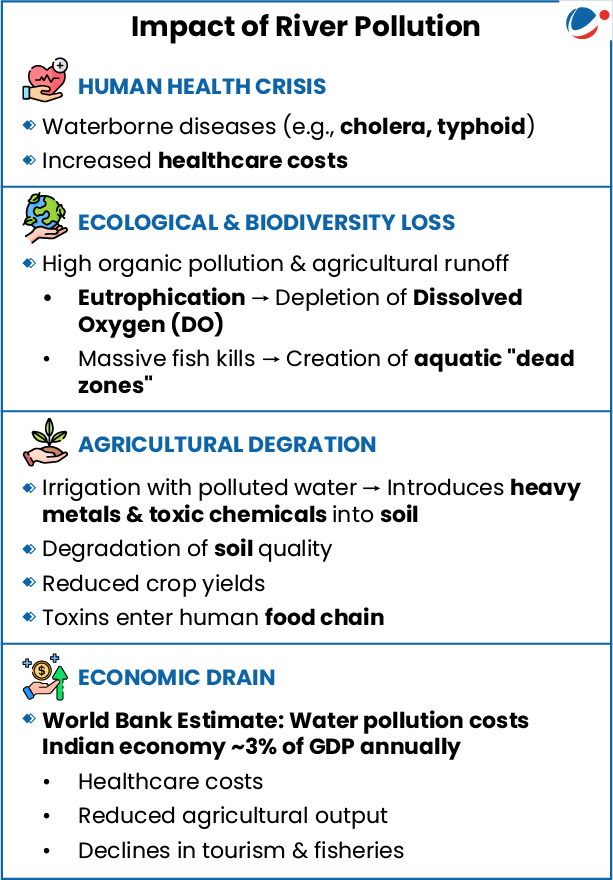
Impact of river pollution on human health, ecology, agriculture sector,, economy

Issues in Regulating River Pollution in India 

  • Ineffective Legal Execution: Even with strict environmental laws in place, a shortage of staff and poor monitoring prevent effective action.
    • E.g., Factories along the Yamuna River routinely dump uncleaned waste due to a lack of strict regulatory oversight.
  • Fragmented governance: River management involves too many different agencies, causing overlapping duties and administrative inefficiencies.
    • E.g., State Pollution Control Boards (SPCBs) frequently fail to coordinate with local municipal authorities which slows down the response to illegal dumping.
  • Under performance of Schemes: Delays in the approval of detailed project reports, slow pace of implementation, and low fund utilisation have been observed.
    • E.g., only 69% of funds allocated to the Namami Gange Programme were utilised up to 2024-25
  • Deficient Sewage Infrastructure: More than 60% of India's sewage flows directly into rivers without undergoing purification.
  • Lack of Political Will: Weak fines and political backing allow many industries to continue polluting without consequence.
    • E.g., Despite numerous Supreme Court directives, leather tanneries in Kanpur persistently discharge toxic chemicals into the Ganga River.
  • Water (Prevention and Control of Pollution) Act, 1974: Establishes Central and State Pollution Control Boards (CPCB & SPCBs) to regulate water pollution; Prohibits use of stream or well for disposal of polluting matter etc.
  • Environment Protection Act, 1986: Empowers the government to set pollution standards and regulate hazardous waste disposal.
    • Government of India has notified industry specific discharge standards under Schedule-I: 'Standards for Emission or Discharge of Environmental Pollutants from various Industries' under this act.
  • National Green Tribunal (NGT) Act, 2010: Provides fast-track resolution of environmental cases. NGT can impose fines on polluters.
  • Municipal Solid Waste (MSW) Rules, 2016 & Sewage Treatment Regulations: Mandates waste segregation and treatment to prevent direct discharge into rivers.
  • Ganga Action Plan (1986) & Namami Gange (2014): Significant funding for sewage treatment plants (STPs), afforestation, and industrial waste control. 
    • It also focuses on river rejuvenation and public awareness campaigns.
  • National Water Quality Monitoring Network (NWMP): Established by CPCB in collaboration with State Pollution Control Boards (SPCBs) in the States and Pollution Control Committees (PCCs) in Union Territories to regularly assess status of water quality of water resources.
  • National River Conservation Plan (NRCP): Centrally Sponsored Scheme to reduce the pollution load in rivers through implementation of various pollution abatement works.
  • Schemes for creation of sewerage infrastructure: Atal Mission for Rejuvenation & Urban Transformation (AMRUT) and Smart Cities Mission.

Way Forward

  • Strengthening Pollution Control Boards: Increase funding, autonomy, and accountability of SPCBs and CPCB.
  • Source control: Identification and management of polluting sources, quantification and characterization of solid waste and sewage generated in catchment area of polluted river stretch. 
  • Upgrading to Real-Time Tracking: Utilize modern technology like artificial intelligence (AI) sensors and satellites to constantly monitor the health of river water.
  • Upgrade existing treatment facilities: Adopt advanced treatment technologies and implement stringent monitoring protocols. 
  • Integrated river basin management: Unify industrial regulation, waste management, and agricultural policies under a single authority.
    • E.g., the EU Water Framework Directive follows a basin-wide approach, improving river health across member nations.
  • Encouraging Public Involvement: Bring local citizens into the loop by having them report pollution and participate in community clean-up efforts.
    • E.g., cleaning drives led by everyday citizens in Varanasi have successfully helped improve the water quality in their local area.

Conclusion

River pollution in India persists due to weak enforcement, poor coordination, and inadequate infrastructure, despite strong legal provisions. Addressing this crisis requires stricter implementation, better governance, technological monitoring, and public participation to ensure clean and sustainable rivers.

Explore Related Content

Discover more articles, videos, and terms related to this topic

RELATED VIDEOS

2
What is Artificial Rain? | Deep Dive With VisionIAS

What is Artificial Rain? | Deep Dive With VisionIAS

YouTube HD
Carbon Markets

Carbon Markets

YouTube HD

RELATED TERMS

3

EU Water Framework Directive

An important piece of European Union legislation that aims to protect and improve the quality of water bodies. It uses a basin-wide approach, promoting coordinated management of water resources across member states.

Integrated River Basin Management

A holistic approach to managing water resources within a river basin, considering all aspects of water use, quality, and ecosystem health, often involving coordination across different agencies and sectors.

Atal Mission for Rejuvenation & Urban Transformation (AMRUT)

A mission launched by the Government of India to ensure that every household has access to a basic amenities and to promote sustainable urban development, including sewerage infrastructure and water supply.

Title is required. Maximum 500 characters.

Search Notes

Filter Notes

Loading your notes...
Searching your notes...
Loading more notes...
You've reached the end of your notes

No notes yet

Create your first note to get started.

No notes found

Try adjusting your search criteria or clear the search.

Saving...
Saved

Please select a subject.

Referenced Articles

linked

No references added yet