


Report of the 16th Finance Commission was tabled in Parliament on February 1, 2026 for the five-year period between 2026-27 and 2030-31.
Key Recommendations of the 16th Finance Commission
- Vertical Devolution: Retained at 41% (unchanged from the 15th FC). The 15th FC reduced it from 42% recommendation of the 14th FC.
- However, this excludes cesses and surcharges levied by the Centre.
- States argue that share of cesses and surcharges in the total revenue has risen substantially, but states remain outside its purview.
- The share of cesses and surcharges, along with the cost of collection, reached a high of ₹13.5 for every ₹100 collected as taxes by the Centre in 2021-22, the highest ratio in at least over a decade.
Criteria for Horizontal Devolution
- Income Distance: Defined as the difference between a state's per capita GSDP and the average of the top three large states. Lower GSDP yields a higher share to ensure equity.
- Population: Based on the 2011 Census.
- Demographic Performance: Now based on population growth from 1971–2011, replacing the 15th FC's change in Total Fertility Rate (TFR) metric.
- This is to reward the States with lower population growth (Southern States) as they will now have a higher share under this parameter.
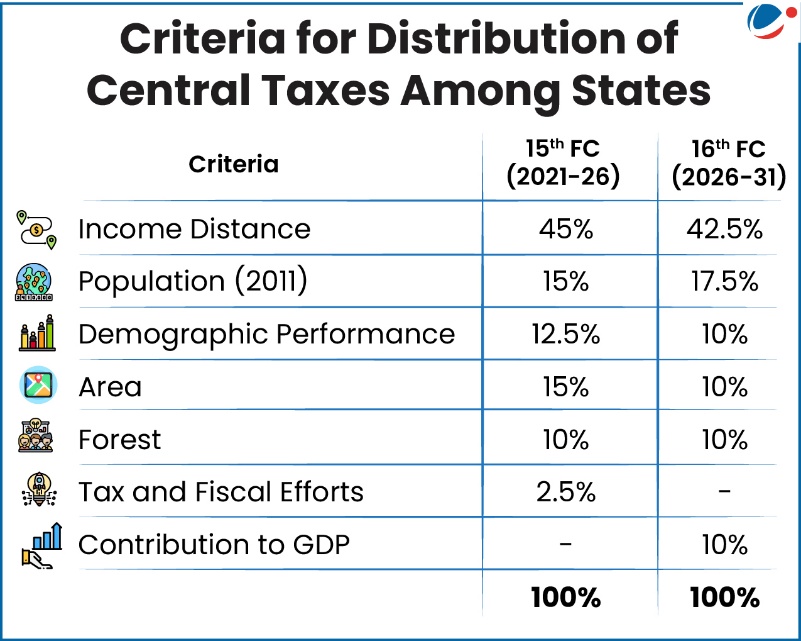
- Forest: Now weighs both total forest area share and the increase in forest area (2015–2023). It now includes open forests, unlike the 15th FC which only counted dense/moderate forests.
- Contribution to GDP: Replaces the tax/fiscal effort parameter. It rewards national GDP contribution, calculated as the square root of a state's GSDP relative to the sum of the square roots of all states' GSDPs. (Uses average nominal GSDP from 2018-19 to 2023-24, excluding the 2020-21 pandemic year).
Grants-in-Aid (Rs 9.47 lakh crore total)
- Focus: Urban/Rural local bodies and disaster management.
- Discontinued: Revenue deficit, sector-specific, and state-specific grants.
Local Body Grants
- Allocation: Rs 4.4 lakh crore for Rural (RLBs) and Rs 3.6 lakh crore for Urban (ULBs).
- For urban local bodies, this is a marked increase from 36% (15th FC) to 45% by the 16th FC.
- A significantly higher share for urban bodies is in recognition of the projected urbanisation level of 41% as of 2031.
- Structure: 80% Basic / 20% Performance-Based (split equally between local and state performance).
- Conditions for Funds: Proper constitution of local bodies, publishing audited accounts, and timely formation of State Finance Commissions. Performance grants require improved Own Source Revenue.
- Tied vs. Untied: Basic: 50% tied to sanitation/waste/water management; 50% untied.
- Performance: 100% untied.
- Special ULB Grants: Infrastructure: Tied to wastewater management for cities with 10–40 lakh population (2011 Census).
- Urbanisation Premium: One-time grant for merging peri-urban villages and formulating a Rural-to-Urban Transition Policy.
Disaster Management
- Corpus: Rs 2,04,401 crore for State Disaster Relief and Management Funds (SDRF/SDMF).
- Cost Sharing: 90:10 (Centre:State) for North-Eastern/Himalayan states; 75:25 for all others.
- New Disasters: Heatwaves and Lightning recommended for notification as national disasters.
- Tech Upgrade: NDMIS to be upgraded into a comprehensive disaster management system for both Union and States.
Four Reforms for Sound Public Finances | ||
Reform Area | Core Objective / Target | Key Actions & Conditions |
Prudent Fiscal Management |
|
|
Power Sector Reforms |
|
|
Subsidy Rationalization |
|
|
PSE Reforms |
|
|
Conclusion
The 16th Finance Commission assumes critical importance at a time when India must balance cooperative federalism with fiscal prudence and developmental equity. Its recommendations will shape not only the sharing of resources between the Centre and the States, but also the quality of public spending, the strength of local bodies, and the resilience of States in the face of disasters and rising welfare commitments.


