


Why in the News?
As per Economic Survey 2025-26, increasing FemaleLabour Force Participation Rate (FLFPR) participation to ~55% by the 2050 could be critical for maintaining a high annual GDP growth trajectory.
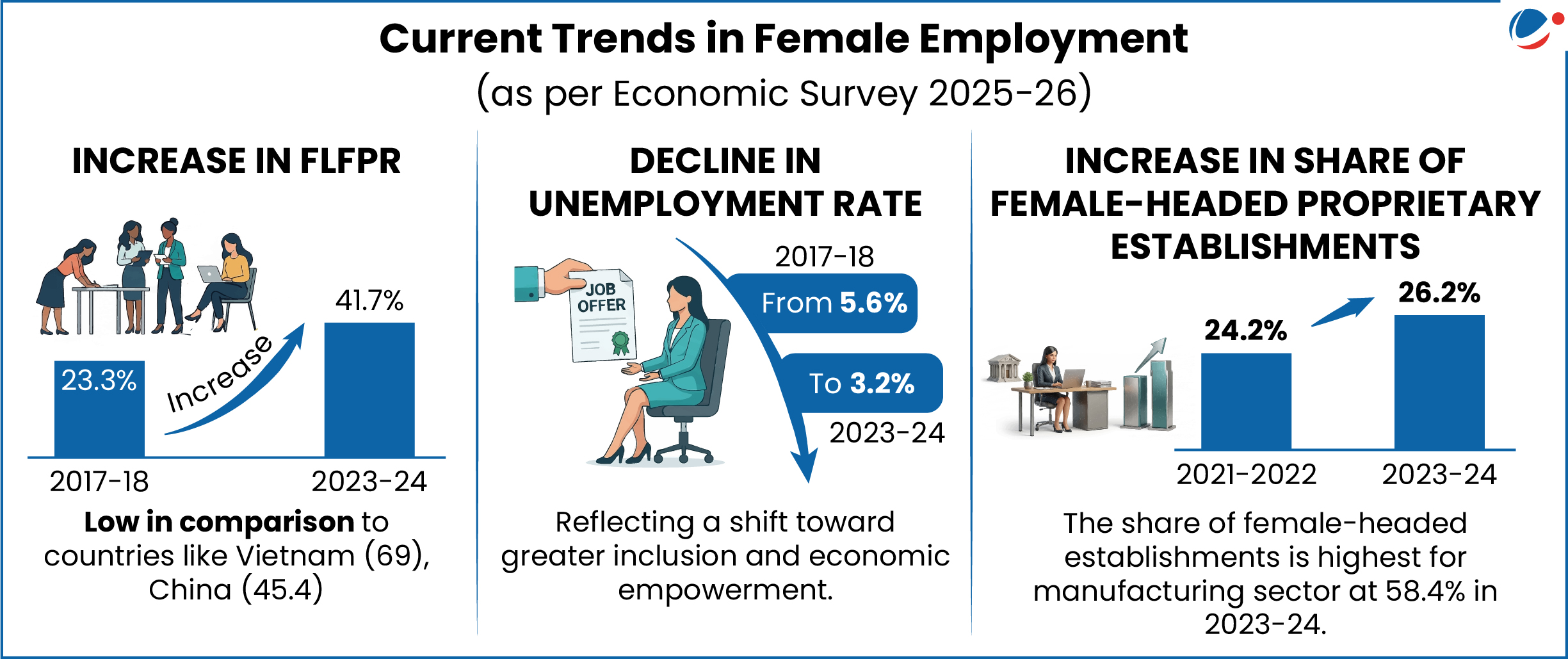
As per WEF's Global Gender Gap Report 2025, India slipped 2 places (131 in2025 from 129 in 2024) and ranked in bottom 5 of Economic Participation and Opportunity subindex, highlighting significance of enhancing FLFPR in India.
Reasons for Low Employment among Women
- Claudia Goldin's U-curve (Nobel Prize 2023): It demonstrates that women's participation in the labour market is influenced by Social Norms/Legislative gaps, Parenthood Effect and Technological Innovations.
- It says that the FLFPR drops during early industrialisation (women leave agriculture but lack factory-ready skills/social permission) and rises again only when education levels cross a threshold and service-sector jobs expand.
- Limited access to STEM careers: In India women constitute 43% of STEM graduates, but only an estimated 27% participate in the STEM (Science, Technology, Engineering, and Mathematics) workforce.
- Growth in rural jobs: Rural FLFPR is considered the primary driving force behind overall increase in women's workforce participation
- Mobility-related barriers: According to a World Bank study (2021), 31% of women cited commuting as a barrier to working.
- 13% and 19% women reported childcare responsibilities and domestic duties respectively as barriers to commuting for work.
- Inflexible work arrangements: Women's caregiving role demands flexible work arrangements.
- E.g., 41% of females aged 15-59 years participated in caregiving for their household members (21.4% for males).
- Unpaid labour: Women spent 363 min/day on unpaid work vs. 123 min/day for men.
- Low share in gig economy: As per estimates, women currently make up 28% of platform economy workers and face barriers like safety risks; lack of maternity leave and welfare benefit; Gender segmentation etc.
- Other issues: Lack of affordable housing; Workplace Discrimination; Sexual Harassment; Lack of Family Support; etc.
Measures taken to Enhance Women Employment
|
Way Forward: Recommended Measures to Enhance Female LFPR
- Extending safety infrastructure and providing affordable intermediate transport:
- Boosting women police visibility in high-traffic zones during off-peak hours. E.g., Kochi's Women Police Control Room vans and Hyderabad's SHE Teams.
- Gender-responsive walking/cycling infrastructure with lighting and safe crossings. E.g., Chennai's inclusive street design manual.
- Women centric industrial clusters and manufacturing: E.g., Sakhi Niwas scheme of the Ministry of Women and Child Development creates a supportive ecosystem for women navigating work and mobility.
- Affordable housing: E.g., Tamil Nadu's Working Women's Hostels Corporation ('Thozhi Hostels').
- Easing unpaid care burden:
- Bridge re-entry barriers: E.g., initiatives such as 'Back to Work' and 'Returnship programmes' for women re-entering workforce.
- Promote flexible work, hybrid models, and gender-responsive standards: E.g., newly enacted Labour Codes allow women workers to work from after availing themselves of the maternity benefit.
- Public-private partnership: E.g., Telangana's WE-Hub connects women with start-up ecosystems and investors.
- Other measures: Encouraging women's participation in STEM disciplines; expanding the network of Anganwadi centres; integrating community crèches; incentivising employer-linked childcare; Aligning training programmes with industry demand; etc.
Conclusion
Women's labour participation is central to India's long-term economic transformation and achieving SDG 5 (gender equality and empower all women and girls). Higher female employment supports fairer labour market outcomes, strengthens household welfare and contributes to building a more inclusive, resilient, and productive economy on the path to Viksit Bharat by 2047.


