


Why in the News?
Recently, Supreme Court passed a slew of directions in State of U.P. vs Ajmal Beg Case, 2025 to tackle dowry evil and enforce prohibition through the Dowry Prohibition Act (DPA), 1961.
About Dowry in India
- Dowry is "any property or valuable security given or agreed to be given either directly or indirectly, by one party to a marriage to the other party to the marriage, at or before or any time after the marriage" (DPA, 1961).
- Dowry-related crimes saw a 14% increase in 2023, with more than 15,000 cases recorded across country and over 6,100 deaths reported through the year. (NCRB, 2023)
- Uttar Pradesh accounted for highest number of cases under DPA followed by Bihar and Karnataka.
Causes for rising Dowry and related Crime in India
- Social Status: Dowry has increasingly become a means of displaying social status i.e., "grand weddings", luxury items, etc. With rising aspirational lifestyles, marriage becomes a platform for conspicuous consumption, pushing dowry demands upwards.
- Financial Security: Provision of dowry can ensure a measure of financial security for the bride, serving as a safety net in times of economic hardship.
- Weak deterrence: Delay in judicial system in handling dowry cases contributes to weak implementation of anti-dowry laws. In 2015, only 34.7% of accused have been convicted while the rest of the cases continued to be pending.
- Despite Dowry Prohibition Act, 1961, many incidents of dowry harassment and deaths go unreported due to corruption, social pressure, and inadequate victim support.
- Transaction: In many regions, groom's education/job (IAS/engineer/private sector package) is treated like an asset, turning marriage into a "transaction", encouraging demand-side dowry.
- Social pressure: Families may keep paying repeated dowry instalments due to fear of social stigma around separation/divorce; concern for children; pressure to maintain family honour etc. This enables continuous post-marriage dowry extraction.
- Lack of Awareness and Education: Many people remain unaware of legal implications and the protections available to them.
Judicial Pronouncements related to Dowry
|
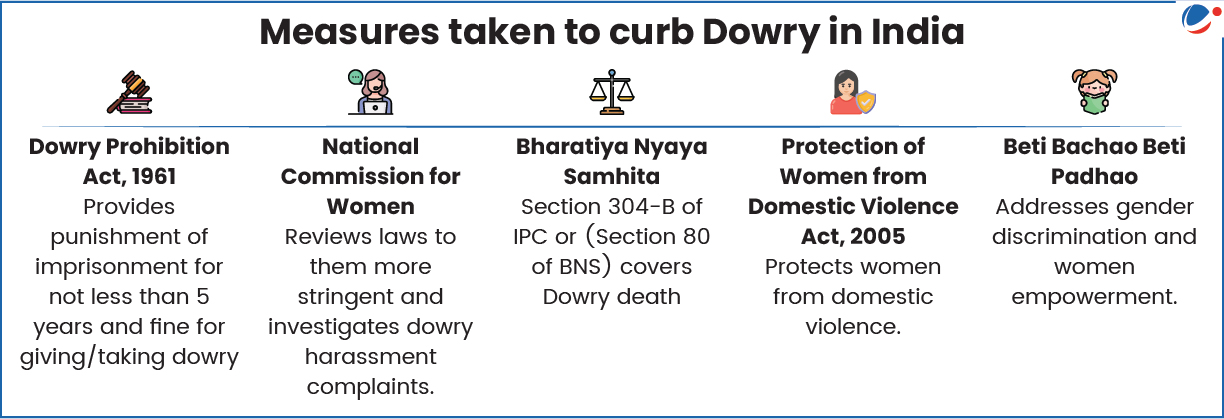
Way Forward
- Directions of Supreme Court in State of U.P. vs Ajmal Beg, 2025 Case
- Appointment of Dowry Prohibition Officers (DPOs): These officers must be adequately trained and their contact details must be widely publicised so that citizens are aware of whom to approach.
- DPOs are government officials appointed by State Governments under India's Dowry Prohibition Act, 1961.
- Expeditious Disposal of Pending Cases: High Courts are requested to take stock of the number of cases dealing with Section 304-B (dowry death) and Section 498-A (cruelty including dowry harassment) of IPC for disposal.
- Now, Section 80 and 85 of BNS, 2023 deals with Dowry death and Cruelty respectively.
- Training for Officials: Police and judicial officers should periodically receive training ensuring sensitivity toward genuine cases while identifying those that may be frivolous.
- Other: Running of Grassroots Awareness Programs by district administration, change in education curriculum for awareness about this evil practice etc.
- Appointment of Dowry Prohibition Officers (DPOs): These officers must be adequately trained and their contact details must be widely publicised so that citizens are aware of whom to approach.
- Supreme Court guidelines in Arnesh Kumar v. State of Bihar, 2014 Case
- All State Governments to instruct its police officers not to automatically arrest when a case under Section 498-A of IPC is registered.
- Police officer shall furnish the reasons and materials which necessitated the arrest while forwarding/producing the accused before Magistrate for further detention.
- Magistrate while authorizing detention of accused shall peruse the report furnished by the police officer in terms aforesaid and only after recording its satisfaction, the Magistrate will authorize detention.
- Authorising detention without recording reasons as aforesaid by Judicial Magistrate concerned shall be liable for departmental action by the appropriate High Court.
- Social norms: Dowry is sustained by social acceptance. Therefore, village committees, Residential Welfare Associations, religious leaders and youth groups can create social sanctions against dowry demand and reward dowry free marriages (certification, public recognition).
Conclusion
Dowry is not merely a legal problem but a socio-economic institution rooted in patriarchy and marriage markets. Hence, the solution requires a "4P approach" i.e. Punishment (deterrence), Protection (victim support), Prevention (social norm change), and Promotion of women's empowerment.


