


United Nations announced the approval of the first carbon credits under global market involving a project in Myanmar coordinated with the Republic of Korea.
About Paris Agreement Crediting Mechanism (Article 6.4)
- It is a carbon crediting mechanism under Article 6 of Paris Agreement.
- It encourages verifiable emission reductions; attracts funding and allows cooperation among countries.
- E.g., company in one country can reduce emission in that country and have those reductions credited to sell them to another company in another country.
- Apart from article 6.4, other two components of Article 6 are:
- Article 6.2: Provides accounting and reporting guidance for Parties
- Article 6.8: Provides opportunities for non-market-based cooperation.
Article Sources
1 sourceNGT while noting the “strategic importance of the project” upheld its environmental clearance and compliance with ICRZ (Island Coastal Regulation Zone) and CRZ norms.
About the Great Nicobar Project
- Location: Great Nicobar Island (southernmost island of Andaman and Nicobar Islands) including parts of Galathea Bay, Campbell Bay and the Great Nicobar Biosphere Reserve.
- Objective: Project envisions transforming the remote outpost into a major transshipment and defence hub with integrated township, 450 MVA Gas and Solar-based power plant, dual-use civil-military airport, etc.
- Implementing Agency: Andaman and Nicobar Islands Integrated Development Corporation along with the NITI Aayog.
Concerns associated with the Project
- Regulatory Lapses:
- Environmental Impact Assessment (EIA) relied on single-season data instead of comprehensive multi-season assessment.
- Proposed compensatory afforestation in Haryana is inadequate to offset loss of a tropical rainforest ecosystem.
- Forest Rights Act (FRA): Government has proceeded with project even after Tribal council withdrew its consent.
- Environmental Impact Assessment (EIA) relied on single-season data instead of comprehensive multi-season assessment.
- Threat to Biodiversity: The project involves diverting approximately 130 sq. km of tropical rainforest (felling one million trees), home to the Nicobar megapode, Nicobar tree shrew, Giant leatherback turtles, corals, etc.
- Social Impact: Project might negatively impact tribal population, e.g. Shompen (Particularly Vulnerable Tribal Group) and Nicobarese.
- Natural Disaster Vulnerability: The Island falls in the highest seismic-risk zone (Zone VI).
Significance of the Project for India
|
The Intergovernmental Oceanographic Commission (IOC) of UNESCO released Integrated Ocean Carbon Research (IOC-R), 2026 report.
About IOC
- Objective: To promote international cooperation and to coordinate programmes in research, services and capacity-building in order to learn more about Oceans.
- Members: 152 (India is a member).
- Secretariat: Paris, France.
Key Highlights of Report
- Carbon Sink: Oceans absorb excess atmospheric CO₂, reducing greenhouse gas concentration.
- Solubility Pump: Cold ocean waters dissolve CO₂ and transport it to deep ocean layers for long-term storage.
- Land–Ocean–Ice Exchange: Oceans exchange carbon with rivers and melting ice, influencing global carbon distribution.
Article Sources
1 sourceIllegal Rat-hole mining has claimed more than 20 lives in Meghalaya.
What is Rat-hole mining?
- Rat Hole’ mining is a primitive and unscientific form of mining.
- In this process, Land is first cleared by cutting and removing the ground vegetation and then digging pits into the ground to reach the coal seam.
- Coal seams are reached by excavating the hill slopes and then coal is extracted through a horizontal tunnel,where workers enter and extract coal.
- Rat-hole mining is prone to collapsing because they lack engineered roofs and side-wall protections.
- Methods of extraction: Side-cutting, Box-cutting
Reasons for Illegal Mining Continuation
- Natural Factors: E.g.,Coal seams in Meghalaya are very thin which makes rat-hole mining more economically viable than opencast mining.
- Lack of Alternatives: Without viable economic substitutes in sectors like horticulture, construction, manufacturing, the population reverts to mining for survival.
- Complex Ownership Structures: The specific ecosystem in Meghalaya involves small, privately or community-owned landholdings with fragmented ownership.
Measures taken to stop illegal rat hole mining
|
5.3.5. Fishing Cat
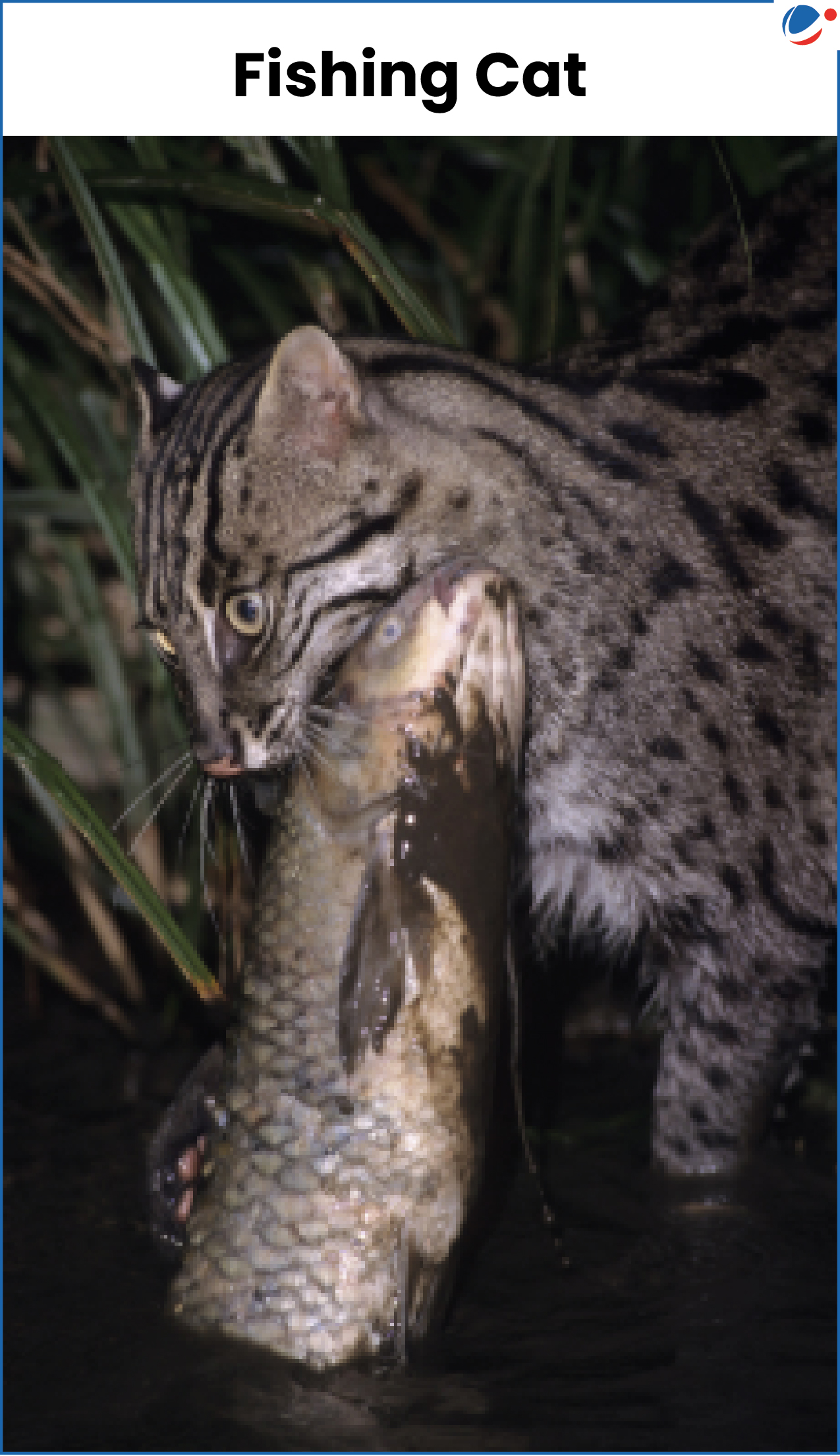
The first scientific assessment has established Kaziranga National Park and Tiger Reserve as a stronghold of the fishing cat.
About Fishing Cat (Prionailurus viverrinus)
- It is a powerful feline, about twice the size of a house cat.
- Habitat: Inhabits wetlands and mangroves in India, Pakistan, Sri Lanka, Gulf of Thailand, etc.
- In India, found mainly in Sundarbans, Himalayan foothills along Ganga & Brahmaputra valleys, and Western Ghats.
- Diet & Behavior: Nocturnal hunters that prey on fish, frogs, crustaceans, snakes, birds, and scavenged carcasses.
- Conservation Status: IUCN Red List (Vulnerable); WPA, 1972 (Schedule I); CITES (Appendix II).
- Recognition: State animal of West Bengal.
NHAI has announced to develop First of its Kind ‘BeeCorridors’ Along the National Highways.
About Beecorridors
- Beecorridors are a continuous linear stretch of bee-friendly vegetation comprising flowering trees and plants.
- It will ensure the availability of nectar and pollen throughout the year.
- Significance: The initiative will help reduce the increasing ecological stress faced by honeybees and other pollinators.
Bees & their Significance:
- Characteristics
- Only female bees have stingers (which are modified ovipositors, organs originally used to lay eggs).
- Feed exclusively on sugary nectar and protein-rich pollen from flowering plants.
- Significance: : A third of the world’s food production depends on bees.
Article Sources
1 sourceLake Mai Ndombe and Tumba of Democratic Republic of Congo are releasing carbon that has been locked away for thousands of years in surrounding peatlands.
- The swamps and peatlands of the Congo Basin cover only 0.3% of the earth’s land surface, yet hold one-third of the carbon stored in its tropical peatlands.
About Peatland
- A peatland is an area of land with layers of accumulated organic surface material in a state of decay (known as peat).
- Peat develops in waterlogged conditions.
- Peatland drainage and fires are estimated to contribute at least 5 % of global greenhouse gas emissions, contributing to climate change.


