


Why in the News?
Larsen & Toubro Wins Department of Atomic Energy Contract to Build LIGO-India Facility in Hingoli district, Maharashtra.
About the Laser Interferometer Gravitational-Wave Observatory (LIGO)
- LIGO is the world's largest gravitational-wave observatory that detects ripples in space-time using laser interferometry.
- Gravitational waves are 'ripples' in space-time caused by some of the most violent and energetic processes in the Universe.
- Predicted by Albert Einstein in 1916 as a consequence of his general theory of relativity.
- They travel at the speed of light ( Nearly 186,000 miles per second).
- These waves squeeze and stretch anything in their path as they pass by.
- Every physical object that accelerates produces gravitational waves.
- But the masses and accelerations of objects on Earth are far too small to make gravitational waves big enough to detect.
- Some examples of events that could cause a detectable gravitational wave are:
- When a star explodes asymmetrically (called a supernova)
- When two big stars orbit each other.
- When two black holes orbit each other and merge.
- When two neutron stars collide. (GW170817 wave detected in 2017 by LIGO detectors)
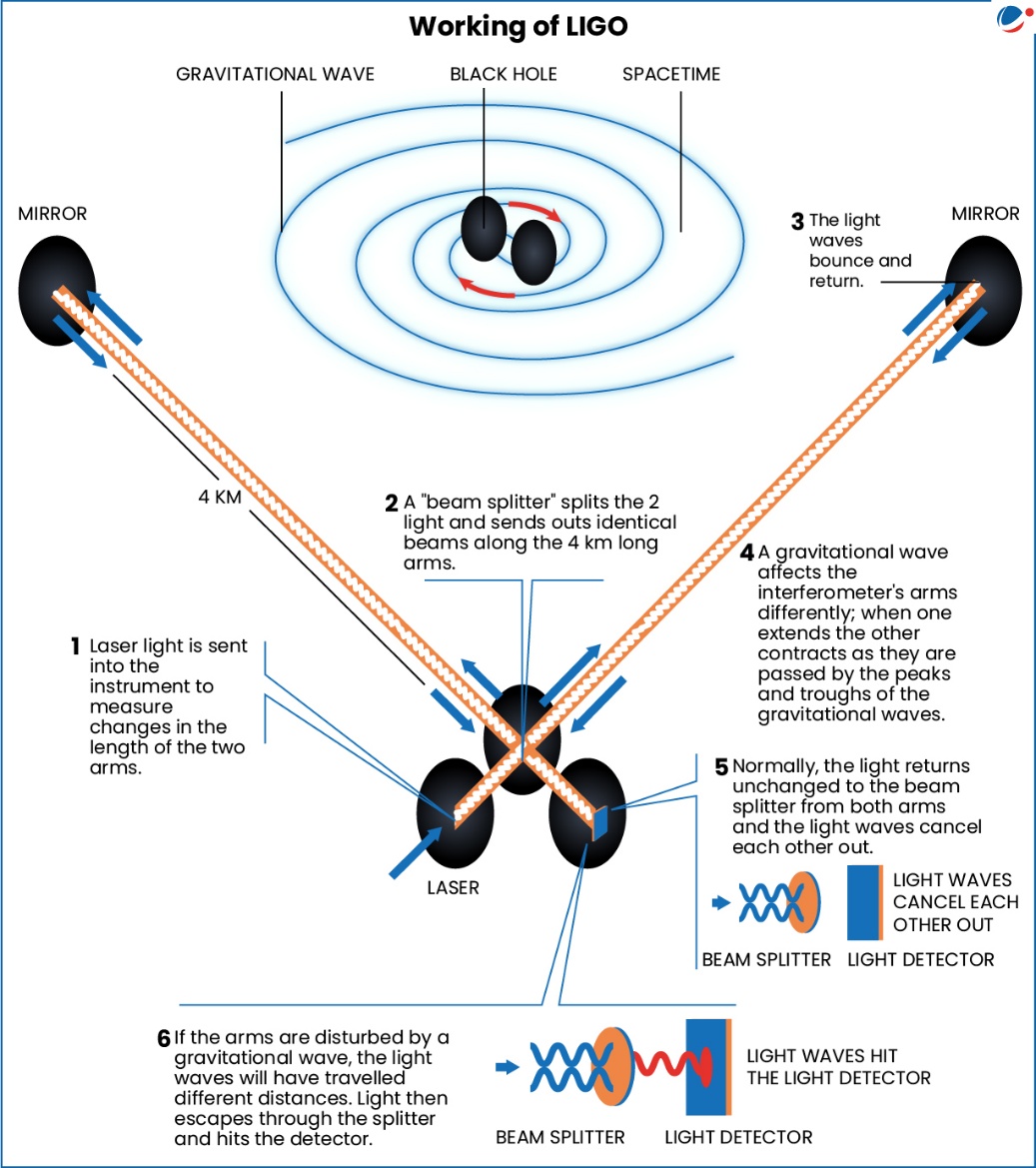
- Funded & Operated by: Supported by the National Science Foundation and operated by the California Institute of Technology and the Massachusetts Institute of Technology.
- Technology: Uses laser interferometers with two 4-km-long arms arranged in an L-shape to measure extremely tiny distortions in space-time.
- Detectors: Two main observatories located about 3000 km apart at Hanford (Washington) and Livingston (Louisiana) in the USA.
- Global Network: Works with detectors such as the Virgo detector (Italy), the KAGRA (Japan) and GEO600 (in Germany).
- Nobel Prize (2017): awarded to Rainer Weiss, Barry C. Barish, and Kip Thorne for their contribution to the LIGO-VIRGO project and its detection of gravitational waves (2015).
LIGO-India
- InDIGO (the Indian Initiative in Gravitational-wave Observations): An initiative to set up advanced experimental facilities, for a multi-institutional Indian national project in gravitational-wave astronomy. (Partnering for establishment of LIGO-India).
- Nature: LIGO-India is a planned gravitational-wave observatory in India that will be part of the global network of detectors studying gravitational waves.
- Situated: Aundh, Hingoli district, Maharashtra.
- Implemented by: By the Department of Atomic Energy (DAE) and the Department of Science and Technology (DST) in collaboration with the National Science Foundation (USA).
- Objective: Improve the detection accuracy and localisation of gravitational-wave sources across the sky through a globally distributed detector network.
- Significance for India: Development of Astrophysical Research Leadership; Technological Advancement; Industrial Collaboration; International Prestige & Diplomacy, etc.
