Parliamentary Panel reviewed AMRUT, highlighting financing gaps, O&M capacity issues in ULBs, and fragmented governance.
Recommendations include integrated urban water management, a national wastewater reuse policy, and long-term demand projections for water security.
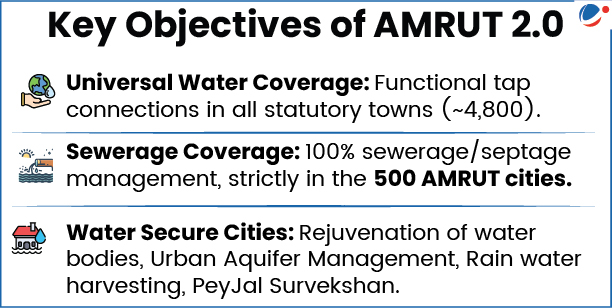
AMRUT 2.0 aims for water security and sustainability, emphasizing outcome-based funding, community participation, and technology adoption.
In Summary
Why in the News?
Standing Committee on Housing & Urban Affairs (18th Lok Sabha) presented its Report titled "Review of Atal Mission for Rejuvenation and Urban Transformation (AMRUT) with special emphasis on Urban Drinking Water" in LS.
More on the News
The Parliamentary Panel focused on urban drinking water within the broader AMRUT framework, examining financing, institutional arrangements, monitoring systems and wastewater management.
The report highlights that while AMRUT has made strides in urban rejuvenation, significant hurdles remain in reaching the goal of water-secure cities.
It emphasizes that current efforts must be integrated across various central schemes such as, the Swachh Bharat Mission (SBM) and Jal Shakti Abhiyan to ensure sustainable results.
Observations & Recommendations of the Standing Committee
Topic
Key Issues Highlighted
Recommendation
Urban Water Infrastructure Funding
Significantfinancing gap between High Powered Expert Committee (HPEC) projections and AMRUT 2.0 allocations.
Limited O&M (Operations & Maintenance) capacity in smaller Urban Local Bodies (ULBs).
Conduct comprehensive state-level assessments to bridge the funding gap and pursue multilateral funding.
Establish an incentive-based O&M framework and assess financial needs with a long-term perspective up to 2047.
Institutional Governance
Governance remains fragmented across various ministries and schemes.
Lack of institutional synergy despite existing convergence mechanisms.
Institutionalize Integrated Urban Water Management (IUWM) by creating a formal inter-ministerial coordination platform and establishing IUWM Cells at the state level.
Monitoring, Data, and Transparency
Data reporting isinsufficient regarding water coverage, Non-Revenue Water (NRW), metering, and financial contributions from States and ULBs.
Launch a standardized outcome monitoring framework and a public digital dashboard for time-series data on 24x7 supplyand NRW.
Implement a robust mechanism to track financial expenditures for increased accountability.
Wastewater Treatment and Reuse
Significant amounts of sewage remain untreated.
Existing Sewage Treatment Plants (STPs) are underutilized.
Formulate a National Urban Wastewater Reuse Policy with enforceable benchmarks to achieve 100% treatment.
Mandate state-level reuse policiesand track the resulting reduction in potable water diversion.
Long-Term Demand Projections
There is currently no consolidated national-level projection for urban drinking water demand through the year 2047.
Commission a unified national assessment for the next 25-30 years that accounts for population growth, migration, and climate resilience.
This is to form the basis of a National Urban Water Security Strategy.
Conclusion
The Parliamentary panel underscores that AMRUT has laid a foundational framework for urban service delivery but has fallen short on speed, scale, and uniformity. Addressing capacity gaps, ensuring robust financing, and enforcing outcome-oriented governance are critical to realise AMRUT's objectives. With AMRUT 2.0, a sharper focus on water security, sustainability, and accountability can convert investments into lasting urban transformation.
About the Atal Mission for Rejuvenation and Urban Transformation 2.0 (AMRUT 2.0) Mission
Launch Date: 1 October 2021 (Successor to AMRUT (2015-2021)).
Nodal Ministry: Ministry of Housing and Urban Affairs
Type: Centrally Sponsored Scheme (CSS).
About: Development of basic infrastructure in the sectors of Water supply, Sewerage and septage management, Storm water drainage, green spaces and parks, and non-motorized urban transport.
Other Features of the Scheme:
Outcome-Based Funding: Cities must submit roadmap to achieve set targets.
Community Participation: with emphasis on women's self-help groups.
Pey Jal Survekshan: A competitive monitoring tool (similar to Swachh Survekshan) to assess cities on water quality, quantity, and reuse.
PPP Mandate: Cities with >1 million population must implement at least 10% of their allocation through Public-Private Partnerships.
Technology Sub-Mission: Focus on Light House Projects and supporting water-sector startups.
Gig Economy Model (AMRUT Mitra initiative): Unique social integration where youth and women are co-opted for feedback and assessment roles.
Mandatory Reforms & Urban Governance: To ensure long-term sustainability, funds are tied to specific reforms e.g. Fiscal Health, Water Efficiency etc.
Implementation & Planning Mechanism
The scheme follows a bottom-up, data-driven planning hierarchy:
City Water Balance Plan (CWBP): The foundational step. Cities assess current supply, demand, and gaps.
City Water Action Plan (CWAP): Projects formulated to bridge the gapsidentified in CWBP.
State Water Action Plan (SWAP): Aggregation of city plans submitted to the Centre (Apex Committee).
Urban Aquifer Management Plan: The Aquifer Management Plan will focus on maintaining positive groundwater balance in urban aquifer systems.
A plan focused on maintaining a positive groundwater balance in urban aquifer systems, crucial for sustainable water resource management in cities, especially considering population growth and climate change impacts.
City Water Balance Plan (CWBP)
The foundational planning document for cities under AMRUT 2.0, where current water supply, demand, and existing gaps are assessed to form the basis for future action plans.
Public-Private Partnerships (PPP)
A collaborative arrangement between a government agency and a private-sector entity for the purpose of providing a public asset or service. In AMRUT 2.0, PPPs are encouraged for cities with over 1 million population to implement a portion of their allocation.
Title is required. Maximum 500 characters.
Search Notes
Filter Notes
Loading your notes...
Searching your notes...
Loading more notes...
You've reached the end of your notes
No notes yet
Create your first note to get started.
No notes found
Try adjusting your search criteria or clear the search.