


Why in the News?
India's civil aviation sector has been in the spotlight following major operational disruptions at a dominant carrier and consequent regulatory action by the Directorate General of Civil Aviation (DGCA).
More on the News
- In early December 2025 a large-scale wave of flight cancellations and disruptions exposed weaknesses in airline operational planning, crew rostering, and contingency management.
- This prompted regulatory interventions by the Directorate General of Civil Aviation (DGCA), including the waiver of new pilot rest norms.
- The crisis raised concerns regarding the Aviation Governance in India prompting fresh inquiries into regulatory effectiveness, DGCA reform, industry concentration, slot allocation, and contingency planning.
The Institutional Architecture of Aviation Governance in India
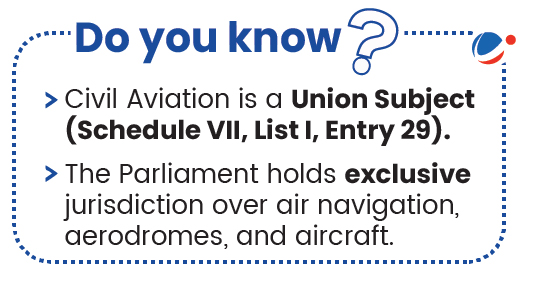
- Ministry: Ministry of Civil Aviation is the nodal ministry for formulating national policies and programs for the development and regulation of the civil aviation sector.
- Directorate General of Civil Aviation (DGCA): Regulatory body in the field of Civil Aviation, primarily dealing with safety issues.
- Responsibility: Regulation of air transport services to/from/within India and for the enforcement of civil air regulations, air safety, and airworthiness standards.
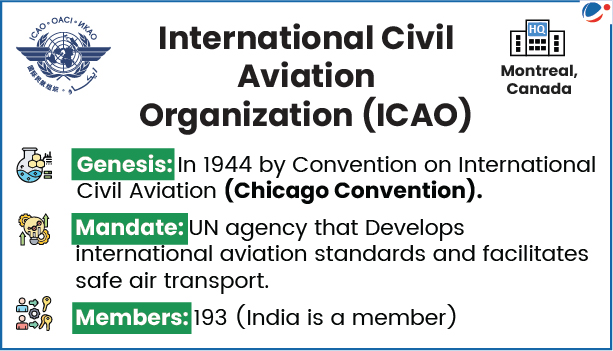
- Also coordinates all regulatory functions with the International Civil Aviation Organisation (ICAO).
- India has been re-elected to the ICAO Council for the term 2025-2028.
- Airports Economic Regulatory Authority of India (AERA): Established in 2009 under the Airports Economic Regulatory Authority of India Act, 2008.
- It regulates tariffs for aeronautical services, determine other airport charges for services rendered at major airports and monitor the performance standards of such airports.
- Bureau of Civil Aviation Security (BCAS): Initially set up as a cell in the DGCA in 1978 and later reorganised into an independent department under the Ministry of Civil Aviation in 1987.
- It lays down Aviation Security Standards per Annexe 17 to the Chicago Convention of ICAO. Annexe 17 is for Safeguarding International Civil Aviation Against Acts of Unlawful Interference.
- Aircraft Accident Investigation Bureau: It was established in 2012 as an attached office under the Union Ministry of Civil Aviation.
- All Accidents and Serious Incidents involving aircraft with an All-up Weight (AUW) of more than 2250 kg or Turbojet aircraft are investigated by AAIB.
- Investigations into occurrences involving an aircraft of maximum mass of 2250 Kg or less, which are classified as Serious Incidents, are carried out by DGCA.
- All Accidents and Serious Incidents involving aircraft with an All-up Weight (AUW) of more than 2250 kg or Turbojet aircraft are investigated by AAIB.
Critical Issues in Aviation Governance in India
- Regulatory Independence & Staffing: The proximity of DGCA to the Ministry raises questions on operational autonomy; independent regulators elsewhere have greater statutory insulation to avoid regulatory capture.
- Parliamentary Standing Committee (380th Report) noted that DGCA is heavily understaffed, relies on non-permanent staff, and highlighted its inability to function as independent, specialized, and effective regulator.
- Fragmented regulatory remit: Multiple agencies with intersecting functions (safety, economic regulation, airport management) can produce coordination shortfalls unless governance mechanisms are harmonized.
- Safety oversight vs. commercial pressures: Rapid growth and market consolidation can create tension between commercial imperatives (cost efficiencies, scheduling) and safety buffers (robust crew rostering, maintenance margins).
- Market concentration: Dominance by a few carriers increases systemic risk. Operational failure at a market leader can cascade into nationwide disruption and stress infrastructure.
- ATF Fiscal Paradox: Aviation Turbine Fuel (ATF) accounts for ~45% of ticket prices in India (~20-30% globally) and remains outside GST.
- State VAT ranges from 1% to 30%, creating a non-level playing field and high-cost structure.
- Maintenance, Repair and Overhaul (MRO) "Resilience" Gap: 80% of major engine overhauls still occur abroad due to the lack of specialized Customs-bonded industrial clusters in India.
- Other Issues: Crew shortages, Infrastructure issues (Airport congestion, mismatch between infrastructure rollout and traffic growth), limited real-time surveillance and incomplete reporting, Issues in consumer protection (i.e. opaque pricing algorithms, baggage rules and ad-hoc policy changes) etc.
Recent Steps Taken for Reforming Aviation Sector:
|
Way Forward
- Autonomous CAA: Transforming DGCA into a self-funded Civil Aviation Authority (CAA) will strengthen DGCA's operational independence while preserving ministerial policy role.
- Workforce reform: Strengthen crew rostering oversight, mandate robust contingency buffers, and invest in training, retention incentives and human factors research to reduce operational fragility.
- Enforcement framework: Develop a transparent, tiered enforcement and penalty framework with published standards, timelines for remedial action and public disclosure of compliance status.
- Separation of functions: Clearer legal separation between safety regulation, economic oversight & accident investigation. E.g. statutory reinforcement of AAIB's independence and review of AERA/AAI roles to reduce overlap.
- National MRO Policy 2.0: Moving beyond GST concessions to create Integrated Aviation Hubs that include engine manufacturing and component testing.
- Increase Sustainable Aviation Fuel (SAF) Mandate: India has committed to an indicative blending target of 1% SAF by 2027 for international flights, scaling to 5% by 2030.
- Market resilience: Encourage competitive diversity (facilitate entry of regional carriers where desirable), review slot allocation and contingency protocols to reduce systemic exposure to a single carrier's failure.
- Consumer safeguards: Codify and simplify the Passenger Charter of Rights, mandate transparent fare components and strengthen fast-track mechanisms for grievance redressal and compensation.
- Other Reforms needed: Dedicated aviation ombudsman to resolve passenger grievances swiftly, institutionalise routine industry-regulator dialogue, Expand DGCA technical manpower, audit capacity and regional offices; etc.
Conclusion
India's aviation sector stands at a critical inflection point where rapid growth demands modern, independent, and resilient governance. Strengthening regulatory autonomy, clarifying institutional roles, and investing in human capital are imperative to align with global standards.


