Aravallis | Current Affairs | Vision IAS
MENU
Home
Quick Links

High-quality MCQs and Mains Answer Writing to sharpen skills and reinforce learning every day.

Watch explainer and thematic concept-building videos under initiatives like Deep Dive, Master Classes, etc., on important UPSC topics.

ESC

Aravallis

28 Jan 2026
5 min

In Summary

  • SC ordered Jharkhand to declare Saranda Forest a wildlife sanctuary, mandating a geo-referenced Mining Plan for "Go" and "No-Go" zones.
  • SC stayed its Aravalli definition, forming an Expert Committee for a uniform definition and directing a sustainable mining management plan.
  • Aravallis, an ancient range, are ecologically vital for climate regulation, groundwater recharge, and biodiversity, facing threats from mining and development.

In Summary

Why in the News?

Saranda Forest case (2025) and Mining Plan

  • The SC ordered the Jharkhand government to declare the Saranda Forest a wildlife sanctuary. 
  • Noting that a ban on mining could promote illegal mining, it ordered a Mining Plan based on geo-referenced ecological assessments to divide the landscape into "Go" and "No-Go" zones for mining.
  • The case exemplifies SC's approach of balancing the need for ecological preservation with the demands of economic growth

The Supreme Court (SC) stayed its previous judgement related to the definition of the Aravalli hills and range. 

Background of the Issue

  • Formation of Expert Committee (May 2024): The SC directed the Ministry of Environment, Forest and Climate Change (MoEF&CC) to form an Expert Committee to recommend a "uniform definition" for the Aravallis.
  • Definition Adoption (November 2025): In T.N. Godavarman Thirumulpad Case (1995), the SC accepted the Committee recommendations of a uniform definition of Aravallis and paused the grant of fresh mining leases.
    • Definition: 'Aravalli Hill' is any landform in designated districts with 100-meter elevation and a 'Range' are two or more hills within 500-meter proximity.
    • SC directed Government to prepare a Management Plan for Sustainable Mining on the lines of the Saranda Mining Plan. (see box)
  • Government Bans Mining (December 2025): Ministry of Environment Forest and Climate Change (MoEF&CC) issued directions to the States for a complete ban on granting new mining leases (exception for critical, strategic and atomic minerals).
  • Judicial Stay and Review (December 2025): Following public protests, the SC stayed its November directions and proposed a fresh, independent review by a high-powered committee.
    • Public protests were rooted in reasons like potential ecological destruction, threat of desertification, groundwater crisis as Aravallis act as primary recharge zone for aquifers.

About Aravallis

  • One of the oldest residual fold mountain ranges of the world (Pre-Cambrian), and predates the formation of the Himalayan ranges.
  • Location: North-western India; stretches in a south-west direction ~692 km from Delhi through Haryana, Rajasthan, and into Gujarat.
    • Highest peak: Guru Shikhar on Mount Abu.
    • Rivers originating from Aravallis: West-flowing (Luni, Sabarmati); East -flowing (Banas); North-flowing (Sahibi), etc.

Significance of Aravallis

  • Ecological and Geographical: Regulation of Climate, temperature and the monsoon cycle of India. E.g. By influencing wind patterns and stabilising soil, the hills reduce dust storms.
    • Barrier against the eastward expansion of the Thar Desert into the Indo-Gangetic plains.
    • Supports biodiversity by providing wildlife migratory corridors.
    • Critical groundwater recharge zone for replenishing aquifers that support agriculture, settlements, and industry. E.g. Chambal, Sabarmati, and Luni rivers dependent on Aravallis
  • Mining and Quarrying: Aravalli region is rich in minerals such as limestone, marble, sandstone, copper, zinc, and tungsten. E.g. Khetri Copper mines
  • Cultural connection: Tribal communities like the Bhils and the Meenas have deep cultural and spiritual connections with the Aravallis. E.g. 'Mandana art' of Meenas is influenced by the flora and fauna of the Aravallis.
    • Aravallis are also home to architectural wonders (E.g. Dilwara Jain Temples and Kumbhalgarh Fort), strategically placed to utilize the rugged terrain for defense.
  • Historical: Aravallis sustained human habitation since Palaeolithic period (E.g. Mangar Bani) and developed the Ahar-Banas tradition (c. 3000–1500 BCE) during Chalcolithic era.
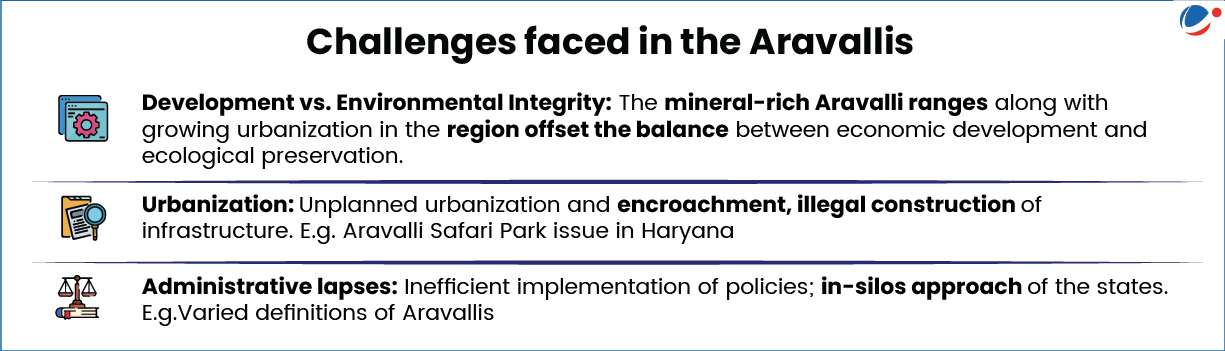
Initiatives taken to protect Aravallis

  • Matri Van Initiative: Launched in Gurugram to develop a 750-acre urban forest in the Aravalli hills as a part of the 'Ek Ped Maa Ke Naam' programme.
  • Aravalli Green Wall Project: Initiative to green 5 km buffer area around the Aravalli Hill Range in four states.
  • State Government Measures: Haryana government in 2016 declared Mangar Bani area (part of Aravalli) a "no-construction zone".
  • MC Mehta v. Union of India Case (2002)In a series of judgments, Supreme Court acknowledged the importance of Aravalli and called for its protection.

Save Aravalli Movement as a Social Movement

  • About: The Save Aravalli Movement is a grassroots environmental campaign triggered by rampant illegal mining, deforestation, and real estate development.
  • History: Limestone mining resulting in falling groundwater levels around the Sariska National Park in Rajasthan
  • Action:  The NGO Tarun Bharat Sangh, led by Rajendra Singh ("Waterman of India"), initiated efforts in 1988 to shut down the ~28,000 legal and illegal mines then operating in the Aravalli region
    • Result: In 1990, SC halted mining in Sariska region.
  • Features:
    • Cross-sectional participation: Indigenous and Tribal Communities (E.g. Bhils, Meenas, Garasias), urban citizens, Legal Experts and Scientists etc.
    • Methods followed: Legal activism (E.g. to enforce the "Precautionary Principle" and the "Polluter Pays" doctrine), awareness marches and rallies, Social Media (#SaveAravalli), Scientific auditing and spatial analyses.
    • Ideology: Environmentalism (responsibility of humans to respect, protect, and preserve the natural world from its anthropogenic afflictions.) 
      • Viewing Aravallis as a "single living ecosystem"
      • Public Trust Doctrine: The State is merely a trustee of natural resources —holding them for the public and future generations.
      • Intergenerational Equity: Preventing future generations from desertification and ecological destruction by preserving the Aravallis as a "heritage of the Earth."

Conclusion

Sustainable management of the Aravalli ranges requires an approach treating them as a unified, continuous geological ridge supported by transparent data, stakeholder consultation, and the strict enforcement of mining bans in sensitive zones.

Explore Related Content

Discover more articles, videos, and terms related to this topic

RELATED VIDEOS

2
Carbon Markets

Carbon Markets

YouTube HD
What is Artificial Rain? | Deep Dive With VisionIAS

What is Artificial Rain? | Deep Dive With VisionIAS

YouTube HD

RELATED TERMS

3

Intergenerational Equity

The concept that current generations have a responsibility to ensure that future generations have access to resources and a healthy environment. For UPSC, this underpins sustainable development and long-term environmental policy.

Public Trust Doctrine

A legal doctrine that posits that the government holds certain natural resources (like water, air, and land) in trust for the benefit of the public and future generations. This is a critical concept for UPSC in environmental law and governance.

Polluter Pays Principle

A fundamental principle of environmental law that holds that the cost of pollution prevention and control should be borne by those who cause pollution. In the context of these rules, it means non-compliance with solid waste management regulations will incur environmental compensation.

Title is required. Maximum 500 characters.

Search Notes

Filter Notes

Loading your notes...
Searching your notes...
Loading more notes...
You've reached the end of your notes

No notes yet

Create your first note to get started.

No notes found

Try adjusting your search criteria or clear the search.

Saving...
Saved

Please select a subject.

Referenced Articles

linked

No references added yet