


Why in the News?
The Standing Committee on Coal, Mines, and Steel, presented its 16th Report on 'Self-Reliance in Minerals and Metals', outlining a roadmap for India to reduce import dependency and achieve the vision of Atmanirbhar Bharat.
Key details of 16th Report on Self-Reliance in Minerals and Metals
- Status of Self-Sufficiency
- Mineral Profile: India produces 95 minerals, including 4 fuel, 10 metallic, 23 non-metallic, 3 atomic, and 55 minor minerals.
- Global Standing in Production: India ranks 2nd in crude steel, primary aluminium and refined lead, 3rd in slab zinc and chromite, and 4th in iron ore and graphite (as per World Mineral Production, 2018-22).
- During the year 2023-24, the Private Sector contributed for 61.4% in the total value of production.
- GDP Contribution: The mining sector contributes approximately 2% to India's GDP, significantly lower than Australia (12%) and Canada (6%), highlighting the need for India to "catch up" through increased exploration and self-reliance.
- High Self-Sufficiency: India is self-sufficient or near self-sufficient in Iron Ore (100%), Chromite (95%), Limestone (93%), Bauxite (85%), Limestone (93%) and Sillimanite.
- Import Dependence:
- Critical Minerals: India is 100% dependent on imports for Lithium, Cobalt, Nickel, Niobium and Gallium.
- Substantial Reliance: Significant imports are required for Rock Phosphate (15% self-sufficient), Magnesite (22%), and Manganese Ore (38%).
- Refined Copper: India currently has 40% import reliance, though commissioning of new plants like Kutch Copper Limited is expected to boost self-reliance.
About Critical Minerals & Rare Earth Minerals
|
Policy Initiatives to Increase Self-Reliance
- Legislative Reforms: The MMDR Amendment Act (2015-2023) introduced transparent e-auctions and a new Exploration Licence (EL) for 29 deep-seated and critical minerals.
- National Critical Mineral Mission (NCMM): The government launched the NCMM in 2025 to establish a robust framework for self-reliance in the critical mineral sector.
- Strategic Acquisitions Abroad: KABIL (a JV of NALCO, HCL, and MECL) was formed to identify and acquire critical mineral assets overseas, particularly in Lithium and Cobalt (e.g., in Argentina, Chile).
- Offshore Mining: The Offshore Areas Mineral (D&R) Act was amended in 2023 to introduce auctions; the first tranche of 13 offshore blocks (including polymetallic nodules and construction sand) was launched in 2024.
- Fiscal Measures: Import duties were eliminated for 25 critical minerals (including Copper ores and Lithium) in the 2024-25 Budget to support domestic refining.
- International Cooperation: India joined the US-led Minerals Security Partnership (MSP) in 2023 to secure global supply chains.
Recommendations
- Inter-Ministerial Monitoring: Establish an inter-ministerial group to monitor the post-auction progress of mineral projects and fast-track operationalization.
- Incentivizing Production: Consider penalties for delays in operationalization and financial incentives for early production.
- Urban Mining & Circular Economy: Promote mineral recovery from e-waste, industrial scrap, and EV batteries through financial incentives (e.g., the proposed ₹1,500 crore incentive scheme).
- R&D Focus: Strengthen Research and Development through Centres of Excellence (CoEs) and utilize AI/ML for mineral targeting.
- Upskilling: Recommends that mining companies allocate a percentage of CSR funds for upskilling the workforce to handle advanced technologies like AI and automation.
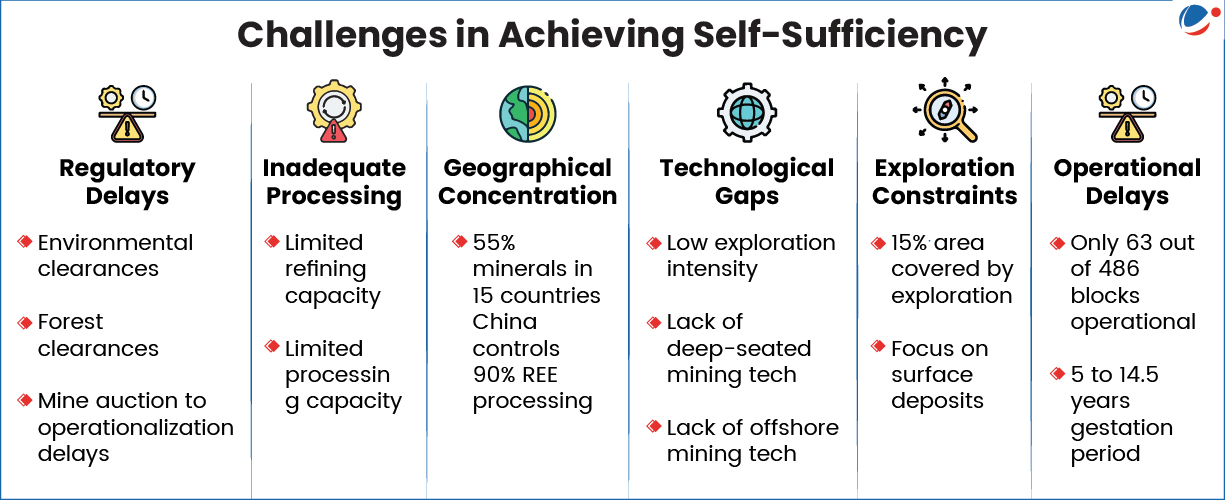
- Statutory Clearances: Give priority to critical mineral projects for environmental and forest clearances to reduce the gestation period between auction and production.
Conclusion
To achieve the vision of Atmanirbhar Bharat, India must bridge the gap between its self-sufficiency in bulk minerals and its import dependence on critical minerals by implementing strategic reforms like the National Critical Minerals Mission, accelerating domestic exploration, fostering public-private collaboration and integrating advanced technologies.


