


India added Gogabeel Lake in Bihar, Siliserh Lake in Rajasthan and Kopra reservoir in Chhattisgarh to the List of Wetlands of International Importance (the “Ramsar List”).
India now has 96 wetlands under Ramsar Convention.
Siliserh Lake
- Location: Paitpur, Alwar District, Rajasthan.
- It is in semi-arid zone and falls in the buffer region of Sariska tiger reserve.
- It is a human-made wetland, created in 1845 AD by Maharaja Vinay Singh by creating a bund across the tributary of River Ruparel.
- Biodiversity: Egyptian Vulture, Black Stork, Tiger, Indian Pangolin, Leopard and Sambar.
Kopra Jalashay
- Location: Bilaspur District, Chhattisgarh.
- It is a reservoir located in the upper catchments of the River Mahanadi.
- Its extensive open water area features shallow nutrient-rich backwaters.
- Biodiversity: Bar-headed goose, Egyptian vulture, River tern, Greater Spotted Eagle.
- Threats: Siltation, invasive non-native species, and intensive agriculture in the surrounding landscape.
Gogabeel Lake
- Overview: It is an oxbow wetland situated in Katihar district, Bihar.
- Gogabeel is formed from the flow of the rivers Mahananda and Kankhar in the north and the Ganga in the south and east
- Significance: It is the first community reserve of Bihar.
- It is a habitat for a wide variety of birds some of which are even migratory birds
About Ramsar List
- Genesis: Established under the Convention on Wetlands (adopted in Ramsar, Iran, in 1971), it is the world’s largest network of protected areas.
- Almost 90% of UN member states including India have acceded to become “Contracting Parties” to the Convention.
- About: Wetlands included in the List acquire a new status at the national level and are recognized by the international community as being of significant value for humanity.
- Criteria: To be designated a “wetland of international importance,” a wetland must meet at least one of nine criteria established by the Ramsar Convention.
The 11th session of the Governing Body of the ITPGRFA concluded in Lima, Peru.
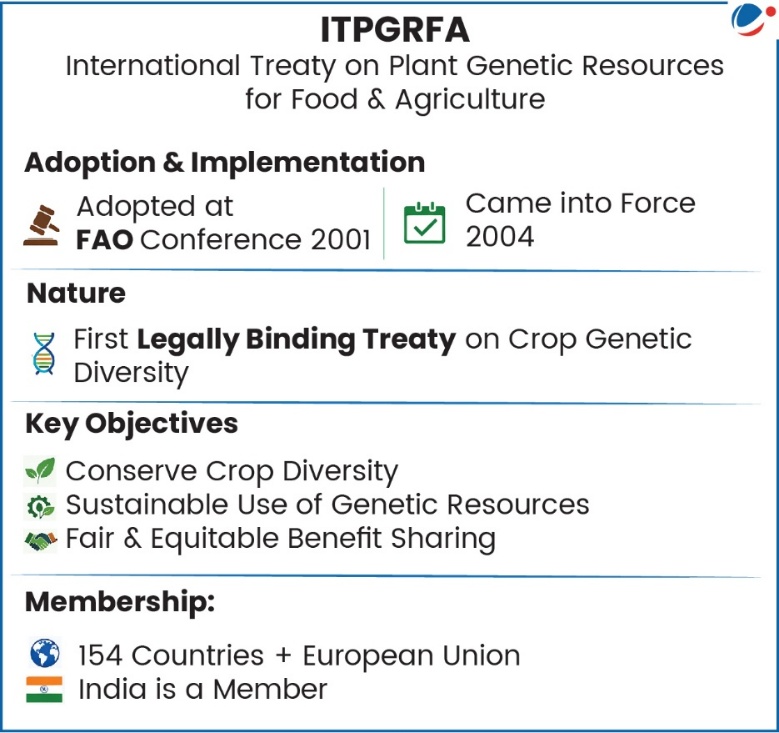
In the session, talks on the enhancement of the Multilateral System (MLS) for the functioning of access and benefit sharing failed. The MLS governs the sharing of genetic resources from 35 major food crops and 29 forages.
- These together make up about 80 per cent of the world’s plant-based diet and are described in Annexure 1 of the Treaty.
- When a country adopts the ITPGRFA, it agrees to make the genetic diversity of these crops, particularly from public gene banks, available to all other members through the MLS.
Compromise proposal presented at the 11th session of the Governing Body (GB 11)
- Adopting the revised standard material transfer agreement (SMTA), while deciding that adequate payment rates and thresholds will be approved at GB 12.
- The SMTA regulates exchanges of plant genetic material, prevents their misuse, and ensures that any commercial benefits that arise are fairly and equitably shared.
- Key issues like payment system, Annex I expansion, and Digital Sequence Information rules were postponed to the next meeting (GB12).
India’s Stand: India sought to safeguard sovereign rights and fair benefit-sharing, opposing the opaque draft and calling for all unresolved issues to be revisited at GB12.
Article Sources
1 source- The State of the World’s Land and Water Resources for Food and Agriculture (SOLAW) 2025:
- Published by: FAO every two years
- Global Environment Outlook (GEO):
- Published by: UN Environment Programme (UNEP)
Article Sources
1 sourceTamil Nadu IAS officer Supriya Sahu was awarded for her pioneering leadership on critical environmental challenges in India, including plastics and wildlife conservation.
About Award
- UN’s highest environmental honour.
- Awarded every year since 2005.
- UNEP honours individuals and organizations working on innovative and sustainable solutions to address the triple planetary crisis of climate change, nature and biodiversity loss, and pollution and waste.
Chandigarh secured first position in the National Energy Conservation Award (NECA) 2025 for efforts in energy conservation and efficiency.
About National Energy Conservation Award
- The awards are given annually by the Bureau of Energy Efficiency (BEE) under the Ministry of Power to recognise outstanding achievements in energy efficiency.
- Conferred based on the State Energy Efficiency Index (SEEI).
- SEEI is a comprehensive national assessment framework developed by BEE in collaboration with the Alliance for an Energy Efficient Economy (AEEE).
- It evaluates state/UT’s energy efficiency across buildings, industry, transport, and municipal sectors through policy implementation and outcomes.
30,000 live animals were seized under Operation Thunder 2025.
About Operation Thunder
- It was coordinated by INTERPOL and the World Customs Organization (WCO), with the support of the International Consortium on Combating Wildlife and Forestry Crime (ICCWC).
- It sought to intercept and seize illegally traded wildlife and forestry commodities across the global supply chain and identify, disrupt and dismantle criminal networks involved in these types of environmental crime.
Gujarat has regained its status as a ‘Tiger State’ after 33 years, with the presence of a tiger in the Ratanmahal Wildlife Sanctuary.
- Gujarat has become the only state in India to host three big cat species i.e. lion, tiger and leopard simultaneously.
About Ratanmahal Wildlife Sanctuary
- Location: Situated in Dahod district, central Gujarat along Gujarat-Madhya Pradesh border.
- History: It was declared as a wildlife sanctuary in 1982.
- This sanctuary harbours the maximum population of sloth bears in the entire state.
- Fauna: Leopard, sloth bear, nilgai, four-horned antelope etc.
- Ecological significance: Forests form the catchment of river Panama, a major river of Central Gujarat.
India is planning to replace the existing Maitri Research Station with a newly designed Maitri-II Station in Antarctica by 2032.
- The new Maitri-II Station is conceived as a state-of-the-art, year-round research hub that will significantly elevate India’s scientific capabilities.
About Maitri
- Built in 1988
- It serves as a gateway to one of the largest mountain chains in central Dronning Maud land, located south of Schirmacher (Antarctica).
India’s other Polar research stations
- Bharati (Antarctica), Dakshin Gangotri (first scientific base station of India situated in Antarctica now decommissioned), and Himadri (Arctic).
Article Sources
1 sourceIndia to have 100 villages to be tsunami-ready.
Currently 24 coastal villages in Odisha have been recognized as Tsunami Ready under Tsunami Ready Recognition Programme (TRRP) by UNESCO based on verification by the National Tsunami Ready Recognition Board (NTRB).
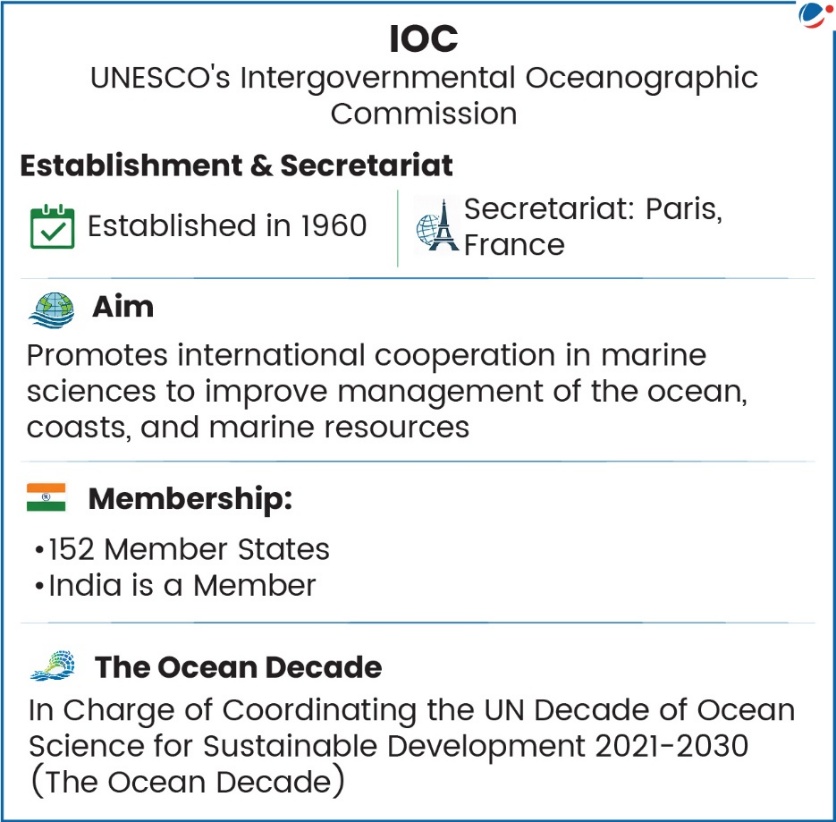
- Tsunami-ready village is certified to the ones that have high awareness about tsunami, hazard preparedness and mapping, public display of evacuation maps, 24-hour warning systems, participation in mock drills etc.
About UNESCO-IOC Tsunami Ready Recognition Programme (TRRP)
- About TRRP: It is an international voluntary community-based effort by UNESCO-IOC to bolster risk prevention and mitigation across global coastal zones.
- Methodology: It has 12 preparedness indicators for a consistent evaluation, and recognition is renewable every four years.
- Implementing agency in India: NTRB established by the ministry of earth sciences, under the chairmanship of Director, INCOIS and members from Indian National Centre for Ocean Information Services (INCOIS), NDMA, MHA etc. implements TRRP.
India’s other efforts to tackle tsunami
- Tsunami Risk Management Guidelines: NDMA guidelines recommend awareness generation, capacity building, education, training and R&D for better tsunami risk management.
- Indian Tsunami Early Warning Centre (ITEWC): Provides Tsunami advisories to Indian Ocean countries for last- mile connectivity.
- Use of technology: e.g. use of Bottom Pressure Recorders (BPRs) buoys, satellite communication for tsunami warning
Article Sources
1 source- Subansiri Lower Hydroelectric Project:
- India’s largest hydropower project, comprising 8 units of 250 MW each, designed as a Run-of-the-River scheme.
- Undertaken by: National Hydroelectric Power Corporation private Ltd (NHPC).
- Location: North Lakhimpur on the border of Arunachal Pradesh and Assam.
- River Subansiri is a major tributary of River Brahmaputra.
- Shyok Tunnel:
- Location: Situated on the Durbuk–Shyok–Daulat Beg Oldie (DS-DBO) Road in eastern Ladakh.
- Road connects Leh to the high-altitude Daulat Beg Oldie (DBO) military outpost near China border (LAC)
- Built by: Border Roads Organisation (BRO).
Article Sources
1 sourceChola and Dok La passes in Sikkim are opened for battlefield tourism under the Bharat Rannbhoomi Darshan initiative.
- Bharat Ranbhoomi Darshan is a joint initiative of Indian Army and Ministry of Tourism, for citizens to visit historic war zones and sites of military significance.
About the Passes
- Cho La Pass
- Location: Chola range of Eastern Himalayas, 17782 ft. above the sea.
- Nathu La and Jelep La passes are also situated in Cho La range.
- Connects Sikkim and Chumbi Valley.
- It was site of 1967 Indo-China skirmishes.
- Location: Chola range of Eastern Himalayas, 17782 ft. above the sea.
- Doka La (Doklam) Pass
- Location: East Sikkim, on the edge of the Doklam plateau, near the tri-junction of India, Bhutan, and China.
- It was the site of the 2017 border standoff between India and China.


