


SC lays down guidelines to evaluate evidence of victims in child trafficking cases.
- Court observed that child trafficking and commercial sexual exploitation of children is a “deeply disturbing reality” in India.
Guidelines to evaluate evidence of victims
- Vulnerability of Victim: Judicial scrutiny must recognise Socio-economic and cultural vulnerability of child victims.
- Minor inconsistencies in a trafficked child’s testimony must not discredit her evidence.
- Sole testimony of the victim is sufficient if it is credible and convincing.
- Secondary Victimisation: Recounting abuse causes psychological trauma, stigma and fear of retaliation. Judicial evaluation must show sensitivity and realism.
- A trafficked child: Must not be treated as an accomplice but as an “injured witness”, deserving due regard and credence.
Tags:
NITI Aayog released Report on ‘Internationalization of Higher Education in India’.
A central pillar of the National Education Policy (NEP) 2020, internationalization focuses on transforming India’s domestic higher education ecosystem into a globally integrated system via -
- Enhanced international students and faculty ratio in Indian Higher Education Institutions (HEIs),
- Presence of local campuses of top global institutions in India,
- Expansion of Indian HEIs outside India, etc.
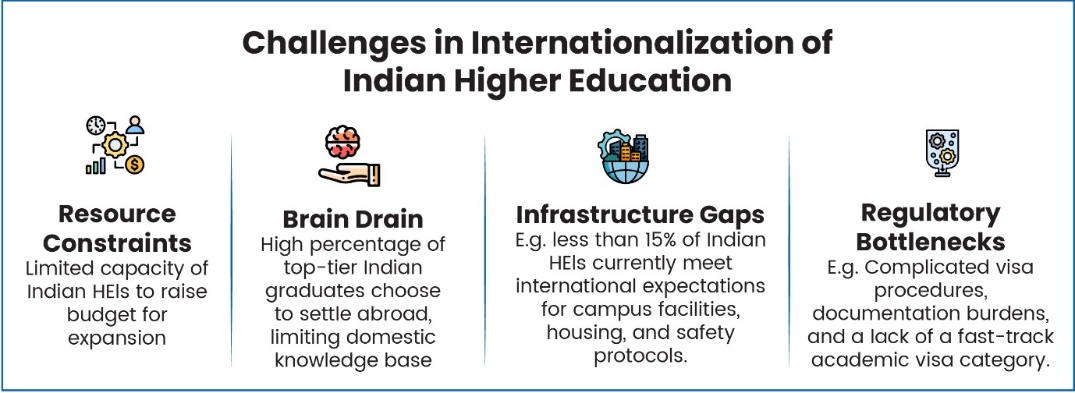
Why India needs internationalization of its higher education?
- Outward remittances: increased by over 2,000% in a decade, reaching nearly USD 3.4 billion in 2023–24 (~ 53% of India’s Union higher education budget).
- Democratization of Quality: 97% of Indian student in domestic institutions can avail high-quality, world-class education that aligns with global standards.
- Global Readiness: By embedding international benchmarks, faculty exchanges, and global curricula into Indian campuses, the country can prepare its massive workforce to be “world-ready” and competitive in the global talent pool.
- Other: Countering brain drain, harnessing the diaspora, improving the global rankings (e.g. higher international student and faculty ratios), soft power projection (e.g. offshore campuses like IIT Delhi in Abu Dhabi), etc.
Policy Recommendations by NITI Aayog
|


