


Why in News?
NITI Aayog released a Report on Public R&D Institutes in India: Driving Innovation through Multisectoral and Systemic Integration.
More on the News
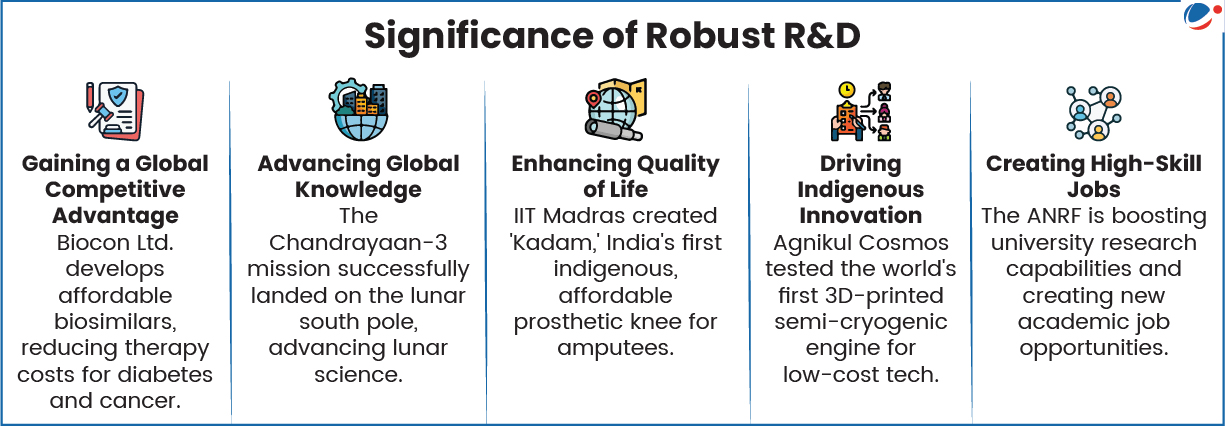
- The report analyses the Public R&D Institutes in India as a robust R&D infrastructure directly contributes to a nation's sustained growth and creates employment opportunities.
- A 2019 study by the OECD found that a 1% increase in R&D investment as a share of GDP led to a 0.13% increase in GDP per capita over the long term
Current Status of R&D Ecosystem:
- Key Findings of the Report:
- Expenditure as % of GDP: Stagnant at 0.6% to 0.7%, which is significantly lower than global leaders (e.g., USA ~3.5%, China ~2.4%).
- Sectoral Distribution: Agriculture and Allied Sectors dominate the landscape with 51% of public R&D institutions.
- Health, IT, and Telecom follow with much smaller institutional shares.
- R&D Institutes Distribution: Among the large States, Karnataka (208) has the highest number of R&D Institutes, followed by Maharashtra (185) and Gujarat (165).
- However, Maharashtra has the highest number of Central R&D Institutes (78), followed by Karnataka (70), and Uttar Pradesh (56).
- Meghalaya (11) has the highest number of R&D institutes among the small States.
- Among the UTs, Delhi has the highest number of public R&D Institutes.
- R&D Institutes Distribution: Among the large States, Karnataka (208) has the highest number of R&D Institutes, followed by Maharashtra (185) and Gujarat (165).
- Other Key Indicators:
- Global Ranking: India ranks 6th globally in patent filings (with 1 lakh+ filings) and 3rd in trademark filings (5 lakh + filings).
- Global Innovation Index: India has climbed to the 38th position in the Global Innovation Index (GII) 2025, up from 81st in 2015.
Key Challenges of R&D Highlighted by the report
- Primary Funding Source: Dominated by the Government Sector (63.6%), unlike developed economies where the private sector contributes over 70%.
- Regional Disparity: Concentration in a few states and cities limits inclusive innovation and region-specific research.
- Eg: 36% of institutes are concentrated in South India.
- Institutional Silos: Lack of synergy between universities (teaching-focused), R&D institutes (research-focused), and industry (market-focused).
- Others:
- Weak Commercialization: A significant gap exists between lab-scale research and market-ready products.
- The Patent Paradox: A surge in quantity does not translate to quality. Many filings are "trivial" or "mundane," intended to boost academic scores (API) rather than market utility.
- Administrative Hurdles: Outdated procurement rules, rigid recruitment structures, and slow decision-making stifle the agility required for modern scientific research.
- Human Capital Stagnation: Lack of mobility for researchers between academia and industry limits the cross-pollination of ideas.
Government initiatives to boost R&D in India
|
Way Ahead to improve R&D Ecosystem
- Place-Based Innovation: Future R&D institutes should be co-located within Industrial Clusters (such as Silicon Valley in USA) to ensure research is market-driven and reduces "Lab-to-Production" time.
- Establishment of Shared Hubs: Instead of duplicating resources, "Shared Equipment Hubs" (such as University of Washington's CoMotion Labs) should be created to provide startups and smaller institutes access to high-end infrastructure.
- Incentivizing Private Sector R&D: Shift from "Government-led" to "Government-enabled" R&D.
- Utilize the Anusandhan National Research Foundation (ANRF) to de-risk private sector investment in "deep-tech" and "sunrise" sectors.
- Academic-R&D Convergence: Implementing a "Dual Appointment" system where scientists can teach at universities and professors can lead research at public institutes.
- MIT (USA), through its Industrial Liaison Program (ILP), enables MIT researchers to develop partnerships with industry leaders and strengthens the exchange of knowledge and resources.
- Strengthening Judiciary: Establish dedicated IP Benches in High Courts to expedite litigation, following the abolition of the Intellectual Property Appellate Board (IPAB).
Conclusion
Research and Development is a catalyst for economic growth, technological self-reliance (Atmanirbhar Bharat), and global competitiveness. Strong R&D is essential for India to transition into a $5 trillion economy and eventually a developed nation (Viksit Bharat @2047).


