


Why in the News?
Recently, the Parliament passed Sabka Bima Sabki Raksha (Amendment of Insurance Laws) Act, 2025.
More about the News
- The Act seeks to amend the Insurance Act 1938, the Life Insurance Corporation Act, 1956 and the Insurance Regulatory and Development Authority Act, 1999.
- The Act seeks to improve the ease of doing business for insurance companies, and to bring transparency in regulation-making and to improve regulatory oversight over the sector.
Challenges affecting Insurance Sector in India
- Low Penetration: Despite growth, insurance penetration as percentage of GDP still remains at 3.7%.
- Capital Constraints: High minimum capital requirements restrict entry of small players and insurance cooperatives, limiting outreach in rural and underserved areas.
- Limited Foreign Capital & Reinsurance Capacity: Restrictions on FDI and high net-owned fund norms for foreign reinsurers reduce capital inflows and risk-sharing capacity, affecting solvency and product expansion.
- Weak Regulatory Oversight & Governance: Limited powers of IRDAI earlier constrained effective supervision, allowing governance lapses, inefficiencies in public insurers, and risks to policyholder interests.
- Financial Literacy & Mis-selling Concerns: Low awareness and suboptimal advisory services lead to potential mis-selling and poor customer trust.
- Product Innovation Gap: Limited innovation in products and services hinders the ability to meet diverse customer needs and emerging risks.
- Public Sector Constraints: Public insurers face inadequate capital, financial losses (~₹26,000 crore), overexposure to health insurance, and lack a level playing field with private players.
- Emerging Risks: Increasing cyber threats, climate change, pandemics, and other intangible asset exposures require rapid adaptation in coverage and risk management.
How the Act seeks to address the challenges in Insurance Sector
- Boosts Capital: The Act amends the definition of an insurance co-operative society to remove the requirement of minimum paid-up share capital of 100 crore rupees for life, general, and health insurance businesses.
- Foreign Investment: 100% FDI (earlier 74%) in Indian insurance companies encourages more foreign capital inflows, addressing the capital inadequacy in public insurers and strengthening financial stability.
- Reinsurance: The Act lowers the net-owned fund requirement for foreign reinsurers from ₹5,000 crore to ₹1,000 crore makes reinsurance more accessible, improving risk-sharing and coverage capacity.
- Eases Regulatory Burden: Increasing the share transfer approval threshold from 1% to 5% simplifies corporate processes, reducing administrative delays.
- Promotes Innovation and Flexibility: Extending SEZ (Special Economic Zones)/IFSC (International Financial Services Centres) exemptions and adaptations allows insurers and intermediaries to operate with more regulatory flexibility, promoting product innovation and tailored solutions.
- Strengthens Policyholder Protection and Awareness: Creation of a Policyholders' Education and Protection Fund helps educate consumers, raise financial literacy, and safeguard policyholders' interests, mitigating issues like mis-selling and underinsurance.
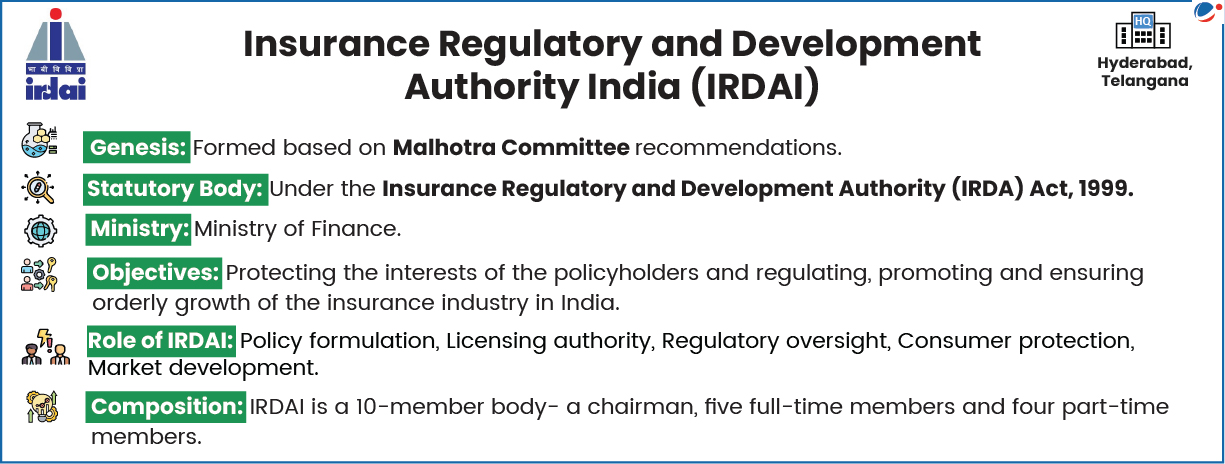
- Enhances IRDAI's Oversight Powers: Empowering IRDAI to supersede boards, regulate remuneration, inspect intermediaries, and approve schemes of arrangement strengthens governance, accountability, and solvency management, addressing public sector inefficiencies and ensuring consumer protection.
- LIC Autonomy: The Act grants Life Insurance Corporation (LIC) the autonomy to open zonal offices and align with foreign regulatory compliance.
Conclusion
The Sabka Bima Sabki Raksha Act, 2025 is a major reform aimed at strengthening India's insurance sector through higher capital inflows, regulatory flexibility, and stronger oversight. By promoting innovation, improving governance, and enhancing policyholder protection, it addresses key structural challenges. Effective implementation can significantly improve insurance penetration and support inclusive, resilient economic growth.



