


Why in the News?
The Central Ground Water Board (CGWB) and States/UTs jointly published the National Compilation on Dynamic Groundwater (GW) Resources of India 2025.
More on the News
- The report highlights the extent of ground water exploitation as % units out of the total 6762 assessment units (Blocks/ Mandals/ Talukas)
Key highlights of the report
- Total Annual Ground Water Recharge: Increased marginally to 448.52 Billion Cubic Meter (BCM) from 446.9 BCM (2024).
- Annual Extractable Ground Water Resources: Increased marginally to 407.75 BCM from 406.19 BCM (2024).
- Total Annual Ground Water Extraction (2025): Marginally increased to 247.22 BCM.
- Stage of Ground Water Extraction (SoE): Marginally increased to 60.63%
- SoE measures how much underground water we are using compared to how much is naturally put back.
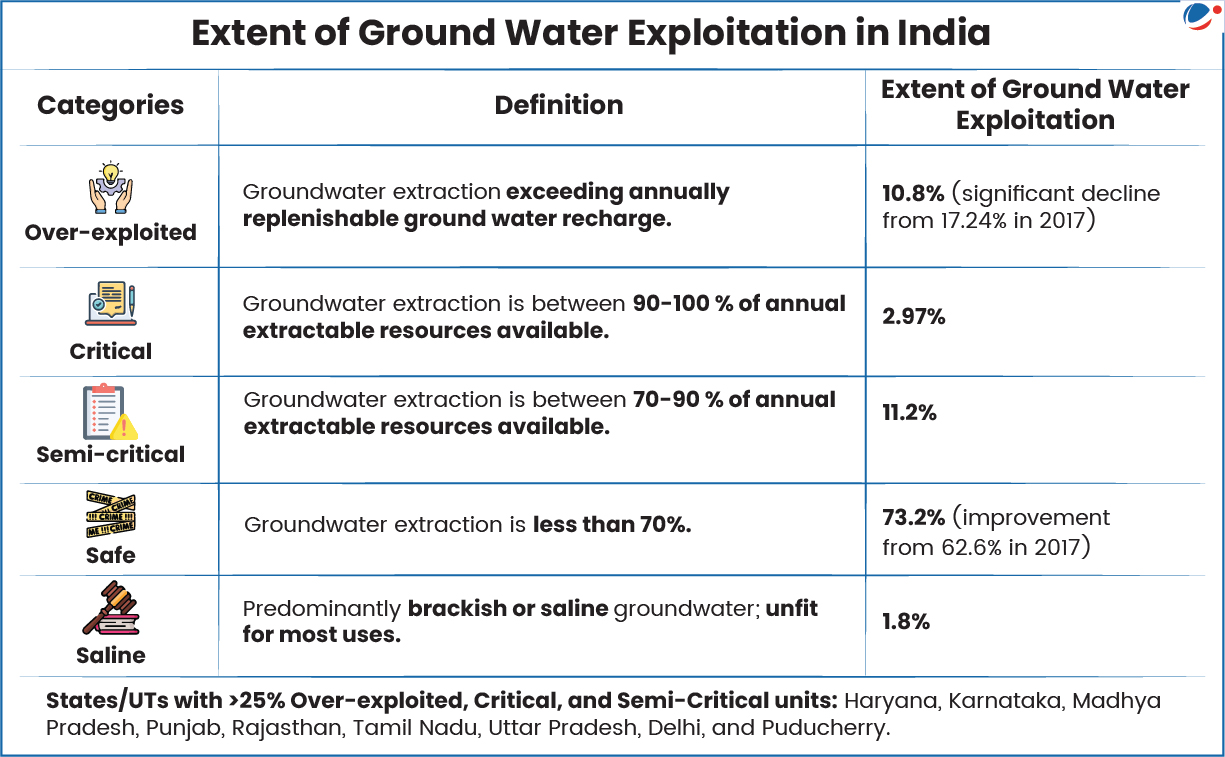
Groundwater Resources of India: Current Scenario
- India is the world's largest consumer of groundwater with ~ 25% of the total global extraction (230 cubic kilometers per year).
- Sectoral Usage: Groundwater sustains ~64% of the irrigation needs, 85% of rural drinking water, and ~50% of urban water needs.
- 87% groundwater extracted is used in agricultural sector and about 11% in domestic sector. (Annual Ground Water Quality Report 2024)
- Specific Contaminants of Concern: Nitrate (Rajasthan, Tamil Nadu, and Maharashtra), Fluoride (Haryana, Karnataka), Arsenic (floodplains of Ganga and Brahmaputra rivers); Uranium (Rajasthan, Punjab).
Issues with groundwater management
- Overexploitation: Due to population growth, agricultural intensification, industrial demands, and urbanisation resulting in scarcity, droughts and heavy metal pollution.
- E.g. As per CGWB, Rajasthan, Punjab, Haryana, and Delhi have been extracting groundwater at a rate of more than 100%.
- A report by Central Pollution Control Board (CPCB) flagged severe contamination levels for Uranium, Lead, and Nitrate, in Delhi's groundwater.
- Urbanization and Aquifer Desaturation: Rapid urbanization leads to sealing of recharge areas and destruction of traditional water bodies, resulting in Aquifer Desaturation.
- Aquifer Desaturation is where the rate of extraction exceeds the minimal recharge occurring through concrete surfaces.
- Institutional and Management Gaps: Multiple agencies and outdated laws (1882 Indian Easement Act) result in fragmented policies and unregulated private wells.
- E.g. Auditing gaps in industrial usage results in over-extraction and pollution
- Climate Change: A study projects tripling of groundwater depletion rates by 2080, primarily driven by climate-induced intensified withdrawal for irrigation. E.g. Erratic monsoon rains increase dependence on ground water.
Way Forward
- Aquifer-based Planning: India has both hard-rock (Peninsula) and alluvial (Indo-Gangetic Plains) aquifers which differ in their physical and socioeconomic profiles. Thus, there is a need for different sets of solutions at both macro and micro levels.
- Institutional Reforms: Create a National Water Commission (NWC) by merging CWC & CGWB for integrated water management (Mihir Shah Committee).
- Legal Reforms: Separate groundwater rights from land ownership to empower local bodies.
- Formalize groundwater rights to empower marginalized communities and farmers, enabling legal access and financial opportunities.
- Sustainable Water Practices
- Water-Efficient Agriculture: E.g. crop diversification, precision agriculture, zero tillage.
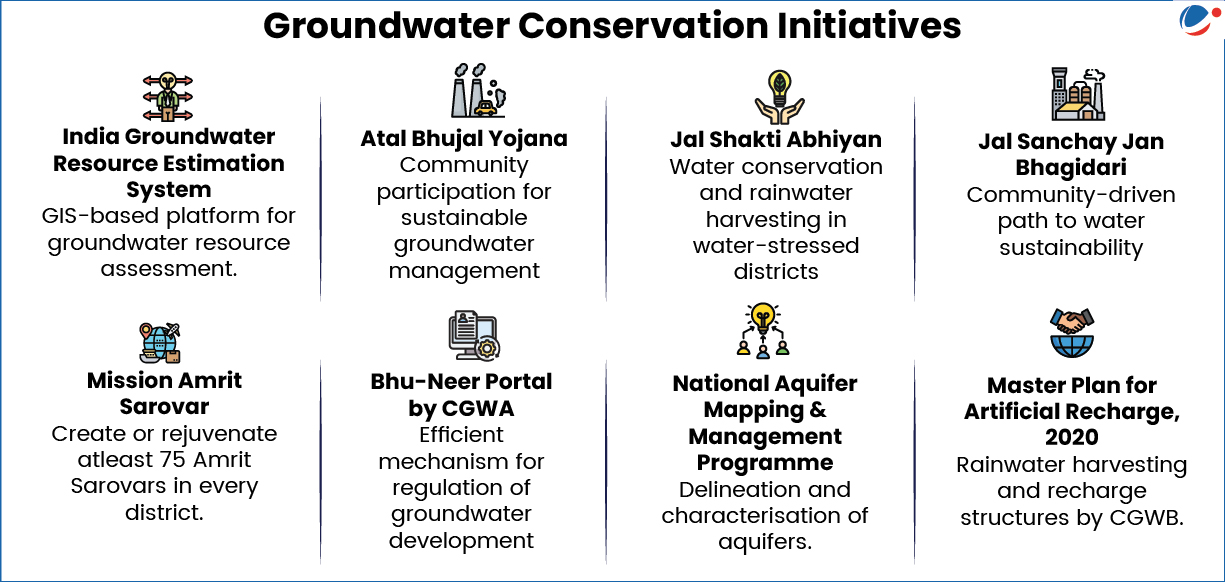
- Rainwater Harvesting and Artificial Recharge: Scale up traditional systems for aquifer recharge. E.g. Rajasthan's Johad.
- Blue-Green Infrastructure: Integrate green spaces (parks, trees) and blue spaces (rivers, wetlands) to rejuvenate aquifers and water bodies.
- Community Empowerment: Support local programs E.g. Telangana's Mission Kakatiya
- Mission Kakatiya involves development of minor irrigation infrastructure, strengthening community-based irrigation management and restoration of tanks.
Conclusion
The National Compilation on Dynamic Groundwater Resources of India 2025 report provides a data-led assessment of India's groundwater resources. While helping in improved planning and management, it also highlights the issues of heavy metal pollution and aquifer depletion which needs a more targeted approach to ensure water safety and accessibility.



